See after sunset in August. There’s a show in heaven.
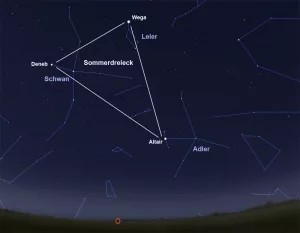
The sky is already summer. Several bright constellations rise high enough to be easily spotted. Eagles, swans and lyres are all visible. Their brightest stars form the summer triangle. This large triangle is clearly visible in the southern sky. You can also follow the Milky Way. It stretches from north to south like a ribbon of light.
However, there is more to the evening sky than stationary stars. The planetary configuration is taking shape.
Find a planet at night
Now the four planets are lined up like pearls on a string. They sit in the southern sky. Venus, Jupiter, Saturn and Mars shine particularly brightly. They appear right after sunset.
Venus leads the way. It is the brightest object in the sky and is often mistaken for a UFO or an airplane by the public. Jupiter follows closely behind. Saturn adds a steady glow. Mars turns reddish.
Why is this important? Because these planets move at different speeds. This consistency won’t last forever. Capturing them means looking at their particular geometric arrangement in relation to the Earth. It reminds us of our place in the solar system. We look at our neighbors.
The peak of the Perseid meteor shower
By mid-August things had changed.
Meteor shower. Especially the Perseid meteor shower.
This is one of the most reliable and active meteor showers of the year. The peak is approaching. You can expect many shooting stars. They ran across the dark sky. As the months go by, the activity increases.
You need darkness to see them. It is best to stay away from city lights. The point of radiation where the meteors appear to appear is located in the constellation Perseus. But you don’t have to see it directly. If you look around you will see a huge sky.
“The Perseid meteor shower is expected to peak near mid-August, displaying many bright bands of light.”
On the way through the summer triangle
If you don’t know where to look for the summer triangle, start with the Milky Way. Follow the bright ribbon.
The three stars of the triangle are Deneb, Vega and Altair.
– Swan Deneb.
– Lila Vega.
– Eagle Altair.
These stars are far away from us. Deneb is thousands of light years away. Vega approaches. Altair is near. However, in our night sky they appear to form a perfect equilateral triangle. It’s an optical coincidence. perspective skills.
Why is this sky important?
We live in a world of screens. We rarely look up. But the summer sky gives us a chance to rest. It’s very simple. directly.
No need for a telescope. No expensive tools required. Just with your eyes.
The positions of the planets change every week. Meteor showers have a time limit. The constellations of the summer vary according to the season. This is a passing opportunity.
Enjoy it while it lasts.
Why the planetary configuration in July and August shines brighter than the stars
You have to look up. The August sky is not only beautiful. This is a tactical representation of celestial mechanics. We are in the middle of a rare parade of planets. Looking south after sunset. You can’t just see the stars. You see a lot of the world. Venus, Jupiter, Saturn and Mars are lined up. They are brighter than any star at night.
This is not a random mess. It’s a geometric arrangement that mirrors our neighbors.
Conjunction of Venus and Jupiter
The show starts at lunch. At twilight Venus sets. It is the second brightest object in the sky after the sun and the moon. It dominates the horizon. An hour after sunset, the afterglow remained.
But the real drama happened in mid-August.
13. and on August 14 there was a close encounter in the sky. A thin crescent moon floats near Venus. This is a strong visual contrast. Bright rocks against a dark sky. Don’t miss this window. The moon moves very fast.
Jupiter is slightly in the lower left corner. This gas giant is the second brightest planet. It was visible until about 10 p.m. It serves as the anchor for the evening. By the end of the month, Venus and Jupiter appear to be in conjunction. They are getting closer. The difference is getting smaller.
16. August The moon appears again. It is close to Jupiter. Two bright objects are lined up. A quick look is enough.
Saturn’s subtle appearance
Further towards the southern horizon Saturn rises. This ringed planet is not as dazzling as its neighbors. Its brightness is comparable to the brightest star. You have to look for it in the dark. It shows when it gets dark. A flat, weak point of light.
It is located below Jupiter. the vertical line of the planet. At the top is Venus. Jupiter is in the middle. Saturn is near the horizon.
Mars: Night King
Then there is Mars.
It is brighter than Jupiter or Saturn. Why? That’s because it passed its closest point to Earth on July 31. The earth is completely illuminated by the sun. reflects the most light. It dominates the southern sky from 9:30 PM until dawn.
A lighthouse painted red. It’s hard to ignore. If you look south late at night, Mars will be brightest there, unless the moon is rising.
Why is this important now?
We buy these windows every few years. But they remind us that we are not alone in the dark. These are worlds. genuine place.
The geometry changes. The angle has changed. This lineup will change next year. This special arrangement no longer exists.
Look up tonight. The planet is there. Wait.
Why this weekend is the best time to see shooting stars
The Perseid meteor shower peaks on the night of August 12th to 13th. Astronomers predict that rates up to 100 meteors per hour. If you’re a night owl, you might want to stay up late this weekend. You will see a bright trace that will flash for a few seconds. The conditions are perfect. The new moon occurs just one day before the peak. Moonlight doesn’t spoil the show.
Where did this show come from?
The name comes from the constellation Perseus. Meteors seem to radiate from that constellation. This is an illusion. Earth passes through a cloud of dust. Comet 109P/Swift-Tuttle left it behind. This happened on the last orbit around the sun. The comet last approached Earth in 1992. The next time you will see it won’t be until 2126.
When to Look Up
The best time to see it is in the evening. Or early in the morning before sunrise. Perseus sits high in the sky. The radiant point rises. Most meteors pass across the frame. Find a patch of grass. Lie back. Relax. No equipment needed. Just look up.
The shadow moves quickly. On August 11, 2018, it hit large areas in Scandinavia, Greenland and Siberia. This is a partial solar eclipse, which means the moon steals only part of the sun’s disk. North China watchers agree. Around 11:00 CET, the dark disk of the Moon slides into the bright surface of the Sun.
The depth of the bite depends entirely on where you stand. In Sweden, the moon covers about a third of the sun. In the polar waters of Siberia, the reach jumps by almost two thirds. This is a stark reminder that geometry is indifferent to human desires.
In Germany, this event was invisible. We look at our ordinary sky while the moon works its cosmic magic hundreds of miles to the north.
Why you missed the 2018 solar eclipse
It’s not bad. This is orbital mechanics. As everyone knows, the solar eclipse path is very narrow. The Moon passes between the Earth and the Sun two to four times a year, but its shadow only touches a small part of the Earth’s surface.
Most of us live outside that area.
A total solar eclipse must be precisely aimed. The moon must be close enough in its elliptical orbit to completely block the sun’s glare. This creates a “path of totality”. If you’re not on this path, you’ll only see a partial eclipse at best. Nothing is gained by going too far north or too far south.
Germany is Long Wait for Totality
The next time Germans will see a partial solar eclipse is in 2021. That’s it. A small part of the sun disappeared. But the perfect spectacle? Dark?
You’ll have to wait until 2081.
And even then, it’s not nationwide. The entire path goes through the Lake Constance area. If you aren’t near Lake Constance in August 2081, we were out of luck again. It will be several decades before the next total solar eclipse is visible in mainland Germany.
How does a solar eclipse happen?
To understand why the 2018 Sweden vs Siberia match looks so different, you need to look at the umbra and the penumbra.
An umbra is the darkest part of the shadow where sunlight is completely blocked. Penumbra is a brighter outer shadow where only part of the sun is covered.
During the August 11, 2018 solar eclipse:
* Sweden is located in the penumbra area and its coverage is about 33%.
* The Siberian Arctic Sea is located deep in the penumbra and seeing up to 66% coverage.
* Germany was outside even the penumbral shadow
The moon’s shadow moves thousands of kilometers per hour. It doesn’t hang around. When it reaches the northern tip of Europe, the angle is just right for some far northern landscapes, but too high for the rest of the continent.
Why Totality Matters
part