


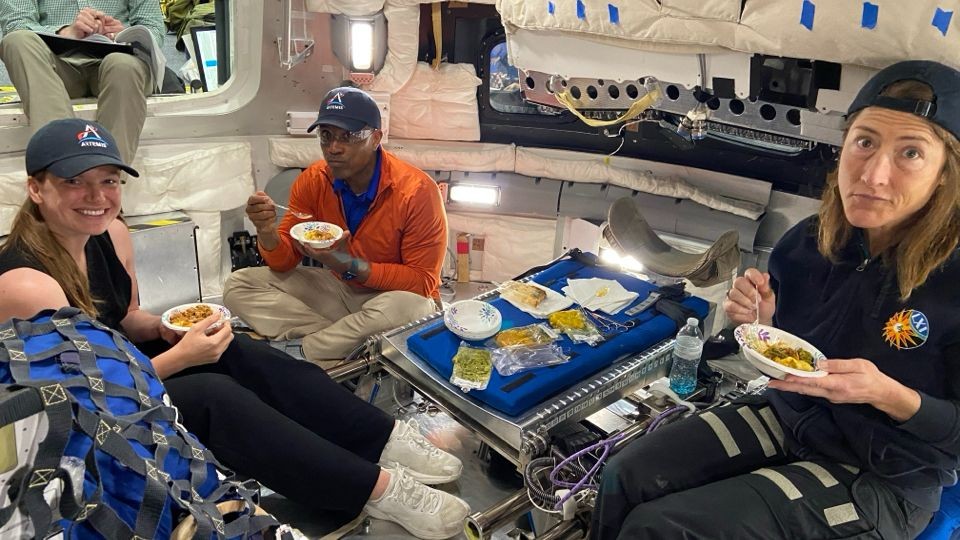
The upcoming Artemis 2 mission, slated for launch no earlier than April 1, will mark a pivotal moment in space exploration. But beyond the technical feats, a fundamental question arises: how will the crew eat during their journey to the moon? The four astronauts – NASA’s Reid Wiseman, Victor Glover, and Christina Koch, alongside the Canadian Space Agency’s Jeremy Hansen – will rely on a carefully curated menu designed for long-duration spaceflight without refrigeration or conventional cooking facilities.
The Challenges of Space Cuisine
Eating in space is far from a simple task. Unlike the International Space Station (ISS), which benefits from regular resupply missions and refrigerated storage, the Orion spacecraft for Artemis 2 is a self-contained environment. This means all food must be shelf-stable for weeks, easy to prepare in microgravity, and produce minimal crumbs to avoid contaminating sensitive equipment.
The menu isn’t just about survival; it’s about sustaining performance and morale. NASA officials emphasize that food selections are developed in coordination with space food experts and the crew, balancing calorie needs, hydration, nutrient intake, and individual preferences.
How It Works: Rehydration and Warmers
Astronauts will primarily rehydrate freeze-dried meals and beverages using Orion’s potable water dispenser. For foods needing warmth, a compact, briefcase-style warmer will be available. Meal times are scheduled for breakfast, lunch, and dinner, with the option of two flavored beverages per day, including coffee for those accustomed to caffeine.
The menu boasts 189 unique food and drink items, including over 10 beverage options, five hot sauces, 58 tortillas, and a selection of desserts like pudding, cobbler, cake, chocolate, and cookies. The spacecraft will carry about two to three days’ worth of food per container, giving astronauts some choice within limitations.
A Step Forward from Apollo
Food science has advanced significantly since the Apollo era. The space shuttle program expanded menu options and onboard preparation capabilities. However, Artemis 2 represents a return to a more austere approach, similar to early long-duration missions, due to the lack of resupply in deep space.
Astronauts sampled and rated foods during preflight testing to ensure nutritional requirements and spacecraft limitations were met. Menus are tailored based on Orion’s capabilities during each phase of flight, with ready-to-eat options prioritized for launch and landing when full food preparation isn’t available.
More Than Just Sustenance
Astronauts acknowledge the psychological value of mealtimes in space. Christina Koch, who spent a year on the ISS, praised the variety of rehydratable options. Jeremy Hansen highlighted the communal aspect of sharing meals, noting that it’s “a necessary thing you have to do, the thing that you should be grateful for.”
“The spacecraft is an environment where foods must be simple to store and prepare, eating requires a minimum of fuss, and preparation is done using simple ingredients and processes.”
The Artemis 2 mission underscores that even in the most technologically advanced endeavors, the simple act of eating remains a critical part of human survival, comfort, and community.


