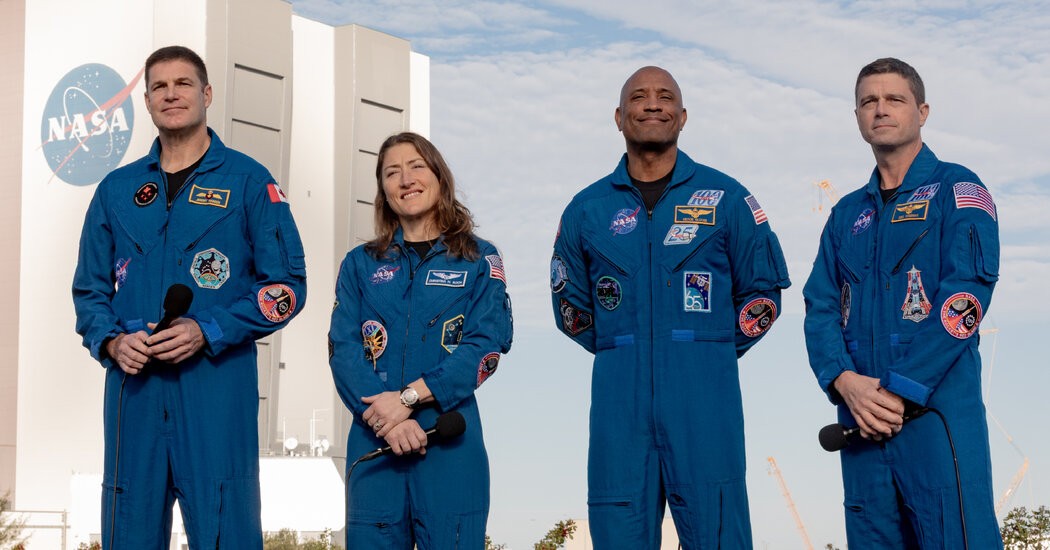
For the first time in over half a century, NASA is poised to send astronauts on a mission to the moon. The Artemis II crew – three Americans and one Canadian – is set for launch at 6:24 p.m. Eastern on Wednesday, April 1, 2026, embarking on a 10-day journey that will loop around the lunar body before returning to Earth. This mission is not about landing; it’s a critical test of the Orion spacecraft and the Space Launch System (SLS) rocket, the foundation for future lunar surface missions.
The Mission’s Purpose and Significance
The Artemis program represents a renewed commitment to deep space exploration after decades of focusing on Earth-orbit operations. While the last human footprint on the moon dates back to 1972, the geopolitical landscape and technological advancements have shifted dramatically since then. The U.S. is now competing with China, which has its own ambitious lunar programs, making this mission a statement of continued leadership in space. The Artemis II flight will stress-test Orion’s life support, navigation, and thermal protection systems in the harsh environment beyond Earth’s protective layers.
The Artemis program initially gained momentum under President Trump and has continued with bipartisan support, highlighting the long-term strategic importance of lunar exploration. The 2022 Artemis I mission successfully tested the hardware without a crew, paving the way for this next step. Future missions, leveraging commercial spacecraft from SpaceX and Blue Origin, are planned to land astronauts on the moon as early as 2028.
Meet the Crew
The four-person team includes:
- Reid Wiseman: Mission commander, a veteran astronaut with extensive experience aboard the International Space Station.
- Victor Glover: Pilot and the first African American to travel around the moon, breaking another barrier in space exploration.
- Christina Koch: Mission specialist and the first woman to venture into deep space, carrying forward decades of female contributions to the space program.
- Jeremy Hansen: Canadian astronaut making his first trip to space, representing international collaboration in lunar ambitions.
The crew’s diversity reflects NASA’s commitment to inclusivity, and their individual backgrounds underscore the global nature of this endeavor.
Technical Details and Launch Outlook
The SLS rocket, standing at 322 feet and weighing 5.75 million pounds when fueled, is designed to deliver the Orion capsule to lunar orbit. Once in space, the crew will separate from the rocket and enter Orion, which has approximately the interior volume of two minivans. The trajectory will take them over 43,000 miles above Earth, setting a new distance record for human spaceflight, surpassing even the Apollo 13 mission’s peak distance.
Forecasters predict an 80% chance of favorable conditions during the two-hour launch window. If the April 1 launch is scrubbed, NASA has backup opportunities through April 6, before waiting until at least April 30 for the next attempt.
How to Follow the Mission
NASA will stream full coverage on YouTube, X, its website, and other platforms, beginning with propellant loading on Wednesday morning. Live conversations with the crew are also scheduled throughout the flight, offering a unique glimpse into their experiences. The mission is designed to be publicly visible, with some observers in Florida and southern Georgia potentially able to see the rocket from their backyards.
Artemis II is more than just another space launch; it’s a step towards a sustainable lunar presence, international cooperation, and a new era of human exploration. The success of this mission will determine the pace and direction of future lunar programs, solidifying NASA’s role in the next chapter of space history.