Time isn’t just sand in an hourglass anymore. We need better.
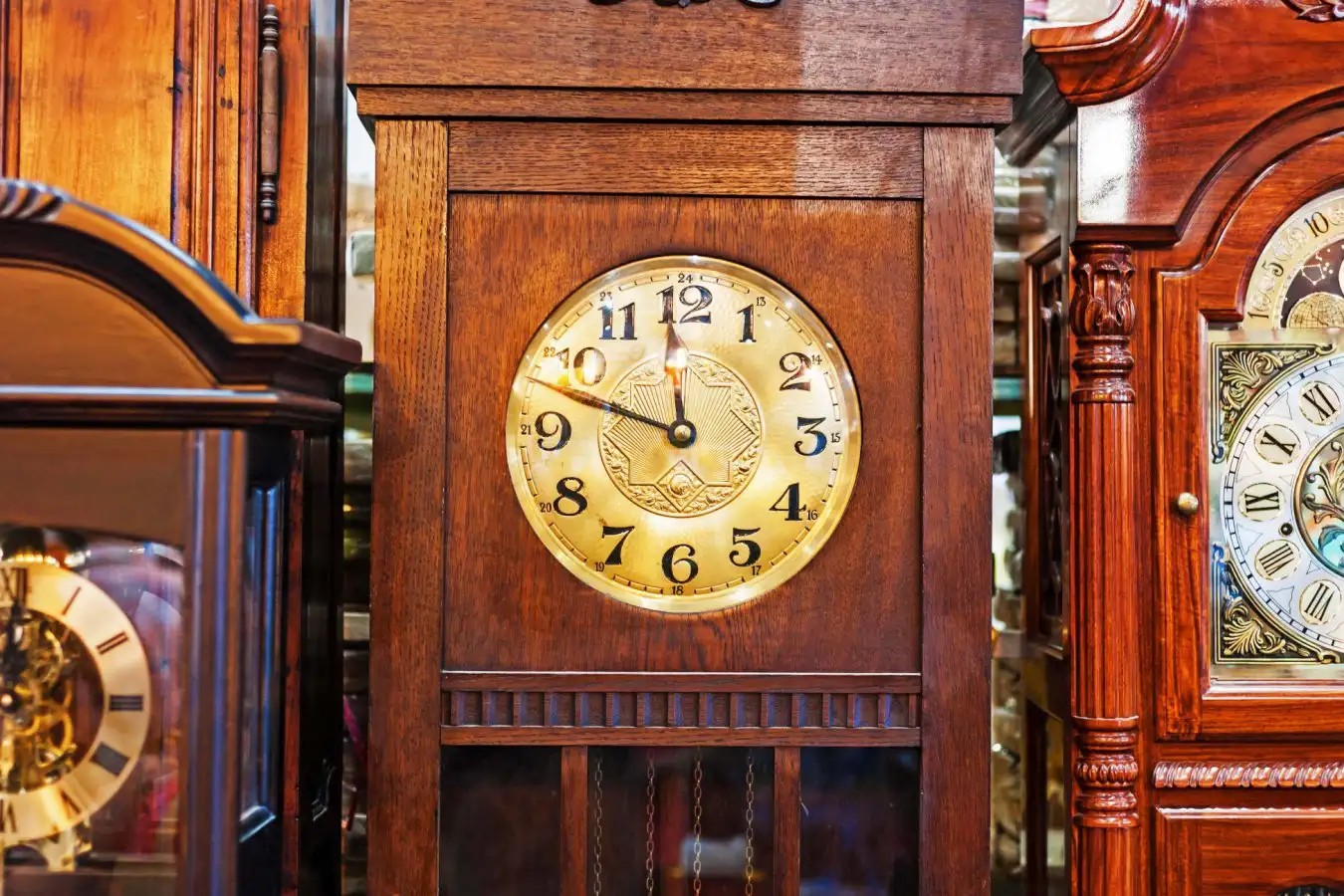
The 17th century gave us the grandfather clock, the pendulum swing that ruled accuracy for centuries. Matteo Brunelli at the Collège de France and his team looked at this classic design. Then they asked a tricky question. Can it survive quantum mechanics?
It turns out it can. But it looks nothing like the antique in your hallway.
The Three-Part Tick
Every grandfather clock has three guts.
First, the pendulum. It swings left and right, defining the tick.
Second, the weights. They drop using gravity, giving the pendulum energy to keep going.
Third, the escapement. This is the nervous system. It converts the pendulum’s sway into the clock hands’ march. It gives the pendulum a little kick. Without it, friction kills the motion. The escapement ensures every swing is the same size.
Brunelli’s team didn’t just imagine a quantum version. They built a mathematical model for it.
Here is the blueprint:
A cavity. Two mirrors facing each other. One fixed, the other oscillating.
An atom sits between them. This atom has three energy levels. Temperature fluctuations in the room make the atom jump between these states. When it jumps, it might spit out a photon. That photon bounces between the mirrors. This light pressure pushes one mirror. Back and forth. Back and forth.
This mimics the falling weight.
But what about the escapement? That’s where it gets strange.
The atom itself is the escapement. It moves through its energy states repeatedly. This cycle forces a sequence of ticks and toks. Brunelli claims this is the smallest escapement mechanism physically possible. Their math suggests that if you tune the system right, this quantum device settles into a stable rhythm. Reliable. Precise. Just like brass and wood should be.
Breaking the Limits
This isn’t just a theoretical parlor trick. The new clock breaks a known rule.
Past autonomous clocks struggled. They were less accurate because their oscillations weren’t perfectly even. They relied on external controls like lasers. Brunelli’s design is autonomous. It operates like a self-standing thermodynamic engine. No lasers needed to keep it steady.
More importantly, it shattered the thermodynamic uncertainty relation. This is a hard limit on how accurate a clock can be relative to the entropy it generates. Accuracy usually requires irreversibility—effort to run backwards. The new quantum clock manages to be incredibly accurate while respecting this physical law. It maximizes irreversibility for optimal timekeeping.
Why It Matters
So why build a clock made of mirrors and single atoms?
Sreenath Manikandan from the Tata Institute of Fundamental Research thinks this is big news. He argues that autonomous clocks are the purest form of timekeeping. They don’t borrow accuracy from another device. They create it.
How else do we understand the fabric of time if we can’t build it from scratch?
Understanding these mechanisms helps probe physics at its edge. Specifically, gravity in the quantum realm. If we can perfect this clock, we might see how gravity interacts with quantum objects. A deep understanding of how a clock works is desirable. This work provides major progress toward that goal.
The Road Ahead
The parts are mostly here. Tiny cavities and photons? Common lab fare.
But putting them together into a working escapement mechanism? That is hard. The novelty makes it technically challenging. It requires precision that doesn’t exist off-the-shelf.
Brunelli is cautiously optimistic. It isn’t unreasonable to build. But it will take work. We have the design. We have the theory.
Now we just have to catch the ticks.