
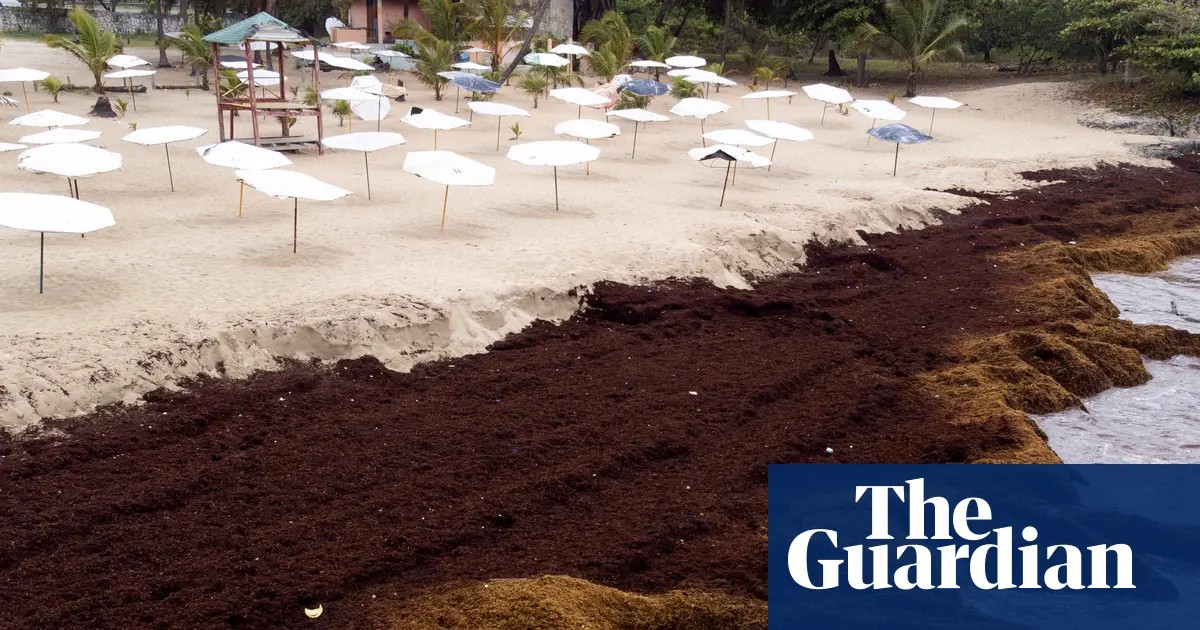
Rapid expansion of seaweed blooms worldwide indicates a fundamental change in ocean ecosystems, driven by climate change and pollution. Scientists warn that this “regime shift” could darken ocean waters, alter marine life, and even accelerate climate breakdown.
Exponential Growth of Seaweed Blooms
Research from the University of South Florida reveals that seaweed blooms have surged by an average of 13.4% annually in the tropical Atlantic and western Pacific over the last two decades. The most dramatic increases occurred after 2008, marking a clear acceleration in this trend.
Before 2008, large-scale macroalgae blooms were rare, primarily limited to the Sargasso Sea. Now, massive blooms are appearing globally – including the Great Atlantic Sargassum Belt, visible from space, stretching from the Gulf of Mexico to the coast of Africa. Other significant blooms have been observed near New Zealand and off the Florida coast.
How Scientists Tracked the Shift
Researchers used artificial intelligence to analyze over 1.2 million satellite images from 2003 to 2022, identifying floating algae with a deep-learning model. This process provided the first comprehensive global picture of these blooms.
The study also noted that while microalgae (phytoplankton) increased at a slower rate of 1% per year, the growth of macroalgae such as sargassum has been particularly explosive, especially since 2010. This suggests that larger seaweed species are better adapted to recent warming trends and nutrient pollution.
Why This Matters: A Regime Shift in Action
The shift towards a “macroalgae-rich ocean” is not just an ecological change; it has broader implications:
- Light Blockage: Dense seaweed mats block sunlight, disrupting underwater ecosystems.
- Carbon Sequestration: While initially absorbing carbon, decaying seaweed can release it back into the atmosphere.
- Ocean Biogeochemistry: Changes in algal composition affect nutrient cycles and water chemistry.
- Climate Feedback: Darkened waters absorb more heat, potentially exacerbating climate change.
The researchers emphasize that these changes are not isolated events but a systemic shift, with tipping points identified in 2008, 2011, and 2012. This indicates that ocean conditions are now fundamentally different, favoring macroalgae growth.
The findings, published in Nature Communications, underscore the urgent need for action to mitigate climate change and reduce nutrient pollution. The expansion of seaweed blooms serves as a clear warning signal that ocean ecosystems are undergoing a dramatic transformation.