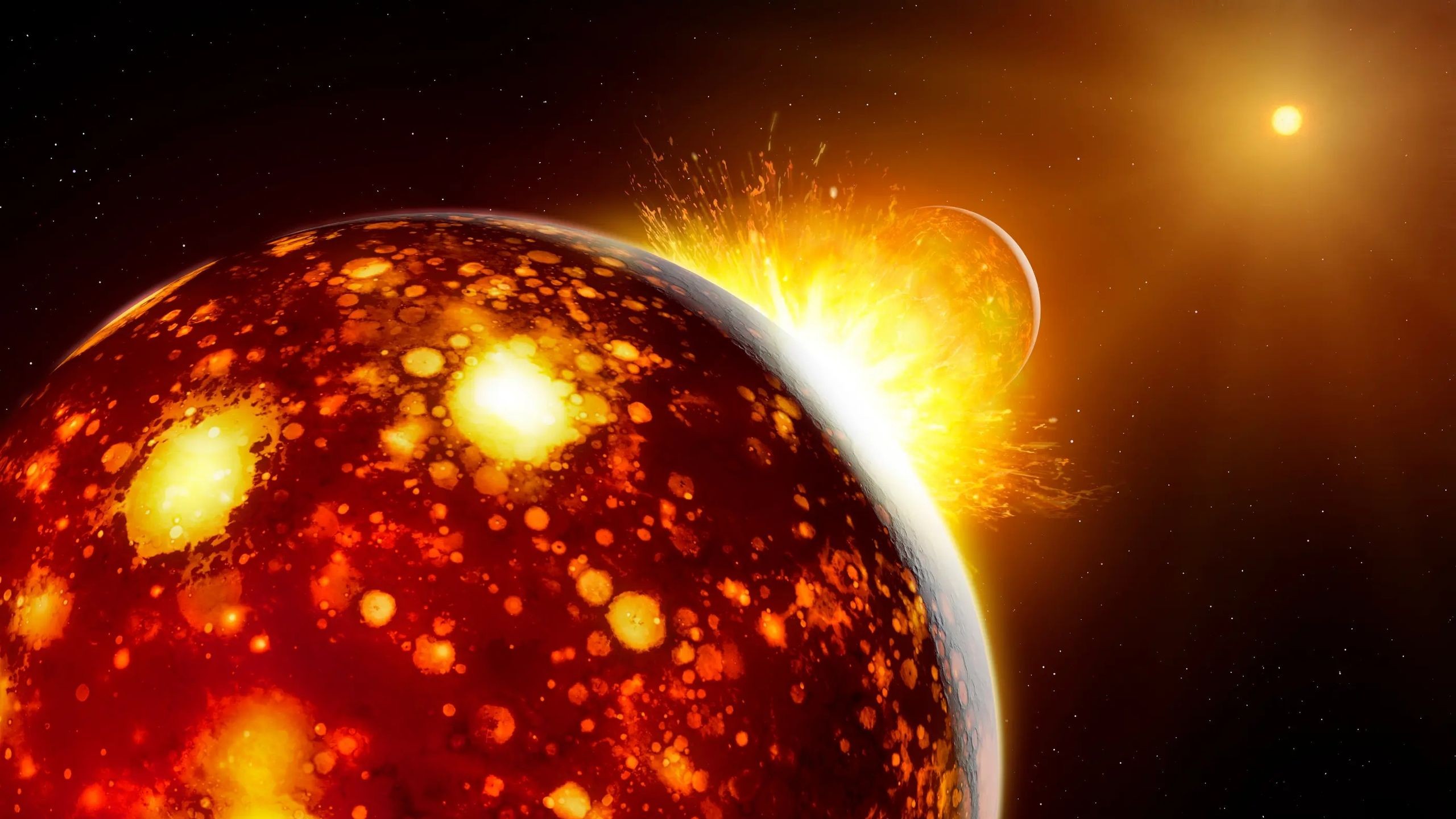
For decades, scientists have debated the origin of Earth’s moon, largely settling on the “giant impact” theory: a Mars-sized object slammed into early Earth, forming the lunar disk from which our moon coalesced. A new study adds critical detail to this picture, suggesting the impactor wasn’t a rogue planet from afar, but a sibling world born in the same region of the solar system as Earth. This discovery refines our understanding of how rocky planets formed in the chaotic early solar system.
Early Solar System Chaos
Around 4.5 billion years ago, the inner solar system wasn’t the stable neighborhood we see today. Dozens, possibly hundreds, of planetary embryos – bodies ranging from moon to Mars size – jostled for space, colliding and merging in a gravitational free-for-all. Jupiter’s immense gravity further stirred this pot, flinging some worlds into new orbits. Theia, the impactor, was one of these early planetary building blocks.
Chemical Clues in Lunar Samples
The puzzle deepened because Earth and the moon share surprisingly similar chemical compositions. If Theia came from elsewhere, we’d expect more distinct differences. Researchers led by Timo Hopp at the Max Planck Institute revisited lunar samples from the Apollo missions, along with terrestrial rocks and meteorites, searching for subtle isotopic traces. These traces act like fingerprints, revealing where material formed relative to the sun.
The team focused on iron, molybdenum, and zirconium isotopes. By analyzing these elements in lunar and terrestrial samples, they could reconstruct Theia’s likely birthplace. The results pointed to a rocky world that formed in the inner solar system, likely even closer to the sun than Earth. This isn’t a new twist in the impact theory, but rather a confirmation of the classical picture of planet formation.
An Unsampled Reservoir
The models suggest both Earth and Theia drew material from a previously unknown “unsampled” region of the inner solar system. This means a type of matter that hasn’t been found in any meteorite collections. This missing material likely formed close to the sun, possibly swept up by Mercury, Venus, or Earth itself. Confirmation would require samples from these planets—a goal for future missions.
The Mystery Remains
While the study clarifies Theia’s origin, questions remain. How did the impact mix the two worlds so thoroughly, erasing almost all chemical distinctions? Cracking this mystery could unlock the final piece of the moon’s violent birth story, explaining how Earth and our satellite came to be.
This refined understanding of the giant impact highlights the brutal, chaotic early days of our solar system, where planetary formation wasn’t a gentle process but a series of cataclysmic collisions.