


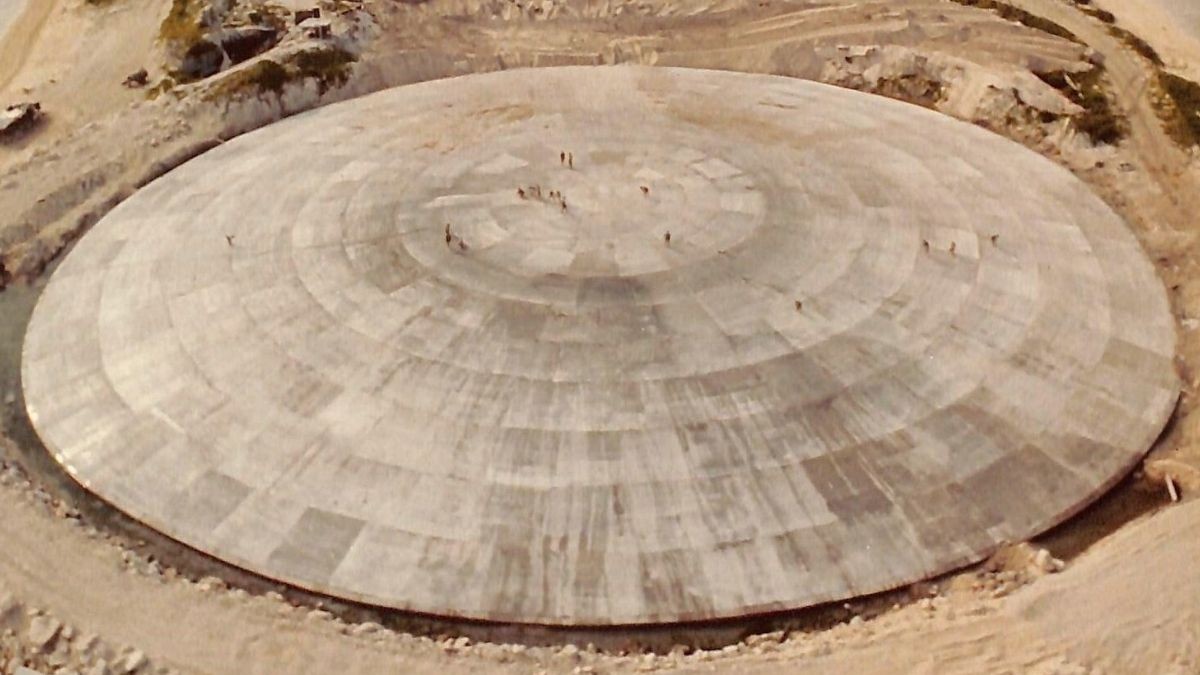
The Runit Dome, a massive concrete structure on the Marshall Island of Runit, is showing signs of decay and leakage, raising serious concerns about the long-term containment of highly radioactive waste. Built in the late 1970s, the dome was intended as a temporary solution to bury over 120,000 tons of material contaminated by decades of U.S. nuclear testing, some of which exceeded the destructive power of Hiroshima and Nagasaki. However, the structure’s vulnerability to rising sea levels and storm surges now threatens to release lethal quantities of plutonium into the Pacific Ocean.
The History of the Runit Dome
In 1958, the U.S. military detonated an 18-kiloton nuclear blast on Runit Island as part of Operation Cactus. After the test, the resulting crater was filled with contaminated soil and debris, creating what became known as the Runit Dome. The dome itself was constructed between 1977 and 1980, but was never designed to be a permanent storage solution. Its unlined base rests on porous coral sediment, which has allowed groundwater to penetrate the dome over time.
Current Risks: Sea Level Rise and Structural Decay
Experts warn that the dome’s integrity is deteriorating rapidly. Cracks have been observed in the concrete, and the island itself sits barely two meters above sea level. Climate scientists predict that the Marshall Islands will experience at least one meter of sea level rise by 2100, which would submerge significant portions of Runit Island and potentially breach the dome.
This is not merely an environmental issue; it’s a humanitarian crisis waiting to happen. The island is located just 20 miles from inhabited communities that rely on the lagoon for sustenance. The presence of plutonium-239, a radioactive isotope with a half-life of over 24,000 years, poses an existential threat to the region.
Expert Assessments and Ongoing Research
Marine radioactivity expert Ken Buesseler from the Woods Hole Oceanographic Institute has stated that leaks are currently “relatively small,” but warns that continued monitoring is crucial. Columbia University chemist Ivana Nikolic-Hughes, who visited the site in 2018, has detected elevated radiation levels in soil samples taken outside the dome. Her research indicates that leaks may already be occurring, either from the dome itself or from earlier haphazard cleanup efforts.
“Given that sea levels are rising and there’s indications storms are intensifying, we worry the integrity of the dome could be in jeopardy,” Nikolic-Hughes stated in an interview with the Australian Broadcasting Corporation.
The U.S. Department of Energy’s Pacific Northwest National Laboratory has also confirmed that storm surges and sea level rise are the primary risks to the site.
The Need for Accountability
Researchers like Nikolic-Hughes and Hart Rapaport have urged the United States to assume responsibility for proper cleanup of the nuclear waste. As UN special rapporteur Paula Gaviria Betancur observed, legacies of U.S. nuclear testing continue to displace Marshallese communities, and climate change now threatens to displace thousands more. The Runit Dome represents a stark reminder of the long-term consequences of nuclear colonialism and the urgent need for environmental remediation.
The decaying dome is more than just a technical problem; it is a political and moral failure. Failure to address the issue will have catastrophic consequences for the Marshall Islands and the wider Pacific region.


