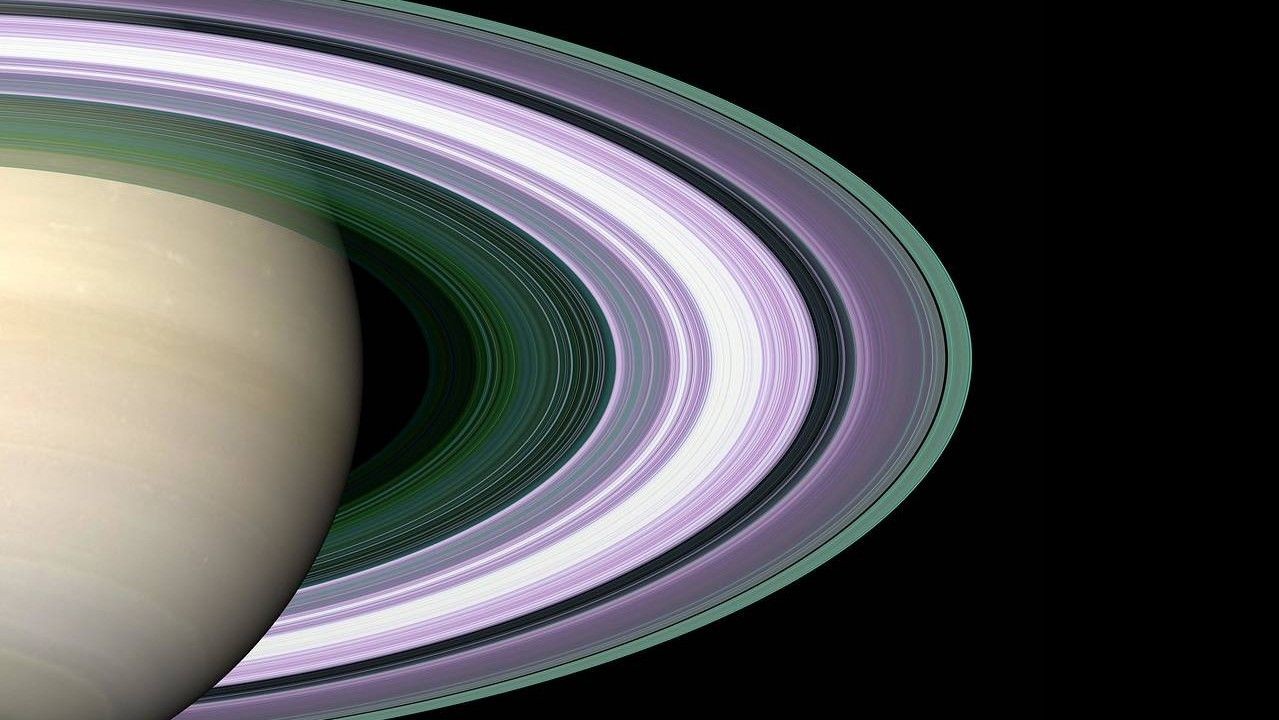
New research suggests that Saturn’s magnificent rings may not be ancient features, but rather the relatively recent debris of a destroyed moon named Chrysalis. The same catastrophic event could also explain the planet’s unusual tilt, challenging long-held assumptions about the Saturnian system.
The Case for a Lost Moon
For decades, scientists have puzzled over two key questions: why Saturn’s rings appear so young compared to the planet itself (formed over 4.5 billion years ago), and why Saturn is tilted at approximately 26.7 degrees. The prevailing theory linked the tilt to gravitational resonance with Neptune, but a missing piece remained.
Recent findings, presented at the Lunar and Planetary Science Conference, propose that Saturn once hosted an additional moon, Chrysalis. Roughly 100 million years ago, this moon ventured too close to Saturn, where powerful tidal forces began to tear it apart.
How the Destruction Happened
The process wasn’t a sudden collision. Instead, Saturn’s gravity systematically stripped away Chrysalis’ icy outer layers over time. This explains why Saturn’s rings are overwhelmingly composed of water ice, with minimal rocky material, as the moon’s rocky core remained largely intact.
The simulations demonstrate that tidal forces would preferentially remove the icy mantle, leaving the rocky core behind. Some of this debris remained in orbit, eventually colliding and spreading into the complex ring system we observe today. While an older ring system may have existed previously, this event would still explain why Saturn’s rings are so young.
Linking Tilt to Destruction
The destruction of Chrysalis also explains Saturn’s tilt. The moon maintained orbital stability for billions of years, keeping Saturn aligned with Neptune’s gravitational tugs. However, as Chrysalis’ orbit became unstable, interactions with Saturn led to its destruction, altering Saturn’s axial tilt. The simulations show that the moon’s breakup would have destabilized Saturn’s alignment over time.
What Remains?
The team estimates that Titan, Saturn’s largest moon, likely removed up to 70% of the initial ring mass over time. This suggests the original ring system was far more massive than today’s. Scientists are still investigating the fate of Chrysalis’ surviving core, and searching for traces of the event, such as unusual impact features on Saturn’s moons.
The research suggests that Saturn’s rings are not a primordial feature, but a relatively recent consequence of a dramatic cosmic event. This raises questions about the stability of other planetary systems and the prevalence of similar catastrophic events throughout the universe.