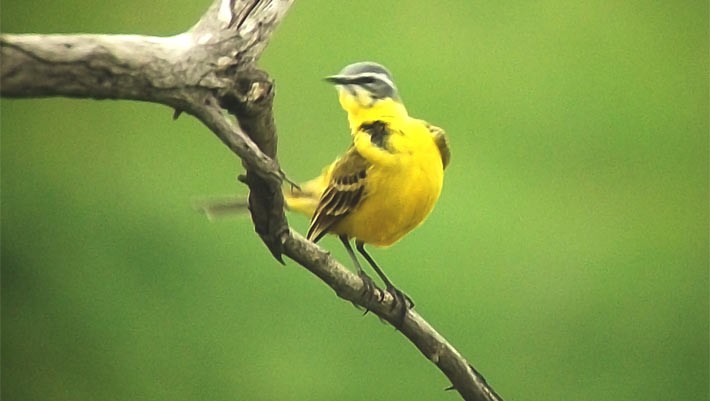
A comprehensive study across Europe has revealed a surprising behavioral pattern in urban wildlife: birds are significantly more wary of approaching women than men. Research involving dozens of bird species in five countries shows that birds consistently flee when women are about one meter closer than they do when men approach.
While the birds clearly distinguish between the sexes, the specific cues triggering this fear remain a scientific mystery.
The Experiment: Measuring Fear in the Wild
To understand how urban animals perceive humans, researchers from UCLA and other European institutions conducted a large-scale field experiment. The team focused on Flight Initiation Distance (FID), a standard metric in ecology used to gauge an animal’s fear level. FID measures the distance between an observer and an animal at the exact moment the animal decides to flee.
The study took place in urban parks and green spaces across Czechia, France, Germany, Poland, and Spain. Male and female researchers walked in straight lines toward various bird species, including:
* Great tits
* House sparrows
* Blackbirds
* Magpies (known for fleeing early)
* Pigeons (known for staying put longer)
The results were strikingly consistent. Across 37 different bird species, the data showed that birds tolerated a closer approach from men. On average, women had to stop one meter further away to avoid triggering a flight response.
A Consistent Pattern Across Species and Borders
The consistency of the findings is what makes them particularly significant. The results did not vary by country or by the natural boldness of the bird species. Whether the bird was naturally skittish or relatively tame, the gender of the approaching human influenced the escape decision.
“Our study revealed that, after accounting for other variables influencing significant variation in FID, birds on average tended to escape from a distance of about one meter longer when approached by women compared to men,” the researchers stated. “Birds were less tolerant of women than of men, and this result was geographically consistent.”
This suggests that the behavior is not a local anomaly but a widespread phenomenon in urban ecology. The birds are actively evaluating the threat posed by humans, and their assessment changes based on the observer’s sex.
The Mystery: What Are the Birds Detecting?
While the what is clear, the why remains elusive. Professor Daniel Blumstein of UCLA, a lead author on the study, admitted that while the data is robust, the mechanism behind it is not yet understood.
“I fully believe our results… but I can’t explain them right now,” Blumstein said. “We used bleeding-edge comparative analysis techniques that showed our findings were consistent across cities and species, but we simply don’t have a conclusive explanation yet.”
Researchers have proposed several hypotheses for the subtle cues birds might be picking up on:
* Pheromones: Chemical signals that humans cannot detect but birds might sense.
* Body Shape: Differences in silhouette or posture.
* Gait: Variations in walking style or movement patterns.
Dr. Yanina Benedetti, a researcher at the Czech University of Life Sciences Prague, noted the personal surprise of the findings. “As a woman in the field, I was surprised that birds reacted to us differently,” she said.
Implications for Science and Urban Ecology
This study challenges a long-held assumption in behavioral biology: that human observers are neutral variables. If birds react differently to men and women, then previous studies that did not control for the observer’s sex may have introduced subtle biases into their data.
“Many behavioral studies assume that a human observer is neutral, but this wasn’t the case for urban birds in our study,” Dr. Benedetti explained. “This study highlights how animals in cities ‘see’ humans, which has implications for urban ecology and equality in science.”
The findings underscore the sophisticated ability of urban birds to evaluate their environment. They are not just reacting to movement or size, but to complex, subtle signals that distinguish human genders.
Next Steps
The publication of these findings in the February 2026 issue of People and Nature opens new avenues for research. Future studies will need to isolate specific factors—such as testing movement patterns, scent cues, or physical traits independently—to pinpoint exactly what triggers the birds’ fear response.
Until then, the one-meter gap remains a fascinating puzzle, highlighting how much we still have to learn about the invisible ways urban wildlife perceives our presence.