For centuries, the prevailing metaphor for the developing brain has been that of a blank slate —a pristine surface waiting for experience to write upon it. However, new research from the Institute of Science and Technology Austria (ISTA) challenges this intuitive assumption.
A study focusing on mouse brains suggests that neural circuits do not start empty and fill up with connections over time. Instead, they begin life “full” and chaotic, possessing a dense, seemingly random web of connections that is subsequently refined and streamlined as the animal matures.
The Pruning Model vs. The Growth Model
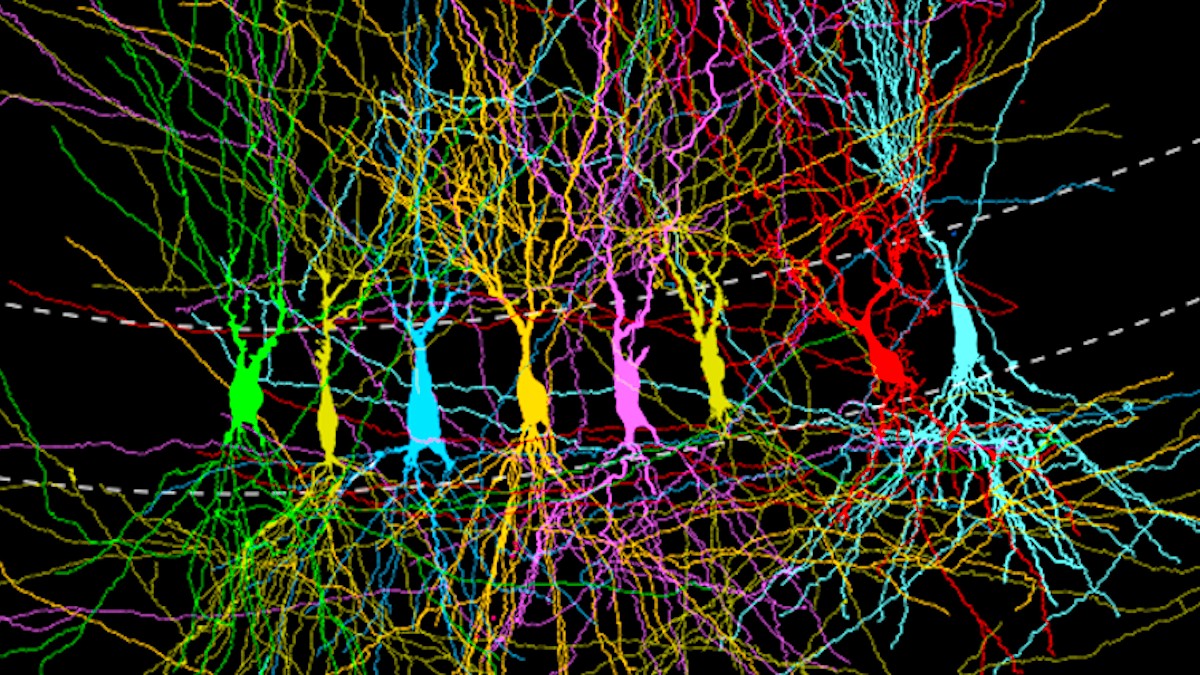
The study, led by neuroscientist Peter Jonas, examined the hippocampus, a critical brain region responsible for spatial memory and the consolidation of short-term memories into long-term storage. Specifically, the team analyzed the CA3 pyramidal neurons, a key circuit within this region.
The findings contradicted the traditional expectation that neural networks grow denser and more complex as an organism ages. Instead, the researchers observed a “pruning model” of development:
- Early Life: The neural network is extremely dense with numerous, seemingly random connections.
- Maturation: As the mouse grows, these connections are selectively eliminated or weakened.
- Adulthood: The result is a highly optimized, structured, and efficient network.
“Intuitively, one might expect that a network grows and becomes denser over time,” explains Peter Jonas. “Here, we see the opposite. It starts out full, and then it becomes streamlined and optimized.”
Why Start With Too Many Connections?
The researchers propose that this “over-engineering” at birth serves a crucial functional purpose. The hippocampus must integrate complex sensory information from eyes, ears, and nose to create coherent memories. This is a demanding task for immature neurons.
Jonas suggests that an “initially exuberant connectivity” provides the necessary groundwork for efficient communication. If neurons had to find each other from scratch in a “blank slate” scenario, the learning process would be significantly slower.
To visualize this, consider navigation:
* The Pruning Model: Imagine a city with a dense, pre-existing grid of roads. To get from point A to point B, you simply choose the most efficient route. The infrastructure is already there; you just optimize your path.
* The Blank Slate Model: Imagine having to build a new road from scratch every time you need to travel somewhere. This would be time-consuming and inefficient for a developing brain trying to learn rapidly.
By starting with a surplus of connections, the brain ensures that potential pathways exist, allowing it to select and strengthen the most useful ones while discarding the rest.
Developmental Stages Observed
The team tracked electrical activity and cellular processes across three distinct developmental stages in mice:
1. Neonatal: Just after birth to 7–8 days old.
2. Adolescent: Between 18 and 25 days old.
3. Adult: Around 45–50 days old.
The data consistently showed that the hippocampal circuit transitions from a state of high-density randomness to a precise, structured network. This selective pruning appears to be the mechanism that enables the complex integration of sensory data required for memory formation.
Implications for Human Understanding
While these findings are based on mouse models, they offer a compelling new perspective on neurodevelopment. The question remains whether human brains follow the same trajectory. If so, it suggests that our capacity for learning is not built by adding bricks to an empty wall, but rather by chiseling away excess marble to reveal a functional sculpture.
This “full start” theory raises important questions about early childhood development and how environmental factors might influence which neural connections are preserved and which are pruned. It shifts the focus from how much we learn to how efficiently our brains organize that learning.
In essence, the brain does not begin as an empty vessel to be filled, but as a complex, over-connected system that learns by simplifying itself.