


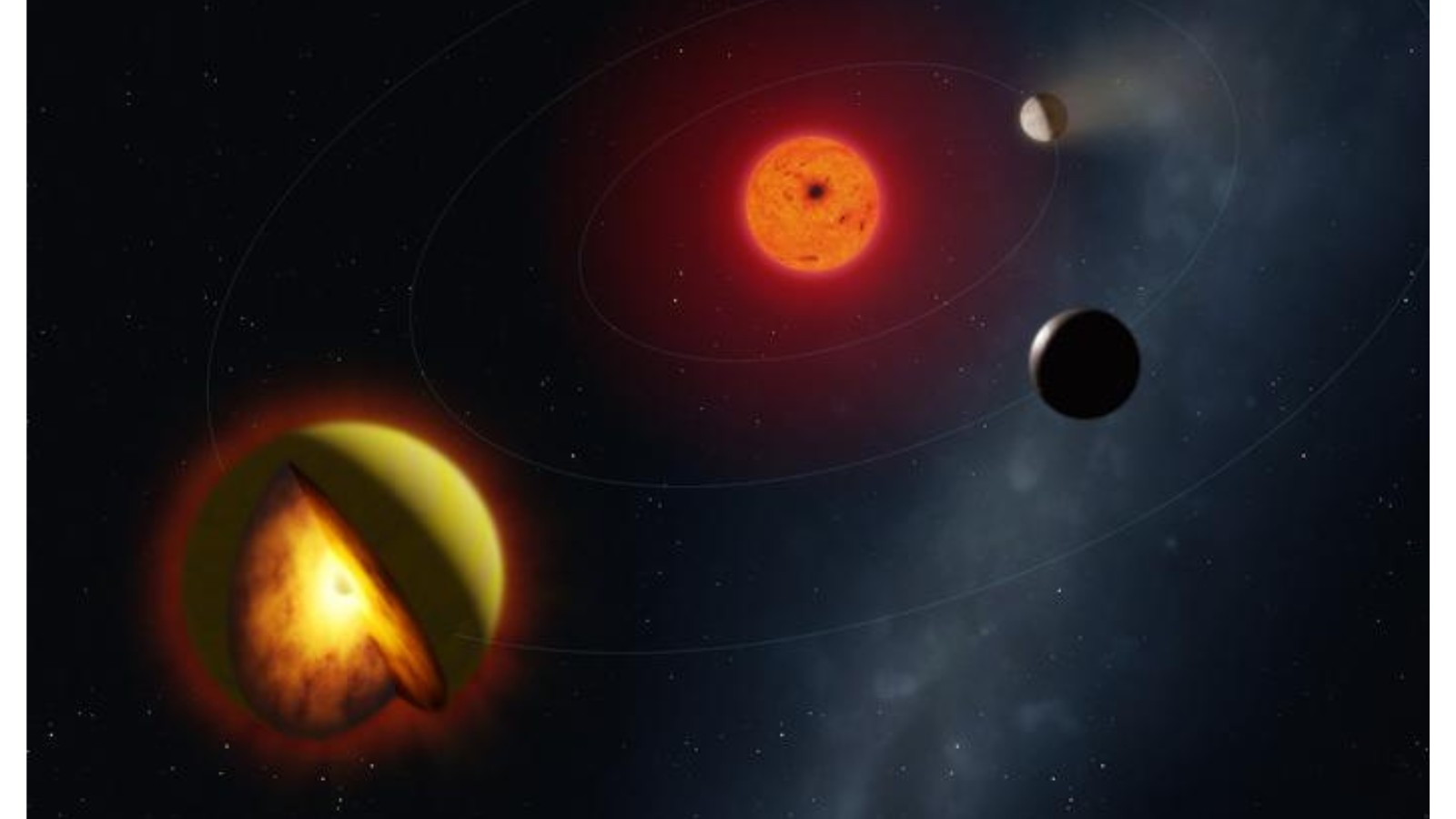
Astronomers have identified a unique type of exoplanet – L 98-59 d – that doesn’t fit neatly into existing classifications, challenging our understanding of planetary diversity beyond our solar system. This newly discovered world, located 35 light-years away, is characterized by an atmosphere rich in hydrogen sulfide, giving it the distinctive odor of rotten eggs.
A Planet Unlike Any Other
The exoplanet, roughly 1.6 times Earth’s size, orbits a small red star and exhibits an exceptionally low density. Current planetary categories struggle to accommodate its composition: it’s neither a rocky gas dwarf nor a water-rich “hycean” planet. Instead, it represents a new class of sulfur-heavy exoplanets.
Why this matters: The discovery forces scientists to re-evaluate how they categorize planets. Previously, models were based on the limited examples within our solar system. This suggests that planetary formation and evolution can yield far more unexpected results than previously thought.
Molten Interior and Sulfur-Rich Atmosphere
Advanced computer simulations reveal that L 98-59 d likely possesses a molten silicate mantle and a global magma ocean. This vast reservoir of molten rock has trapped sulfur for billions of years, which gradually released into the atmosphere as sulfur dioxide and other sulfur compounds.
The planet’s magma ocean also helps retain its hydrogen and sulfur-rich atmosphere, protecting it from erosion by radiation from its parent star. Over eons, the exchange between the atmosphere and the planet’s interior shaped it into a gas-rich, sulfurous world with no direct equivalent in our solar system.
Implications for Exoplanet Research
The discovery highlights the potential for uncovering previously unknown planetary types. According to Harrison Nicholls of the University of Oxford, “This discovery suggests that the categories astronomers currently use to describe small planets may be too simple.”
Key takeaway: The ability to reconstruct the deep past of distant worlds using computer models allows scientists to overcome the limitations of direct observation. Despite the inability to physically visit these planets, researchers can infer their interior structure and evolutionary history with increasing accuracy.
The planet was likely born with volatile material, possibly as a larger sub-Neptune, then shrank and cooled over billions of years, retaining a significant atmosphere. The finding demonstrates that planetary evolution can take unpredictable paths, resulting in worlds that defy easy categorization.
“Although astronomers can only measure a planet’s size, mass, and atmospheric composition from afar, this research shows that it is possible to reconstruct the deep past of these alien worlds – and discover types of planets with no equivalent in our own solar system.” — Raymond Pierrehumbert, University of Oxford.
This discovery opens the door to further investigation of exoplanet diversity and challenges existing theoretical frameworks. The search for other unique worlds beyond our solar system is now more critical than ever.


