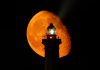
The total lunar eclipse occurring on March 3, 2026, will be the last one visible from many parts of the world for nearly three years. Observers in East Asia, Australia, the Pacific, and western North America will witness the full moon – often called the “Worm Moon” – darken to a reddish-copper hue for 58 minutes as it passes through Earth’s shadow.
Why This Matters: Rare Alignment
This eclipse is notable not just for its beauty, but because it marks the start of a prolonged absence of total lunar eclipses. The moon’s orbit doesn’t align perfectly with Earth’s shadow every month; eclipses only occur during specific “eclipse seasons” when the sun, Earth, and moon are nearly in a straight line. Even then, a full, dramatic “blood moon” effect requires a precise alignment that won’t happen again until New Year’s Eve 2028.
Understanding Lunar Eclipses: Total, Partial, and Penumbral
Lunar eclipses happen when the full moon moves into Earth’s shadow. This shadow has two parts:
- Umbra: The dark, central part of the shadow, which causes a total eclipse when the entire moon passes through it. The resulting red color is due to sunlight filtering through Earth’s atmosphere.
- Penumbra: The lighter, outer part of the shadow, which causes a fainter dimming of the moon during a penumbral eclipse.
Partial eclipses occur when only a portion of the moon enters the umbra. The March 3 eclipse will include all phases: penumbral, partial, and total, lasting over five hours from start to finish.
The Coming Eclipse Drought: 2026-2028
After March 3, 2026, no total lunar eclipses will be visible for 34 months. While partial and penumbral eclipses will still occur, they lack the striking visual impact of a full “blood moon.” The next sequence of eclipses will be:
- Aug. 28, 2026: Deep partial eclipse (93% umbral coverage).
- Feb. 20, 2027: Penumbral eclipse.
- July 18, 2027: Penumbral eclipse.
- Aug. 17, 2027: Penumbral eclipse.
- Jan. 12, 2028: Shallow partial eclipse.
- July 6, 2028: Partial eclipse (39% umbral coverage).
The Return of Totality: 2028-2029
The eclipse drought ends dramatically in late 2028 with a tetrad—three total lunar eclipses within a year:
- Dec. 31, 2028: Total eclipse (71 minutes totality) visible from Africa, Europe, Asia, Australia, Canada, and Alaska.
- June 26, 2029: Total eclipse (102 minutes totality) visible from the Americas, western Europe, and Africa.
- Dec. 20, 2029: Total eclipse (54 minutes totality) visible from North and South America, Europe, Africa, the Middle East, and Asia.
The alignment shifts in the moon’s orbit will bring the full moon back into deeper alignment with Earth’s shadow, ensuring spectacular total eclipses for years to come.
In short, the March 3, 2026, eclipse is the last chance to see a truly dramatic lunar eclipse until the end of 2028, when a series of spectacular events will return to the night sky.