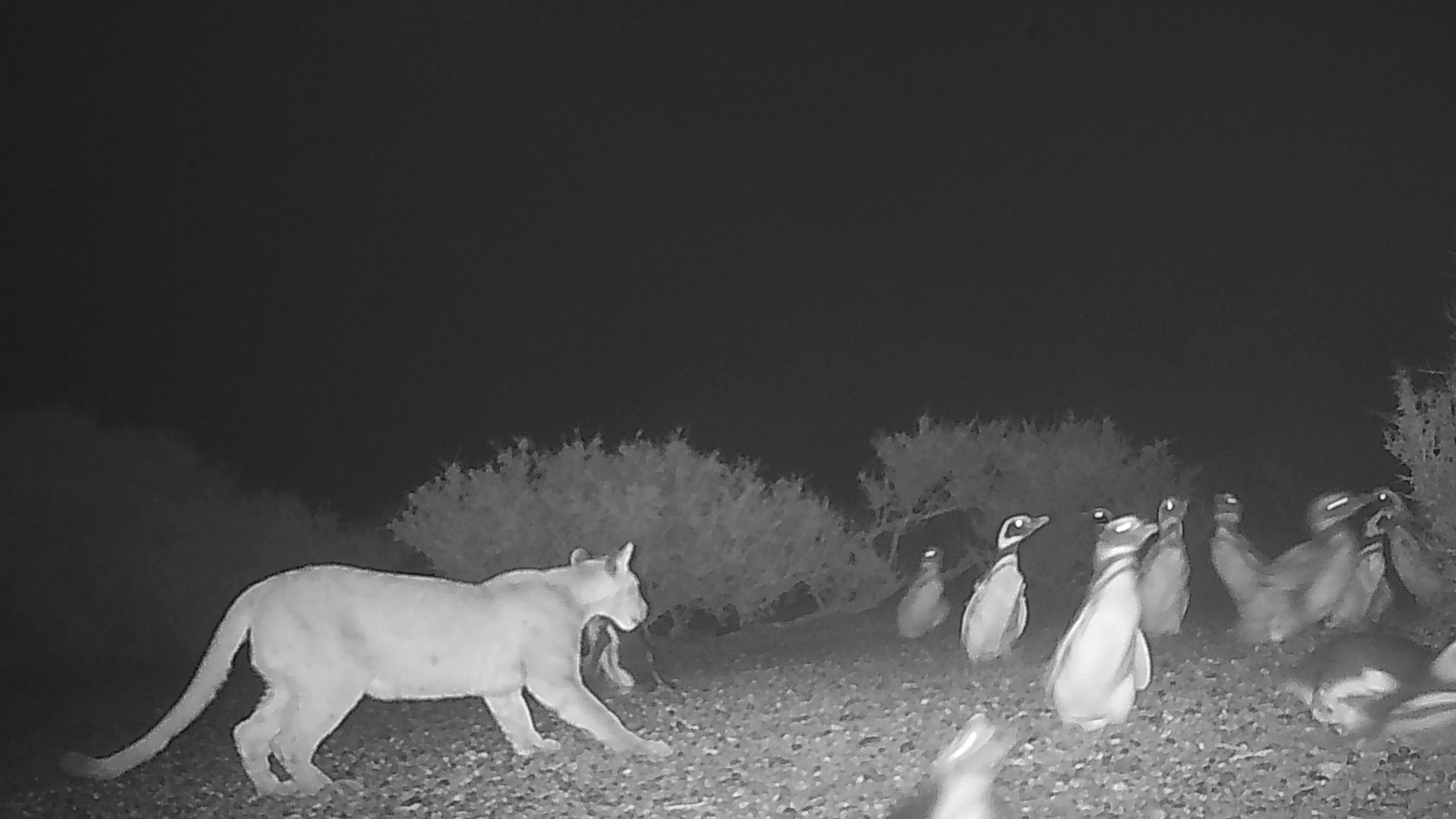
Pumas returning to Patagonia are not just reclaiming their territory—they’re rewriting the rules of big cat behavior by feasting on a readily available, unusual prey: Magellanic penguins. A recent study reveals that these normally solitary predators are exhibiting unprecedented tolerance of one another, driven by the concentrated food source of a mainland penguin colony. This demonstrates how rewilding efforts can create entirely new ecological dynamics, rather than simply restoring past conditions.
The Return of the Puma and the Rise of Penguin Predation
For much of the 20th century, sheep ranchers pushed pumas out of Patagonia. However, with the establishment of Monte Leon National Park in 2004, the cats began to return. In their absence, a unique situation developed: a large colony of Magellanic penguins, typically confined to offshore islands, established a breeding ground on the mainland, numbering around 40,000 pairs. The returning pumas quickly exploited this new opportunity, with penguin remains appearing in their scat shortly after the park was created.
Researchers initially assumed only a few individuals were responsible for this shift. However, extensive monitoring revealed that many pumas were actively targeting the penguins, leading to an unusually high concentration of the predators near the breeding colony.
Social Tolerance Driven by Abundant Prey
The study, published in Proceedings of the Royal Society B, found that pumas that regularly hunted penguins exhibited significantly higher levels of social interaction than those relying on other prey. Researchers tracked 14 pumas via GPS collars, documenting 254 encounters between penguin-eating individuals, compared to just four between those who did not hunt penguins. These encounters clustered around the penguin colony, suggesting that the abundant food source reduces competition and allows for greater tolerance among the cats.
This behavior is particularly notable because pumas are typically solitary animals with large territories. The presence of the penguin colony has led to a more than doubling of puma density within the park, exceeding previously recorded concentrations in Argentina. The shift in social dynamics is a direct consequence of a concentrated, reliable food source.
Implications for Conservation and Ecosystem Management
The findings underscore the complexity of modern conservation efforts. Restoring wildlife doesn’t simply rewind ecosystems; it creates novel interactions that reshape animal behavior. Understanding these changes is essential for effective management. The study’s co-author, Mitchell Serota, emphasizes that conservation strategies must be grounded in how ecosystems function today, not based on assumptions about the past.
The impact of puma predation on penguin colonies is still being assessed. While large, established colonies may be resilient, smaller or newly forming colonies could be more vulnerable. The situation presents a complex challenge for park managers, as it involves the interaction of two native species in a way that differs from historical patterns.
Researchers plan to investigate how this relationship affects other prey species, such as guanacos, to gain a more comprehensive understanding of the cascading effects within the ecosystem.
Ultimately, the Patagonian puma’s adaptation to penguin predation highlights the unpredictable outcomes of rewilding and the need for flexible, data-driven conservation strategies.