We usually look back in time when we peer through a telescope. James Webb? Not this time.
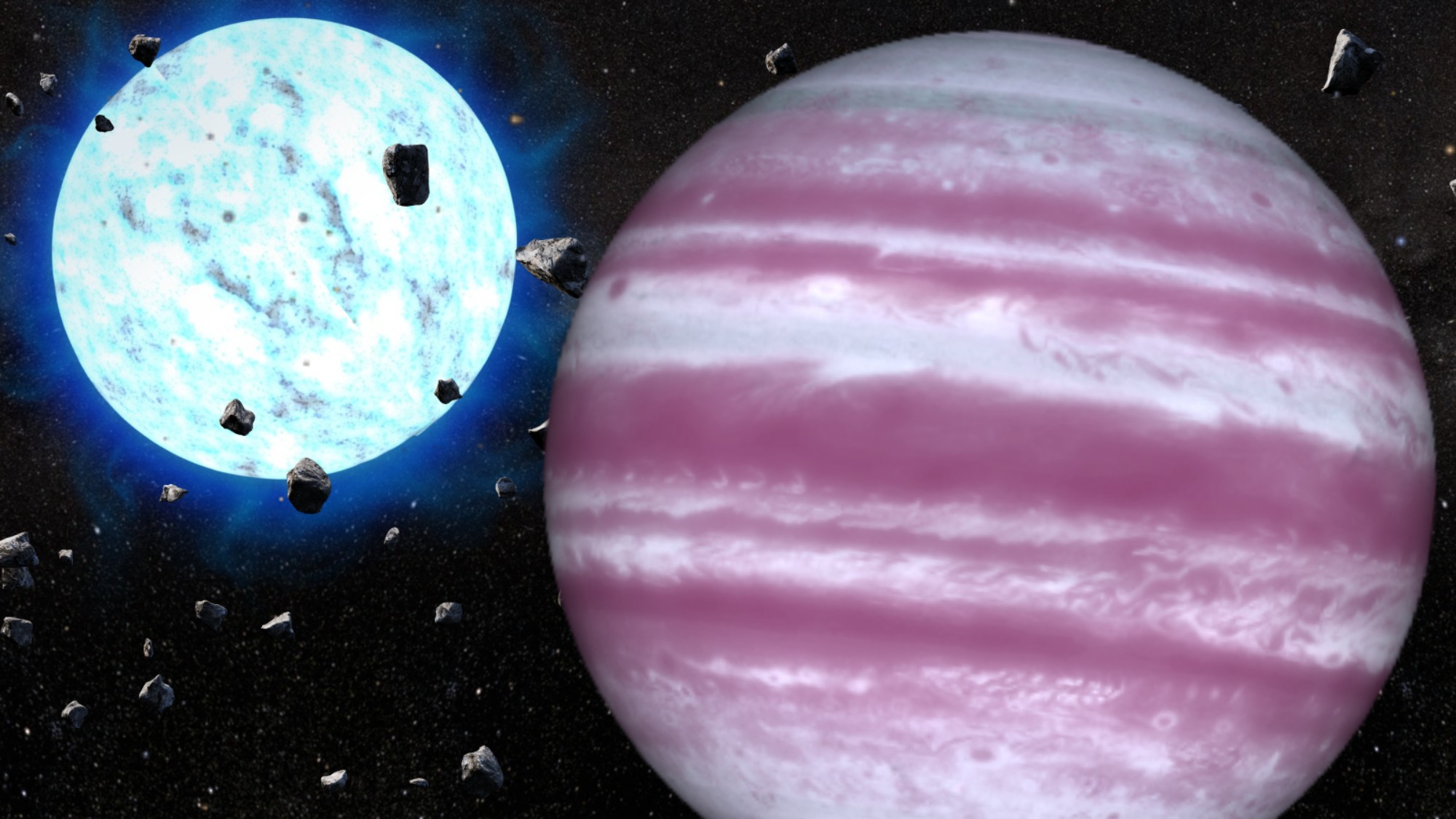
Scientists have peered forward into a future roughly six billion years from now. They did it by staring at a weird, gas giant exoplanet circling a dead star. An exoplanet called WD 1856 b. Its host, a white dwarf known as WD 1856+524, sits 80 light-years out. It is what remains of a star like our sun, long after the fire has gone out.
It gives us a glimpse of Earth’s end. Or rather. Our survival.
Our sun will not stay quiet forever. It will swell into a red giant, consuming Mercury, Venus, and likely Earth. It will shed its skin, leaving behind that same smoldering core we see in this distant system. But the outer planets? Jupiter. Saturn. They might remain. They just won’t look the same.
The Survivor
WD 1856 b makes no sense, initially. It is the size of Jupiter. It orbits a star the size of Earth.
The planet is seven times larger than the object it circles. It takes 1.4 days to complete one loop, a track just 2% the size of our own orbit. It should be dead. Stars explode, planets get swallowed. How does this gas giant hang around, so close, so intact?
First spotted in 2020 using the TESS spacecraft and Spitzer, it was the first whole planet found near a white dwarf. Now, with James Webb’s help, researchers from the University of St Andrews measured its mass and atmosphere. They expected cold.
It is hotter than physics said it should be.
260 Fahrenheit. That’s 127 Celsius. If it relied solely on the feeble light of its dead parent star, WD 1856 b should be roughly 240 degrees cooler. So where is the heat coming from?
Where Does It Get Hot?
There were two theories for how the planet ended up here.
One, it rode through the destruction. Swallowed by the expanding red giant, it survived the trip through the interior of a dying sun, emerging on the other side.
Two, it moved. Gravity did the work. The white dwarf lives in a triple star system. The companions pulled, nudged, and slingshotted WD 1856 inward during or after the star’s collapse.
Temperature solved the argument.
Ryan MacDonald’s team modeled the cooling history of a planet with a mass four to eleven times that of Jupiter. If WD 1856 b had passed through the star, the internal heating would still be significant today. But it isn’t.
The host star became a white dwarf between 3 to 5.5 billion years before this current heat was generated. Which means the planet was outside when the red giant burned. It wasn’t inside.
“Our results show that stellar death is notthe end – some planets experience a vibrant and lively after the death of their star.” — Ryan MacDonald, Univ of St Andrews.
Christopher O’Connor of Northwestern puts it better: As the planet migrated inward, friction with gravity heated it up. It has been cooling down ever since. The planet wasn’t born close to the white dwarf. It was moved.
A Blink in Time
Why does this matter? Because we need to know how planets survive violent stellar death.
It also shows off what the James Webb Space Telescope can actually do.
White dwarfs are dim. This specific one? Barely visible to human eyes without aid. And the transit—the moment the planet blocks the star’s light—lasts just 8 minutes.
“It’s very much if you blink, you miss it.” — Victoria Boehm, Cornell.
Capturing enough light during that tiny window requires an instrument that can see in the dark faster than almost anything else in space. No one else could pull the spectrum of a gas giant circling such a faint remnant.
It suggests our solar system won’t go out quietly. The outer giants will drift inward, scalded by the collapse, then slowly, patiently, cool.
We are not done with the data yet. The search for other planets orbiting dead suns is just beginning. The future looks strange, and quiet, and a bit hot.