A multidisciplinary team led by Professor Garrick Allen of the University of Glasgow has successfully reconstructed 42 missing pages from Codex H, a sixth-century manuscript containing the Letters of St. Paul. This breakthrough offers scholars and the public an unprecedented look at one of the most significant early witnesses to the New Testament, revealing not just the text itself, but the physical history of how sacred books were treated, preserved, and repurposed over centuries.
From Binding Material to Digital Reconstruction
Codex H vanished from historical record after the 13th century, when it was dismantled at the Great Lavra Monastery on Mount Athos in Greece. Its pages were not discarded but recycled : they were re-inked and used as binding material and flyleaves for other manuscripts. Today, these scattered fragments are held in collections across Italy, Greece, Russia, Ukraine, and France.
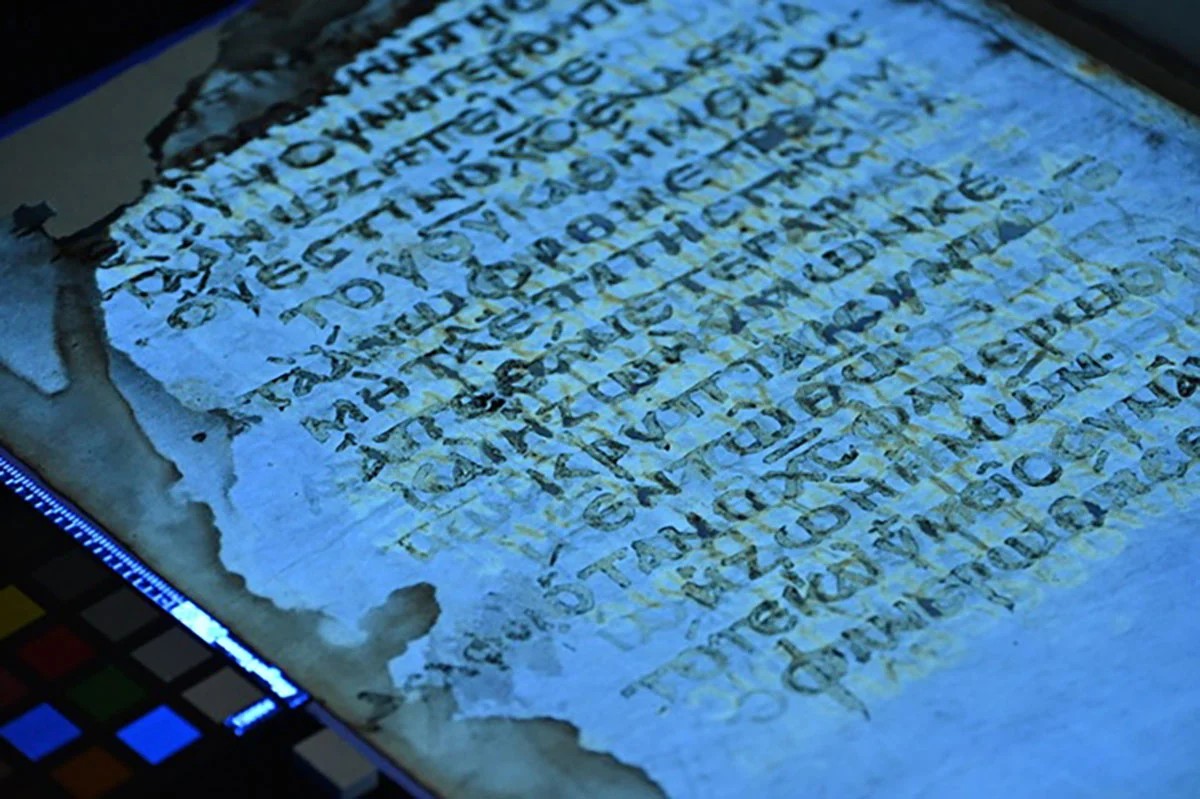
The recovery of the original text was made possible by a phenomenon known as “offset” damage. When the manuscript was re-inked in the Middle Ages, the chemicals in the new ink seeped through the parchment, creating faint mirror images of the original text on adjacent pages. These “ghost pages” were barely visible to the naked eye but became clear through advanced imaging.
“The breakthrough came from an important starting point: we knew that at one point, the manuscript was re-inked. The chemicals in the new ink caused ‘offset’ damage to facing pages… sometimes leaving traces several pages deep.”
— Professor Garrick Allen
In partnership with the Early Manuscripts Electronic Library (EMEL), researchers utilized multispectral imaging to process images of the existing fragments. This technology allowed them to extract the hidden “ghost” text, effectively retrieving multiple pages of information from every single physical leaf. To verify the timeline, experts in Paris performed radiocarbon dating, confirming the parchment’s origin in the 6th century.
Why This Matters: More Than Just Text
While the recovered material includes sections of Paul’s Letters already known to scholars, the significance of Codex H lies in its physical and structural history. It provides a rare window into how early Christian communities engaged with scripture—not just as abstract words, but as tangible objects that were copied, corrected, damaged, and reused.
Key insights from the discovery include:
- Early Chapter Divisions: The pages contain the oldest known chapter lists for Paul’s Letters. These divisions differ significantly from modern systems, offering clues about how early readers navigated and organized the text.
- Scribal Practices: The fragments reveal how sixth-century scribes actively engaged with the text, including their methods of correction and annotation. This highlights the human element in the transmission of sacred writings.
- Medieval Recycling Culture: The manuscript’s condition illustrates the practical realities of medieval book production. Rather than destroying worn-out books, communities often repurposed them, giving new life to old materials.
Professor Allen describes the find as “nothing short of monumental,” noting that recovering this quantity of evidence about the manuscript’s original appearance provides a deeper understanding of Christian scripture’s evolution.
Accessing the Past
This project was funded by the Templeton Religion Trust and the Arts and Humanities Research Council (UK), with cooperation from the Great Lavra Monastery. The findings are not confined to academic circles; a new print edition of Codex H is forthcoming, and a digital edition is freely available online.
For the first time in centuries, these recovered pages are accessible to the public and scholars alike at codexh.arts.gla.ac.uk.
Conclusion: The recovery of Codex H ’s ghost pages transforms a scattered collection of medieval bindings into a coherent historical narrative. By combining advanced imaging with traditional scholarship, this project illuminates not only the text of the New Testament but also the material culture that preserved it.