


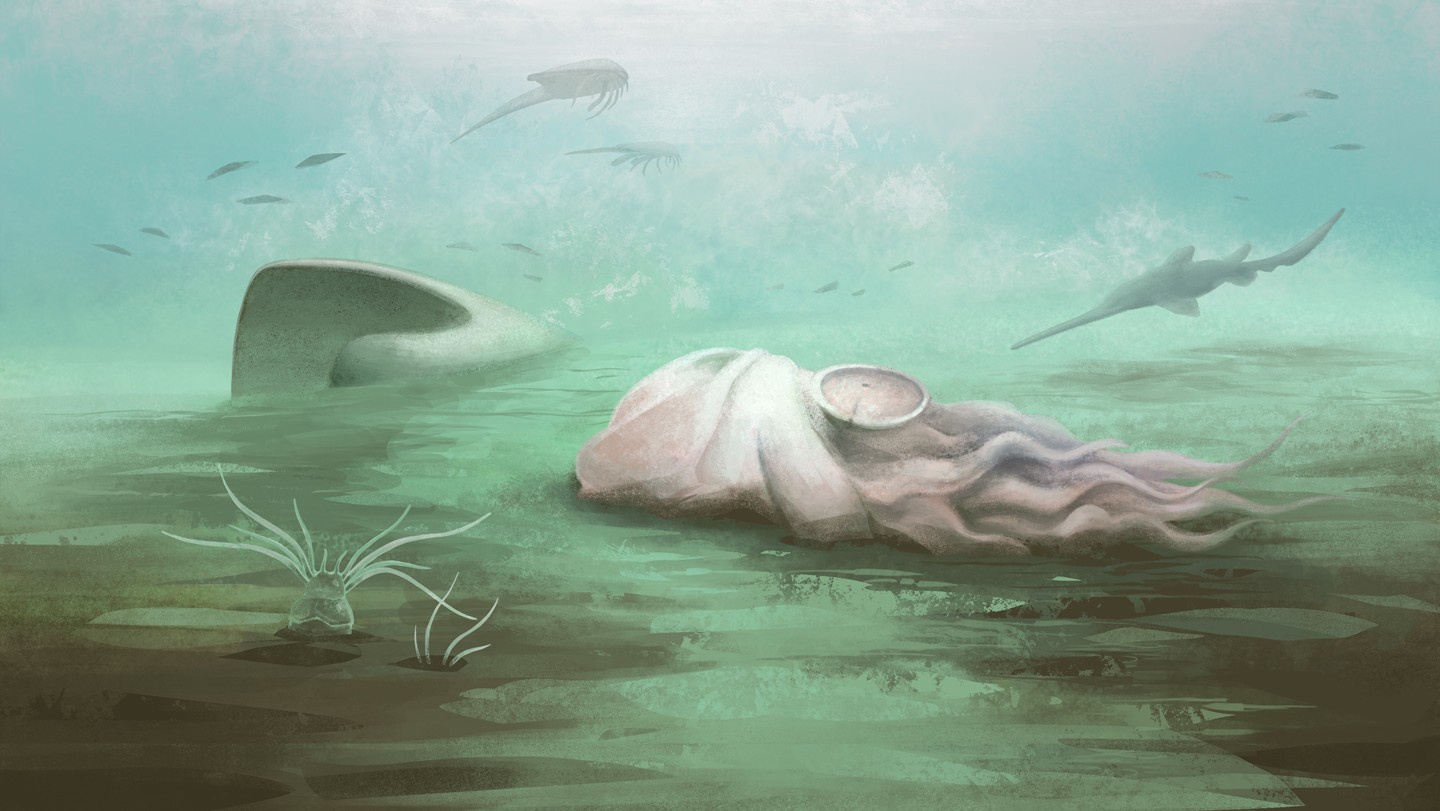
For over two decades, paleontologists have been puzzled by a specific fossil that challenged everything they knew about the evolutionary timeline of cephalopods. A creature once hailed as the oldest known octopus, Pohlsepia mazonensis, has now been reclassified. New research suggests this 310-million-year-old specimen was actually a partly decomposed nautilus.
The Evolutionary Discrepancy
When the fossil was first described in 2000, its discovery created a significant “missing link” problem in the geologic record. Found near Chicago, the fossil featured a rounded body, fin-like structures, and a tangle of arms.
While its appearance suggested an octopus, its age presented a massive contradiction:
– The Fossil’s Age: ~310 million years old.
– The Known Octopus Record: Fossil evidence of true octopuses does not appear until at least 150 million years later.
This 150-million-year gap made it nearly impossible for scientists to map how octopuses evolved, as Pohlsepia simply didn’t fit into the established biological timeline.
The Breakthrough: X-Raying the Past
To solve the mystery, paleontologist Thomas Clements and his team at the University of Reading turned to high-powered X-ray technology. Rather than just looking at the shape of the fossil, they used X-rays to examine the chemical signatures of the minerals preserved around the animal’s soft tissues.
This advanced imaging led to a critical discovery: the radula.
The radula is a specialized, rasping tongue found in various mollusks. It serves as a biological “fingerprint” because its structure is highly specific to different species. The team’s findings revealed:
– Octopus radulae typically feature 7 to 9 teeth per row.
– The Pohlsepia specimen featured at least 11 teeth per row.
This tooth count aligns much more closely with the nautilus —an ancient, shelled cephalopod that is still found in modern oceans—than with an octopus. In fact, the teeth closely resemble those of an extinct nautilus species, Paleocadmus pohli, found at the same site.
Why the Fossil Looked “Wrong”
A common question arises: if it was a nautilus, why did it look like an octopus without a shell?
The researchers believe the answer lies in decomposition. The fossil shows signs that the animal had begun to rot before it was fully encased in sediment. Much like modern nautiluses, the soft tissue of the creature likely separated from its shell during decay, leaving behind a fleshy, arm-like mass that mimicked the silhouette of an octopus.
Why This Reclassification Matters
This discovery does more than just correct a single entry in a textbook; it recalibrates our understanding of life’s history.
By removing Pohlsepia from the octopus lineage, the evolutionary timeline becomes much more logical. It confirms that octopuses are a much younger group than previously thought, resolving the awkward 150-million-year gap and providing a clearer, more accurate map of how cephalopods diversified over millions of years.
Conclusion
The reclassification of Pohlsepia mazonensis from an octopus to a nautilus settles a long-standing paleontological debate, smoothing out the evolutionary timeline and providing a more accurate history of cephalopod development.


