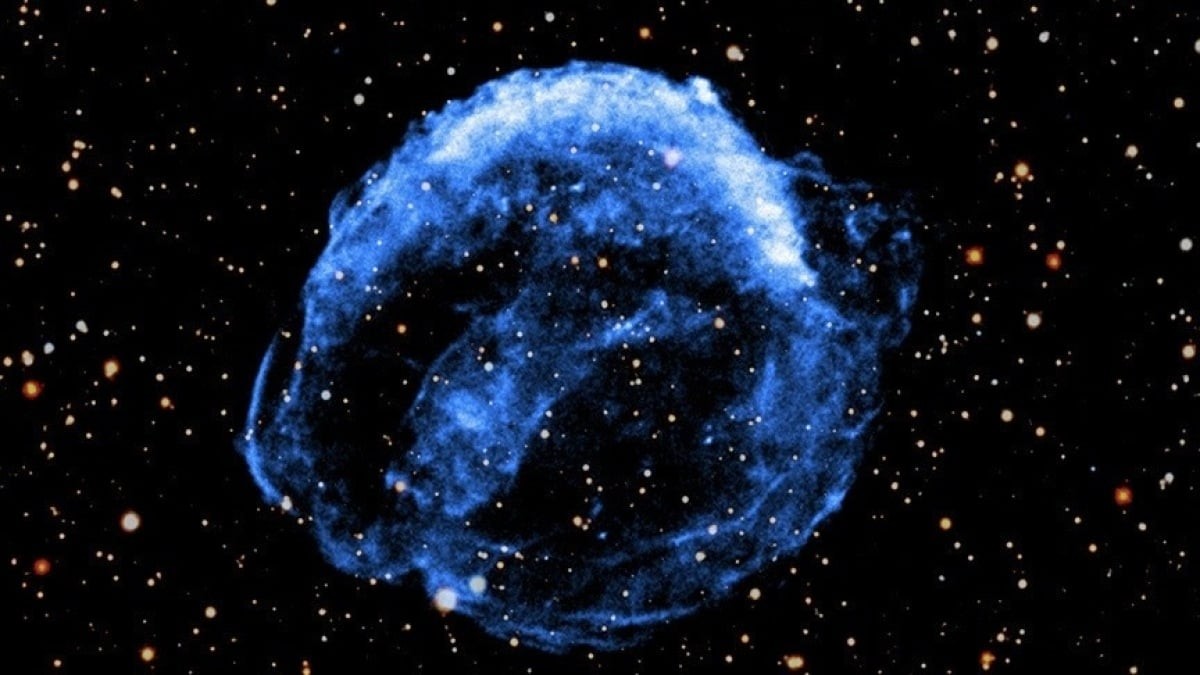
For over four centuries, astronomers have studied the aftermath of a star’s spectacular death – a supernova remnant known as Kepler’s Supernova. Now, using 25 years of data from NASA’s Chandra X-ray Observatory, scientists have compiled the longest X-ray movie of this cosmic event, revealing the shockwave from the explosion racing through space. This isn’t just a stunning visual; it’s a crucial study in understanding how supernovas function and how reliably they can measure the universe’s expansion.
The Legacy of Kepler’s Supernova
First observed in 1604 by German astronomer Johannes Kepler, this supernova lies roughly 17,000 light-years from Earth within the Ophiuchus constellation. While Kepler initially thought it was a new star, we now know it as the radiant aftermath of a stellar explosion. This particular supernova, a Type Ia, is especially valuable to astronomers because of its predictable brightness, making it a key tool for calculating cosmic distances.
Uneven Expansion: A Cosmic Clue
The new time-lapse shows that the expanding shockwave from the supernova doesn’t move at a consistent speed. In some directions, it blasts outward at approximately 14 million mph, while in others, it slows to around 4 million mph. This variation isn’t random; it indicates the explosion is colliding with gas of differing densities. The analogy is straightforward: like a vehicle traveling on clear highway versus rough terrain, the shockwave moves faster through less dense material.
This uneven expansion provides insights into the environment surrounding the star before it exploded. Type Ia supernovas occur when a white dwarf star accumulates matter from a companion star, eventually detonating. The density variations in the shockwave reveal how much material had accumulated around the system before the explosion, effectively mapping the star’s history.
Refining Cosmic Yardsticks
Type Ia supernovas are considered “standard candles” – objects with known brightness that allow astronomers to measure distances in the universe. However, these explosions aren’t perfectly uniform. The study of Kepler’s remnant helps refine how much astronomers can trust these events as cosmic yardsticks by demonstrating that local environments can subtly alter their behavior.
As Jessye Gassel, a George Mason University graduate student, explains, “It’s important that we understand these events because (they help) cosmologists measure the expansion of the universe.” There’s still much to learn about these explosions and the factors that influence them.
A Limited Window
The Chandra X-ray Observatory’s lifespan is finite, meaning astronomers may only have another decade to continue monitoring Kepler’s Supernova. However, future missions like the proposed AXIS X-ray satellite could extend these observations, providing further details about this and other stellar explosions. This study highlights the importance of continued investment in space-based astronomy to unravel the mysteries of the cosmos.
The data from Kepler’s supernova provides a unique laboratory for studying the messy realities of stellar explosions, helping us better understand not just the deaths of stars, but also the fundamental structure and expansion of the universe itself.