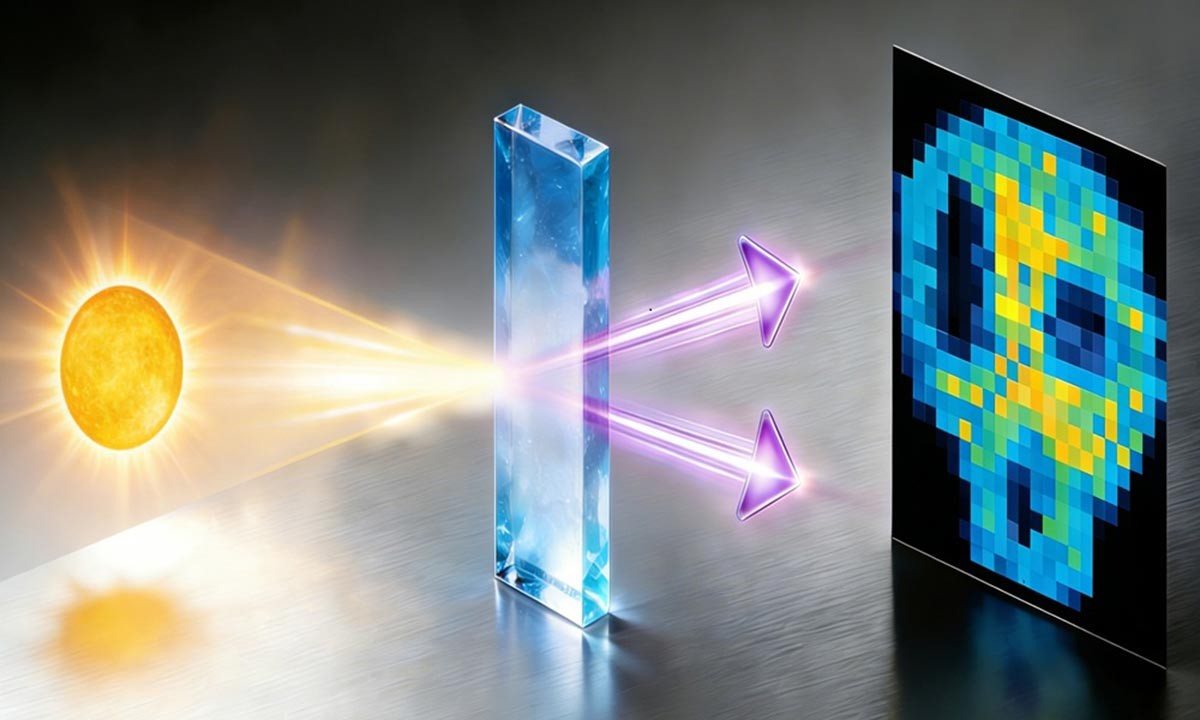
Sunlight works. It actually works. For quantum ghosts.
Most scientists would tell you this is impossible. Quantum optics demands precision. Stability. Lasers. You point a coherent beam into a crystal, it spits out entangled photon pairs via spontaneous parametric down-conversion—SPDC for short—and off you go building strange physics experiments. Sunlight is chaotic. It flickers. The angle changes. Who trusts that mess for something this delicate?
But wait.
Recent findings suggest we were wrong. Or at least, overly rigid. SPDC doesn’t need perfect coherence. Partial coherence does the trick, dragging some quantum properties along for the ride. If the math holds up, maybe the sun can be our pump source too.
Chasing the Star
Xiamen University took the bet.
A team led by Wuhong Zhana nd Lixiang Chen built a rig that uses only sunlight to drive SPDC. No external lasers. No grid power. Just raw solar radiation captured, channeled, and smashed into a crystal.
Here’s how it looks:
- An automatic tracker. Think telescope mount, but dedicated to keeping the sun locked in sight.
- A 20-meter plastic multimode optical fiber. This sucks the light down the shaft, into the dark indoors.
- A periodically poled potassium titanyl phosphate (PPKTP) crystal. This is the workhorse.
Why bother? Why not just buy another laser?
Remote environments. Space. Places where batteries die or generators are heavy liabilities. A passive quantum source that runs on a giant nuclear fusion reactor hanging in the sky sounds inefficient, but it’s robust. It requires no maintenance, just alignment.
Ghosts in the Data
Did it work? Yes. But proving it required a specific test: ghost imaging.
This isn’t about seeing clearly in the dark. It’s a quantum trick where you reconstruct an image using correlations between photons. You never point a camera directly at the object. Instead, you detect one photon from an entangled pair, know where its twin went, and piece together the picture statistically.
The sunlight setup produced pairs with strong position correlation. Strong enough.
- Double-slit test : Passed.
- Complex 2D reconstruction : They made a “ghost face” appear from the data noise.
The numbers speak for themselves. The sunlight system hit 90.7% visibility in ghost imaging. A standard 405nm laser running at the same pump power? 95.5%.
It’s not quite a tie, but it’s uncomfortably close. The broad spectrum of sunlight helps achieve quasi-phase matching in the crystal, churning out those correlated pairs in high volume. Long integration times smooth out the sun’s natural jitter, boosting signal-to-noise ratios until the image pops out clean.
What Now?
This is the first time sunlight-pumped SPDC has successfully generated a ghost image.
It removes the laser. It removes the electrical dependency. What you get is a passive source of correlated photons. Useful? Maybe immediately. Definitely potentially. Think about quantum sensors in space. No power draw means less drag, less heat, more autonomy.
Future upgrades might lean on compressed sensing or machine learning to sharpen the reconstruction, but the proof is already on the table. The sun isn’t just a lamp anymore.
It’s a quantum pump.
And that’s weird, in the best possible way.
Reference : Ye Xing et al., “Sunlight-excited spontaneous parametric Down-Conversion for ghost imaging,” Advanced Photonics (April 2026).