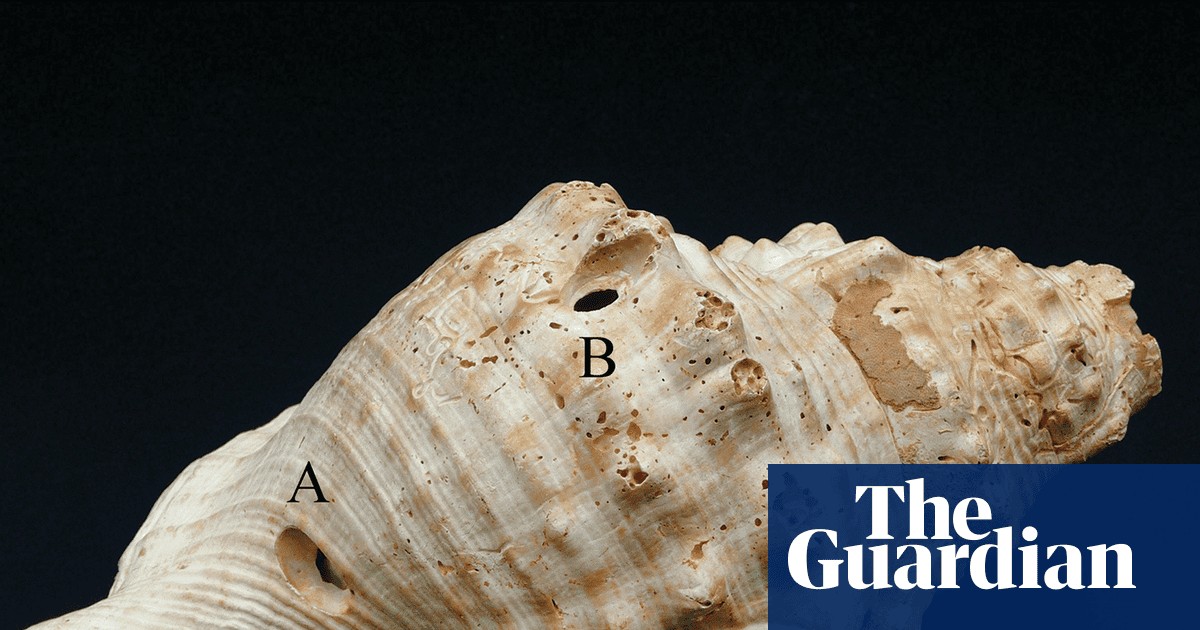
Archaeological findings in Catalonia, Spain, suggest that some of the oldest musical instruments ever discovered may have been used for both communication and artistic expression nearly 6,000 years ago. Researchers have identified twelve large shell trumpets found in Neolithic settlements and mines, dating back to the late fifth and early fourth millennia BC. These instruments, crafted from Charonia lampas sea snails, offer a rare glimpse into the soundscapes of ancient Europe.
The Discovery and Its Implications
The shells were not used for food—the snails had already died before being collected—and modifications, like removing the pointed tip, confirm their use as trumpets. Modern experiments conducted by archaeologist Miquel López García, a professional trumpet player, prove they produce a “powerful, stable tone” akin to a French horn. This isn’t just about instruments; it’s about early human communication and possibly, the origins of music itself.
The discovery challenges our understanding of how prehistoric societies interacted. The shells could have facilitated long-distance communication between communities or within mining operations, where six were unearthed in variscite mines. The fact that similar shells were used for warning systems as recently as the mid-20th century, as evidenced by García’s family tradition in Almería, highlights the instrument’s remarkable longevity.
Beyond Utilitarian Function: An Ancient Musical Heritage
The shells’ musical potential extends beyond simple signaling. By manipulating airflow and hand positioning, researchers found they could alter tones and timbres, suggesting improvisation and nuanced sound exploration. This pushes the idea of prehistoric music beyond mere utility; these instruments could have served expressive, artistic functions, fostering social bonds and emotional expression.
This isn’t an isolated phenomenon. The Marsoulas Cave in France yielded an 18,000-year-old shell trumpet with identical characteristics, suggesting a continuous tradition spanning millennia. The Catalan shells, like their Paleolithic predecessor, display “expressive qualities” hinting at broader musical applications.
The Bigger Picture: Why This Matters
The study raises fundamental questions about the origins of music. Was early musical expression purely utilitarian—a survival tool—or did it stem from deeper human needs for connection, emotion, and self-expression? The shells suggest that perhaps both played a role. These ancient instruments weren’t just tools for survival; they were among the first sound technologies humans ever developed, with the ability to shape vibrations in a manner similar to modern brass instruments.
These findings underscore that music isn’t a modern invention but a deeply ingrained human practice, evolving alongside our societies for tens of thousands of years. The echoes of these ancient shell trumpets remind us that the need to create, communicate, and express ourselves through sound is an enduring part of what makes us human.