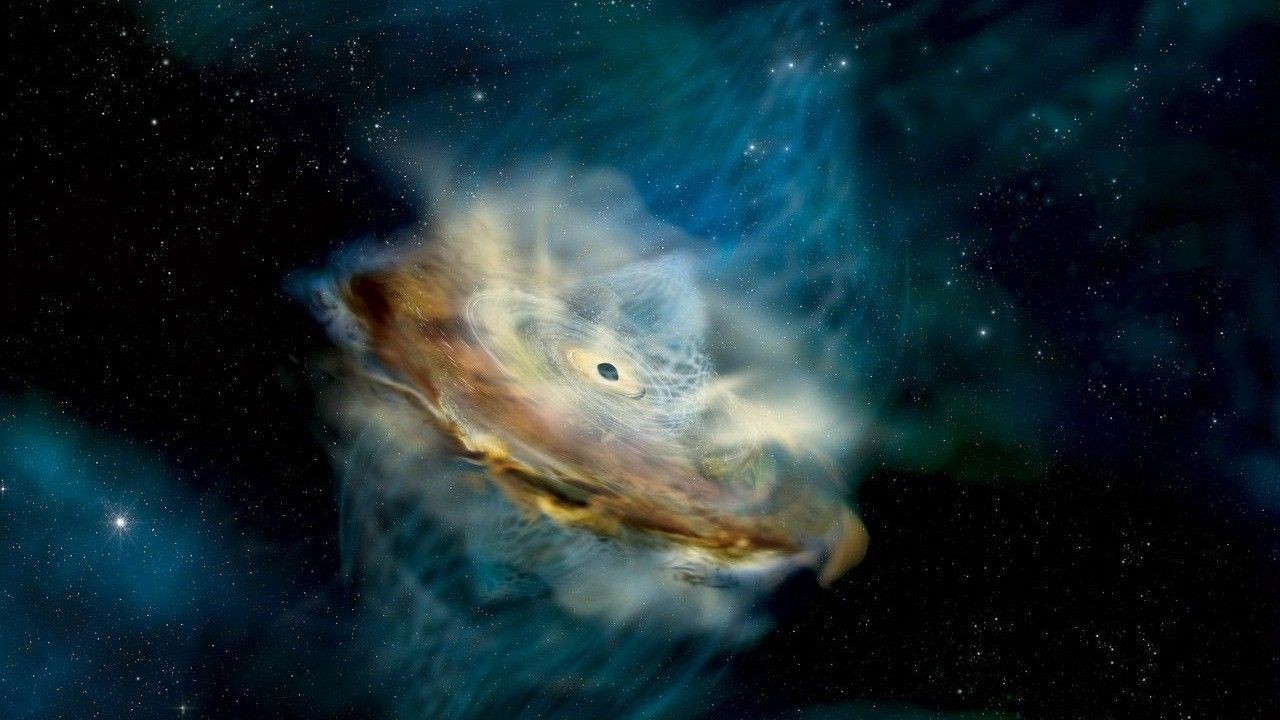
A newly observed black hole from the early universe is challenging established astrophysical models by exceeding predicted growth rates and simultaneously exhibiting unexpected radiation patterns. The object, designated ID830, is a supermassive black hole (SMBH) that existed when the universe was just 15% of its current age, already weighing in at 440 million times the mass of our Sun. This discovery raises fundamental questions about how these colossal entities formed so quickly.
The Eddington Limit and Super-Eddington Growth
Black holes are known for their insatiable appetites, but their growth is theoretically constrained by the Eddington limit. This “speed limit” dictates that the outward pressure from radiation emitted by infalling matter should eventually halt further accretion. However, ID830 appears to be consuming matter at 13 times the Eddington limit – a feat previously thought impossible for sustained periods.
Researchers propose several mechanisms to explain this super-Eddington growth. One possibility is that the black hole undergoes brief, intense feeding spurts, rapidly ingesting gas and dust before radiation pressure builds. Another suggests that material is consumed from the black hole’s equator while radiation is expelled from its poles, bypassing the usual limitations.
The Unexpected Combination of Radio and X-Ray Emissions
What makes ID830 even more peculiar is that it emits both intense X-ray and radio waves at the same time. Current models predict that super-Eddington accretion should suppress radio emissions. This contradiction suggests that the underlying physics of extreme accretion and jet formation are not fully understood. The black hole’s corona—a turbulent, billion-degree cloud of particles orbiting at near light speed—is thought to generate the X-rays, while powerful magnetic fields launch the radio jets.
Implications for Early Universe SMBH Formation
The existence of ID830 supports the idea that SMBHs grew much faster and earlier in the universe than previously assumed. The James Webb Space Telescope has already revealed unexpectedly massive black holes from this era, and ID830’s behavior helps reconcile those observations with theoretical models.
One leading hypothesis posits that the first generation of stars, known as Population III stars, collapsed to form massive black hole “seeds” of over 1,000 solar masses. Even with these seeds, reaching the observed sizes would require prolonged, rapid accretion. The discovery of ID830 suggests that these periods of super-Eddington growth may have been more common than scientists thought.
The Prevalence of Extreme Quasars
Preliminary data suggest that quasars like ID830—those capable of exceeding the Eddington limit and displaying both radio and X-ray emissions—may be far more numerous in the early universe than predicted. Models previously estimated that only 10% of quasars have powerful radio jets, but this new research suggests that such energetic objects could be significantly more abundant, reshaping our understanding of galaxy evolution.
The behavior of ID830 demonstrates that the universe still holds surprises. Its existence forces us to reconsider the standard models of black hole growth and early galactic evolution, suggesting that extreme feeding and excretion phases may have been a common feature of the cosmos in its infancy.