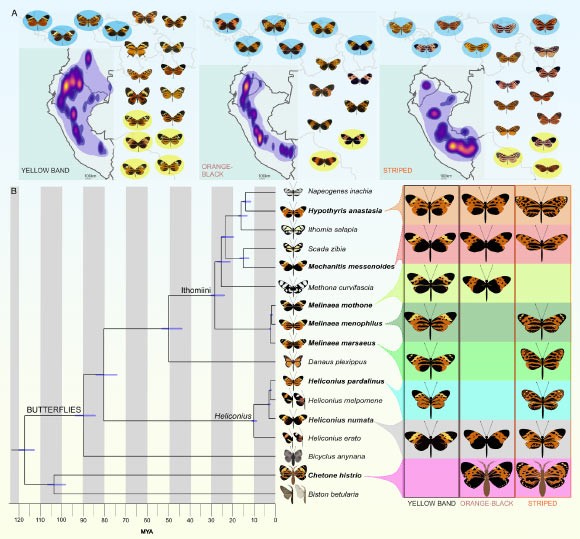
Convergent evolution—the phenomenon where unrelated species independently develop similar traits—is often viewed as a series of happy accidents. However, a landmark study reveals that this process is far more predictable than previously thought. Researchers have discovered that butterflies and moths have relied on the exact same genetic “toolkit” to evolve warning color patterns for over 120 million years, suggesting that nature follows a consistent, repeatable script rather than rolling the dice every time.
The Power of Mimicry
In the lush rainforests of South America, survival for many insects depends on visibility. Species such as certain butterflies and day-flying moths are toxic or distasteful to predators like birds. To survive, they display bright, distinct wing patterns that serve as a warning: “Do not eat me.”
This strategy, known as Müllerian mimicry, creates a shared visual language. When multiple toxic species look alike, predators learn the warning signal faster and avoid all species sharing that pattern. Consequently, there is intense evolutionary pressure for these unrelated insects to converge on the same color schemes. But how do distinct lineages, separated by millions of years of evolution, arrive at the same visual solution?
A Consistent Genetic Script
To answer this, a team of researchers from the University of York and the Wellcome Sanger Institute analyzed the genomes of seven distantly related butterfly lineages and one day-flying moth. Despite their evolutionary distance—diverging since the time of the dinosaurs—the study found a striking genetic parallel.
All the species studied reused the same two genes, ivory and optix , to control their wing coloration. Crucially, the mutations did not occur within the genes themselves. Instead, the changes happened in the regulatory “switches” that turn these genes on or off. This allows the insects to tweak their color patterns without disrupting other essential biological functions.
Even more remarkable was the discovery in the moth species. It utilized a large chromosomal inversion—a segment of DNA flipped backwards—to control its coloration. This is the same genetic mechanism used by one of the butterfly lineages. As Professor Kanchon Dasmahapatra of the University of York noted, this demonstrates that “evolution can be surprisingly predictable,” with species using identical genetic tricks repeatedly over deep time.
Why This Matters for the Future
This finding shifts our understanding of evolution from a chaotic, random process to one that is constrained by specific genetic pathways. When developmental pathways are limited, nature tends to reuse existing solutions. This “gene reuse” is particularly common when species face similar environmental pressures, such as the need to deter predators or adapt to heat stress.
“Trait convergence in different species can be caused by genetic changes at different genes or the same gene… Where genes are reused, convergence may result from independent mutations at the same gene or because the same alleles are reused,” the researchers explained.
Understanding these predictable patterns is not just an academic exercise; it has practical implications for conservation and climate science. If evolution follows a recognizable script, scientists may be better equipped to predict how species will adapt to rapid environmental changes, such as shifting climates or new diseases. It suggests that some species may have inherent genetic capacities to adapt, while others might lack the necessary “toolkit” to survive.
Conclusion
The discovery that butterflies and moths have used the same genetic switches for 120 million years underscores the predictability of evolution. By identifying these conserved genetic pathways, researchers have moved closer to understanding the rules that govern life’s diversity, offering new insights into how nature responds to the challenges of survival.