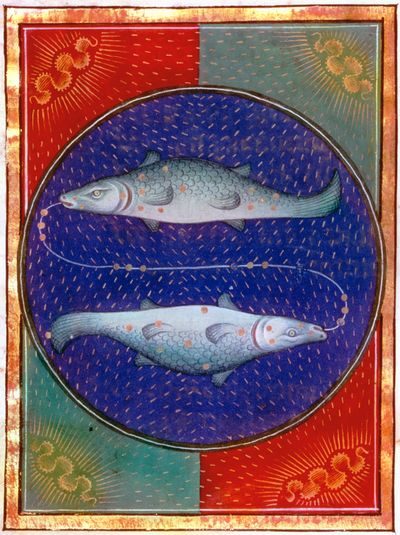
Pisces is not a constellation you discover by accident. There are no bright, easy-to-find stars like Orion or the Big Dipper. Instead, it hangs as a subtle, faint outline in the northern sky, quietly hidden between Aries and Aquarius. For most stargazers, it’s a ghost in the night. But astronomically, it is far from insignificant.
The constellation is about one hour in right ascension and fifteen degrees north declination. This jargon simply indicates its location on the sky map. More importantly, the vernal equinox happens here. This is the special point where the Sun’s apparent path crosses the celestial equator and moves from south to north. It is the starting line for measuring the longitude of the sky and the right ascension. Without this Pisces anchor point, our entire sky mapping coordinate system would lack a fixed reference.
The dim stars of Pisces
If you’re looking for a dramatic asterism, you won’t find it in Pisces. The stars here are dim. There is no discernible grouping, no bright beacon to guide your gaze. The brightest star in the entire constellation is Eta Piscium, and it also only shines at magnitude 3.6. In the night sky, it is barely above average. You need requires dim skies and patient eyes.
However, this lack of brilliance does not diminish its importance. The vernal equinox is within its boundaries. This single fact makes pisces the cornerstone of observational astronomy. It is the zero point of the sky coordinates. Every time astronomers observe a star, planet, or galaxy, they measure its position relative to that point in Pisces.
The vernal equinox, the point where the Sun’s apparent annual path passes north of the celestial equator, is in Pisces.
Why is the weak constellation important? Because it anchors the sky. Without it, navigation, timekeeping and sky mapping would falter. Stars may be dim, but their role is structural. It’s a reminder that not everything important is loud. Sometimes the most critical items are the ones that are hard to find.
The precession of the equinox slowly moves this point away from the zodiac sign of Pisces to Aquarius. We are in transition. Technically speaking, the era is changing. But for now, the equinox still rests here. The coordinate system still relies on it. The sky is a clock and Pisces holds the hands.
The myth behind the signs
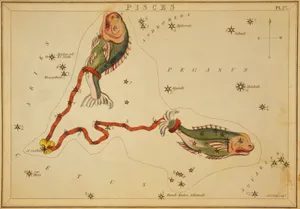
Astrology places Pisces at the end of the zodiac cycle, the twelfth and last sign. It usually governs the window between February 19th and March 20th. But what does the symbol actually mean? Two fish tied together with string isn’t just a random doodle. It comes straight from Greek mythology.
According to one version of the story, Aphrodite (Venus) and her son Eros (Cupid) fled from the monster Typhon. They jumped into the river to survive. In order not to get lost in the water or separated, they turned into fish. A cord tied them together so they could swim safely as a pair.
Another variation says they haven’t changed. Instead, two real fish carried them to safety.
In any case, the image is about connection. Survival through union. The duality of the sign.