


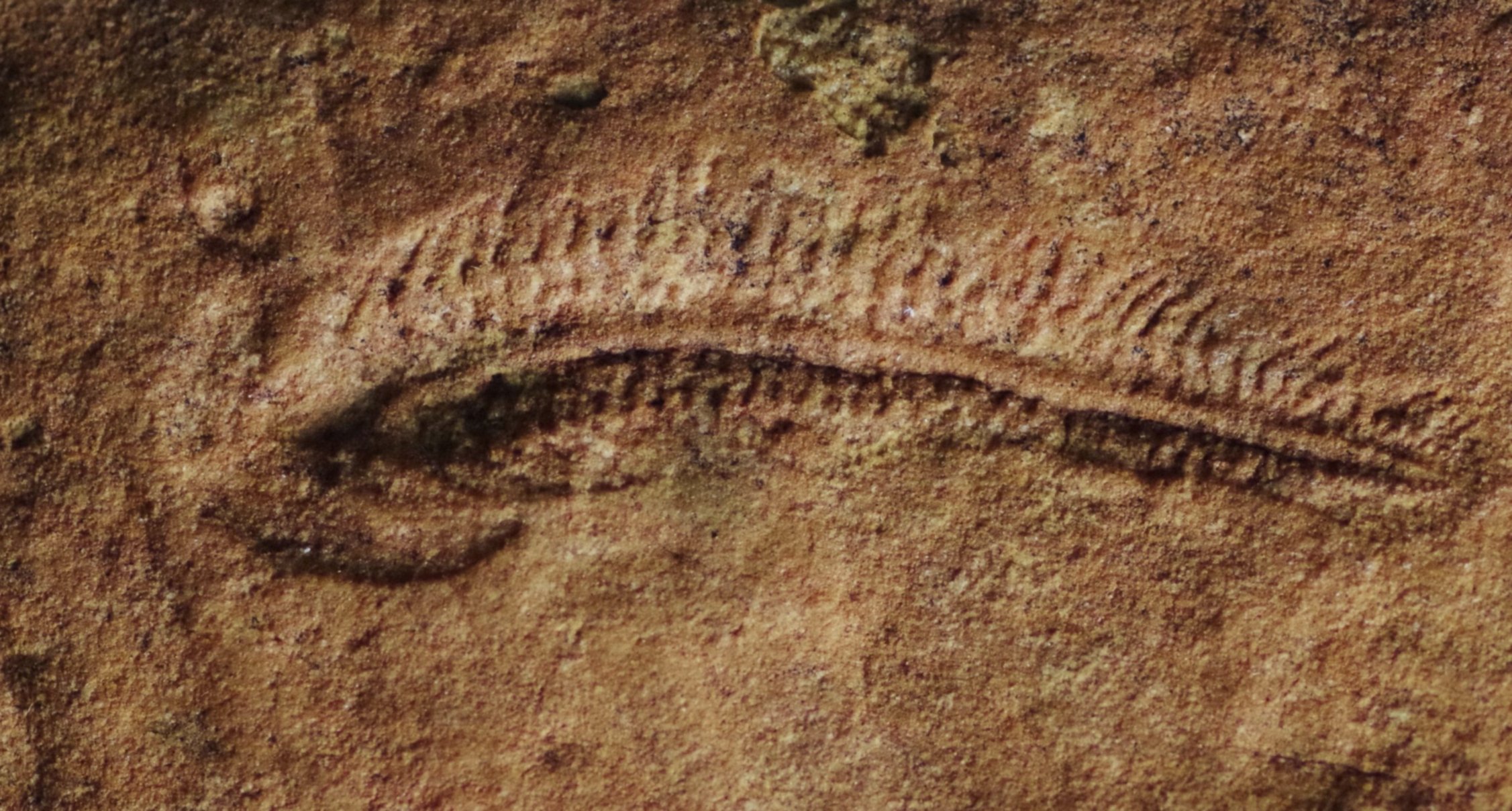
Most people associate handedness with holding a pen. Or kicking a soccer ball. But a new study suggests that Spriggina floundersi had a preferred direction long before humans learned to throw things.
This small, flattened creature lived over 550 million years ago on the ancient seafloor. It bent its body to the right. Repeatedly.
That tiny bias might be the oldest known example of lateralized behavior in the fossil record. It pushes the roots of “handedness” back to the Ediacaran Period. Long before most familiar animal groups existed.
The Oldest Right-Handed Animal
The research, published in Scientific Reports, was led by scientists from the American Museum of Natural History, Harvard, Florida State University, and UC Riverside. They examined fossils of Spriggina. These creatures show bilateral symmetry. Front. Back. Left. Right. Top. Bottom. You share this plan.
The team looked at how these fossils curved. Random chance usually means a mix of left and right curves. Instead, they found a population-wide pattern.
“When we talk about being right-or-left-handed… our research shows that an animal without hands… may have had its own version.”
— Scott Evans, lead author and assistant curator at the American Museum of Natural History
Spriggina is the state fossil of South Australia. It honors Reg Sprigg. He recognized the Ediacara biota’s importance over 75 years ago in the Australian outback.
Where and How Did This Happen?
The evidence comes from Nilpena Ediacara National Park and nearby areas in South Australia. Storms buried seafloor communities rapidly. They were preserved for roughly 550 million years. This rare fossil record offers a detailed look at life during a major transition.
Microscopic organisms. Then larger, multicellular bodies. Capable of movement. Capable of complex behavior.
To determine if Spriggina favored one side, researchers studied over 100 specimens. They came from Nilpena and the South Australia Museum in Adelaide.
The analysis wasn’t straightforward. The fossils are mirror-image impressions. Rock preserves the back. Not the animal itself. So, what looks like a left curve in stone was actually a right bend when the animal was alive.
Roughly twice as many fossils showed left curves. Once they flipped the data to account for the mirror effect, the pattern became clear. Living Spriggina bent to the right about twice as often as left.
Why It Matters for Evolutionary Biology
This wasn’t random. The preference appeared across the population. Thus, it wasn’t just individual quirks. It suggests a neurological trait.
Lateralized behavior in living animals—octopi, birds, mammals, insects—is tied to complex nervous systems. It indicates organized sensory processing. If Spriggina did this, its brain (or nerve net) might have been more advanced than its simple body shape implies.
“Spriggina may therefore be the oldest-known animal to show population-wide handedness,” says coauthor Mary Droser.
It challenges the assumption that such traits are recent evolutionary developments. Some of our most basic instincts have incredibly deep origins.
The study includes lead author Scott D. Evans and colleagues Jenson Webb, Ian V. Hughes and William Parker. Mary L. Droser also contributed. The work received partial support from a NASA Exobiology grant.
Did this right-bend help Spriggina navigate predators? Hunt prey? Avoid the current? The paper doesn’t say.
It just proves that even half a billion years ago, some creatures had their own way of doing things. Right.


