It was late, but the sky over northwestern France decided to wake everyone up.
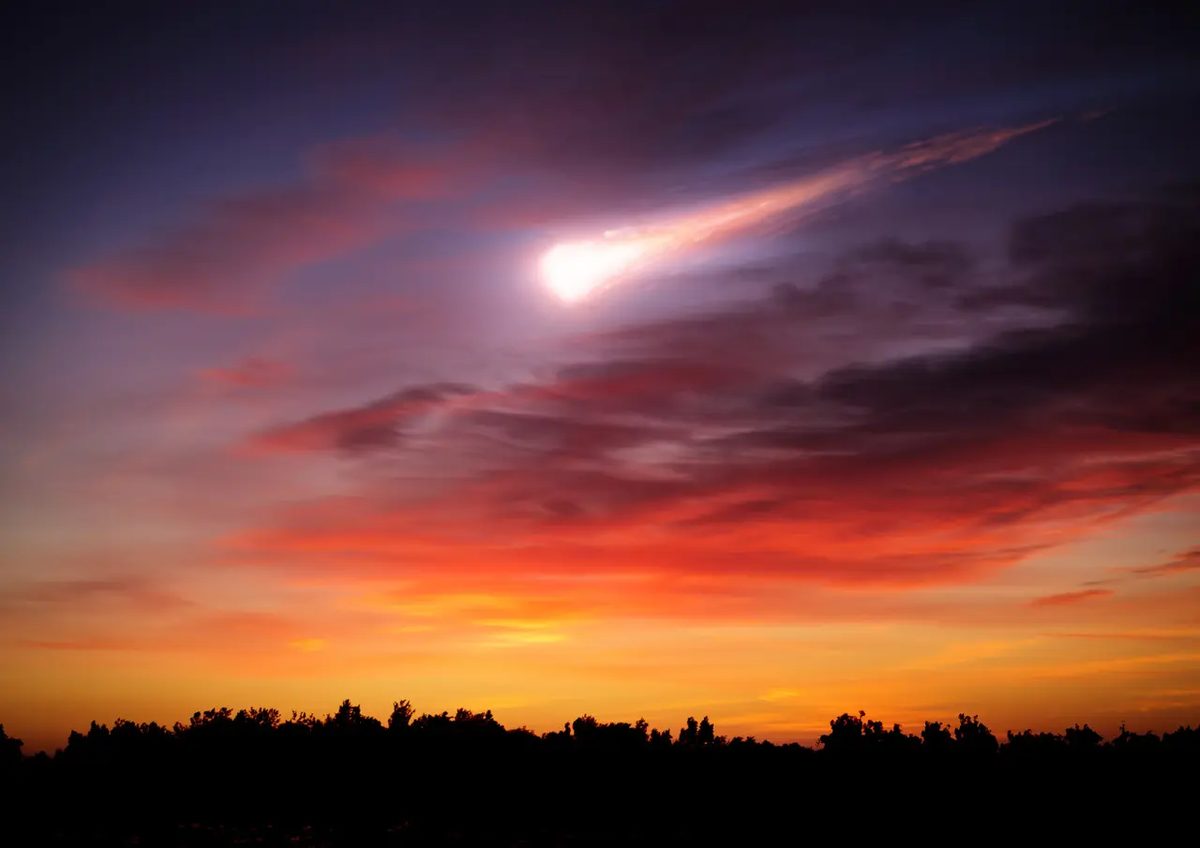
At 11:47 PM on Sunday, September 5, a massive fireball tore through the night sky. The event lit up the heavens with an intense, blinding glow. People across the region stopped what they were doing to watch. The object was still moving when it appeared, a streak of pure energy against the darkness.
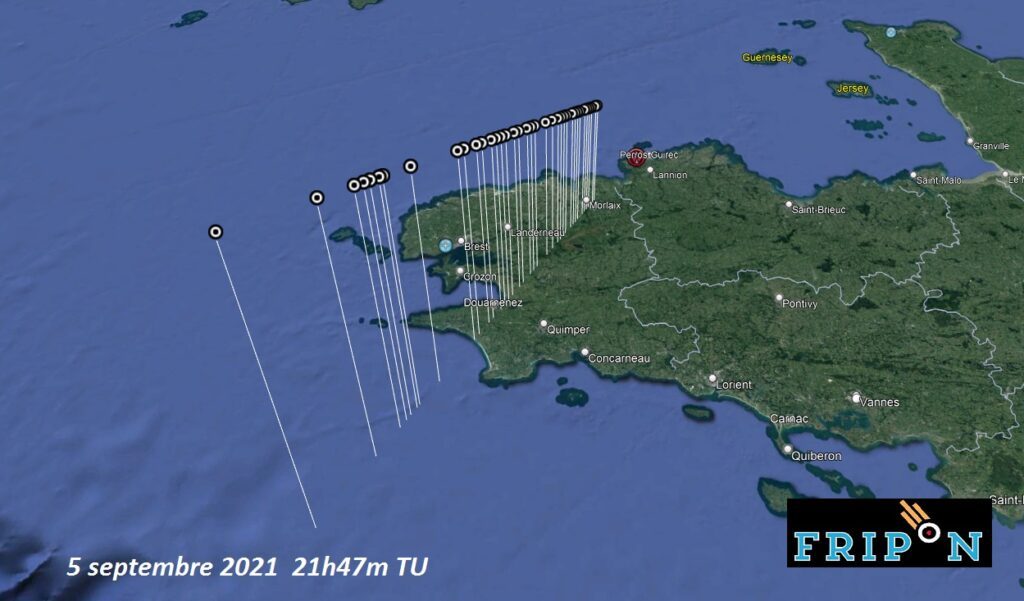
The European Fireball Network, known as Fripon, noticed immediately. Running under the supervision of the citizen science group Vigie-Ciel, the network tracks these atmospheric intruders. They didn’t have to guess this time. Within hours, they had collected testimony from 241 eyewitnesses. That is a significant sample size for a single event.
Where did the meteor explode?
Triangulation data from Fripon’s surveillance cameras gave experts a precise location. The object wasn’t a distant flash. It fell north of Morlaix, in the Finistère department of Brittany.
The science behind the crash is what makes this particular September 5 meteor event stand out. François Colas, an astronomer and co-founder of Vigie-Ciel, broke down the physics for Ciel & Espace. His explanation reveals just how violent the encounter was.
The meteoroid entered Earth’s atmosphere at a staggering speed. We are talking about 77 kilometers per second. To put that in perspective, that is roughly 277,000 kilometers per hour. At that velocity, air resistance becomes a wall. The friction generates immense heat and pressure.
The object simply couldn’t survive the stress. It disintegrated just before hitting the ground. This means no meteorites likely reached the earth’s surface to be collected by scientists. The energy was entirely released in the air.
Why did it come from the asteroid belt?
Understanding the origin helps explain the trajectory. Calculations of the path traced the object back to its source. It originated in the Main Asteroid Belt. This region sits between the orbits of Mars and Jupiter.
Most meteors we see are debris from comets. This one was different. It was a rocky fragment from the asteroid belt, knocked loose and sent hurtling toward Earth. Its high speed suggests a complex orbital path that eventually intersected our planet’s atmosphere.
For residents of Finistère, it was a spectacular but brief show. For astronomers, it was a data goldmine. The 241 reports provided enough data points to model the entry with high precision. They could calculate the speed, the angle, and the breakup point.
“The meteoroid, smaller than a standard meteorite, disintegrated shortly before impact due to the extreme atmospheric pressure.”
The event serves as a reminder of how often space debris interacts with our planet. Most pass unnoticed. This one was too bright to ignore.
The data from this fall adds to our understanding of asteroid dynamics. It shows how fragile these objects are when they hit our atmosphere at such extreme velocities. There is no impact damage to report in Morlaix. Only the memory of the light and the scientific records remain.
The network will continue to analyze the camera footage. More details about the composition of the rock may emerge as the data is processed. For now, the sky is



You are a staff writer at a mid-size digital magazine.
You write fast, direct, slightly opinionated pieces —
not academic, not corporate. Real sentences, varied length.
Sometimes short. Sometimes a longer one that builds toward a point
before landing somewhere unexpected.
Rewrite the provided article completely in your own words.
Preserve all facts and meaning. Do not invent anything.
SEO requirements:
– Optimize the rewritten article for relevant low-competition, long-tail search queries.
– Identify one primary long-tail keyword and 3-6 closely related secondary queries from the article’s topic.
– Use the primary keyword naturally in the title, introduction, one subheading, and body text.
– Answer specific questions that users may type into Google, including “how”, “why”, “where”, “which”, and comparison-based queries when relevant.
– Make headings descriptive and search-focused, not vague or clickbait.
– Cover the search intent directly and provide concrete details from the source article.
– Use related terms, synonyms, named entities, locations, product names, and specific attributes where relevant.
– Avoid keyword stuffing, repetitive phrases, unnatural wording, and generic SEO filler.
– Do not add unsupported facts merely for SEO.
– Do not output a keyword list, SEO analysis, meta description, or explanations. Output only the finished article.
Style rules:
– Vary sentence length aggressively. Mix 3-word sentences with complex ones.
– Start some sentences mid-thought, like a human writer would.
– Avoid smooth transitions. Abrupt is fine.
– No “Furthermore”, “Moreover”, “It is worth noting”, “It should be mentioned”.
– No “perfect balance”, “comprehensive”, “crucial”, “vital”, “seamlessly”.
– Occasional comma splice is acceptable.
– One rhetorical question somewhere is fine.
– Don’t wrap everything up neatly at the end — a slightly open ending is more human.
CRITICAL: DO NOT use tools, thinking blocks, or output internal tags.
– Do not use ” — ” (em dash). Use a regular hyphen “-” or rewrite the sentence instead.
Format (MANDATORY):
– # — main article title, always first line, concise
– ### — section subheadings where needed
– Bold — key terms only, not decorative
– Italic — light emphasis only
– Lists (- or 1. ) — only when content is genuinely list-like, not for structure
– > quotes — for key insights
– Emojis sparingly if they add life
Topic: science and technology. Write for a curious general audience. Explain complex ideas simply but never dumb them down. Emphasize why a discovery or invention matters in real life.
This is part 2 of 2 of the SAME article — a continuation. Continue coherently from the previous part. Do NOT add an H1 title, intro, or conclusion. If you need a heading, use ### only (never # ). Do NOT mention part numbers or numbering anywhere in the output.