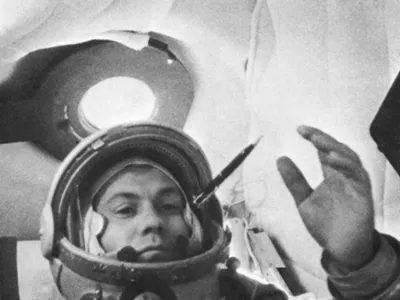
Pavel Popovich did not start in a laboratory. He started with livestock.
He was born in Uzin, Ukraine in 1930 and spent his childhood as a herdsman in the U.S.S.R.. This background may seem coincidental, but it defines the kind of grit to go into space. In 1951, he moved to Magnitogorsk, Russia, graduated from technical school, and then joined the army. He joined the Air Force. Graduated from the Stalingrad Air Force Academy in 1954. He became a pilot.
Then the Great Leap began. In 1960, Popovich became one of the first men selected to cosmonaut training.
His glory came on August 12, 1962. He piloted the Vostok 4 spacecraft. This is not just a solo flight. This is a historic maneuver. Andriyan G. Nikolaev had launched a day earlier on Vostok 3.
Together they became the first two men to go into space at the same time.
The spacecraft came within 5 kilometers apart. It is about 3 miles. It’s a tense, silent dance on the edge of the atmosphere. Vostok 4 landed on August 15, 1974. Wait. No. August 15, 1962.
Why is this important today? Because it showed that humans can operate in proximity. It shows that the space is not just a destination for one person at a time. It’s a neighborhood.
Popovich later returned to the stars. In July 1974, he took command of Soyuz 14. He flew with flight engineer Yury P. Artyukhin. They docked with Salyut 3. This is not a tourist hotel. This is a military space station that had placed in orbit on June 25.
Their mission lasted 15 days. They spent that time looking down. They conducted reconnaissance of the Earth’s surface. They mapped the Earth from above.
After his space career ended, Popovich stayed in the loop. From 1980 to 1989, he was deputy chief of the Yuri Gagarin Cosmonaut Training Center in Star City near Moscow. He retired as an active cosmonaut in 1982.
He died on September 30, 2009 in Gurzuf, Ukraine. At the time of his death, he was the chairman of the All-Russian Institute of Agricultural Photography and Geometry.
The herdsman had moved on to map their land from space.
The transition from tending cows to tending the space station was not smooth. It’s jagged. It requires a specific kind of focus. Popovich had it.
We often think of space exploration as a series of lone heroes. Popovich and Nikolaev proved that it can be a team effort. They touched each other from a distance. They checked in and went home.
The technology behind the Vostok 4 was primitive by today’s standards. The controls are manual. There is little room for error.