


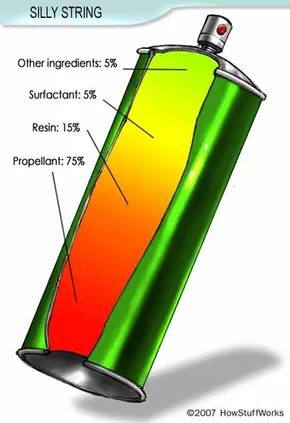
Silly String might look like harmless fun, but the chemistry inside that bright plastic can is surprisingly complex. About 75 percent of the liquid in a standard can is propellant. You release this gas every time you press the nozzle. This high percentage of gas creates issues that go far beyond just making a mess at a party.
Regulators have watched this product closely since its early days. The original propellants used in Silly String were ozone-depleting substances. That fact drew the attention of the United States Environmental Protection Agency and other bodies. Regulations issued in the 1970s and 1980s specifically named Silly String to prohibit its use of certain harmful chemicals.
How Aerosol Safety Evolved Over Time
CFCs and hydrochlorofluorocarbons (HCFCs) are now banned for non-essential applications. Manufacturers had to find alternatives. This shift didn’t eliminate all problems. In 1989, regulators found banned substances in Silly String sold at Woolworths in the United Kingdom. Authorities also spotted CFC-containing spray string in Canada in 2002.
The problem wasn’t just overseas. In September of 2006, the EPA learned that five American companies were selling spray string containing banned HCFCs. These cans had been imported from China and Taiwan. Authorities believe most of the ozone-depleting compounds had already escaped into the atmosphere before anyone noticed. Once the EPA discovered the violation, they confiscated the remaining cans. They incinerated the products using a procedure designed to destroy the HCFCs.
Flammability and Physical Dangers
The high propellant content gives Silly String two seemingly opposite hazards. Some propellants are highly flammable. Others become so cold when leaving the container that they can freeze a person’s skin. Most can labels include warnings about specific precautions. Many specify to avoid heat and open flames.
Some formulations have been dangerous enough to cause widespread concern. The United States Consumer Product Safety Commission issued a recall for a variety of spray string in 1990. The recalled products used a highly flammable propellant.
Why Cities Ban Silly String
Municipal authorities worry about Silly String for practical reasons. Sprayed string creates a significant mess. Several cities have banned its use during celebrations. Parades and holidays like Halloween are common targets for these bans.
The strands are essentially sticky plastic. They are hard to remove from concrete and brick. Worse, they can clog storm drains. They also take up valuable space in landfills.
Its long-lasting popularity makes it unlikely that safety or environmental concerns will cause it to disappear from shelves anytime soon. The chemistry is messy. The cleanup is messier. But the product remains a staple of pop culture.

