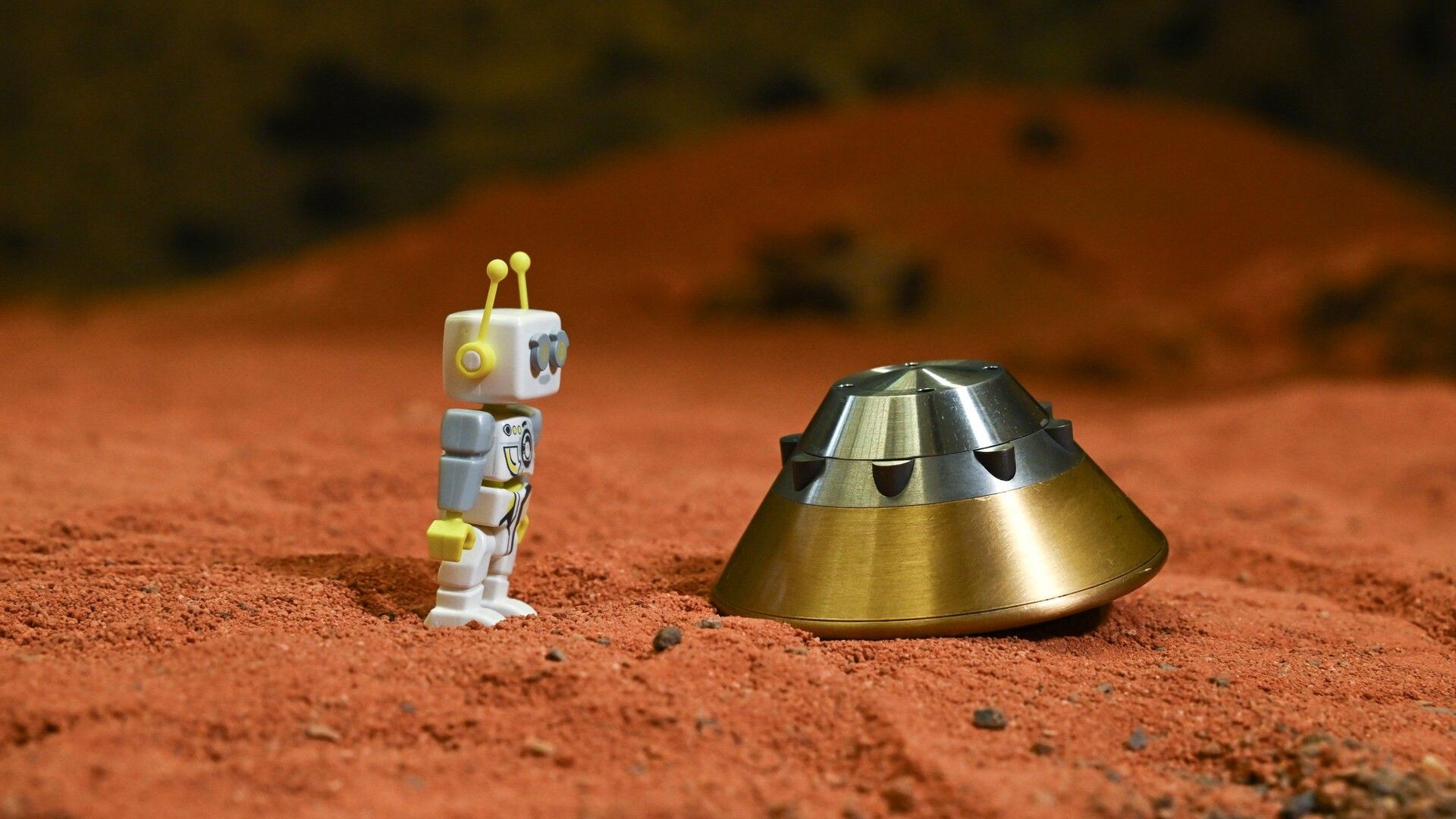
The European Space Agency (ESA) has completed a dramatic series of high-speed tests that look more like action movie stunts than scientific research. In preparation for its upcoming ExoMars mission, engineers launched 20 miniature capsules out of a specialized bore gun at speeds exceeding 2,600 mph (4,200 kph) —nearly four times the speed of sound.
While the scale is small, the stakes are high. These tests are a critical step in validating the technology required to safely land the Rosalind Franklin rover on the surface of Mars, a mission currently targeted for launch in 2028.
Testing the “Entry, Descent, and Landing” Phase
The core challenge of any Mars mission is not just reaching the planet, but surviving the journey through its atmosphere. To address this, ESA developed the Entry Descent and Landing Module (EDLM). Before building the full-scale version, engineers needed to verify that the aerodynamic design could withstand the extreme forces of entry.
To do this, they created 3-inch-wide scale models of the capsule. Each model was equipped with sensitive electronic circuits designed to monitor flight dynamics in real time. The capsules were fired into a specialized test chamber, mimicking the supersonic conditions a spacecraft would encounter as it plunges through the Martian atmosphere.
During these brief flights—covering approximately 755 feet (230 meters) —the sensors captured vital data regarding:
* Acceleration profiles
* Trajectory stability
* Aerodynamic movement
Why This Matters: Surviving 17,000 G-Forces
The significance of these tests lies in the sheer physical stress placed on the hardware. Despite their toy-like appearance, these miniature capsules withstood acceleration forces of nearly 17,000 g. For context, a typical fighter jet pilot might experience 9 g before losing consciousness; these capsules endured nearly two thousand times that force without structural failure.
This data is crucial because landing on Mars is notoriously difficult. The planet’s thin atmosphere provides little braking power, requiring spacecraft to rely on complex heat shields and parachutes to slow down from supersonic speeds. Any flaw in the aerodynamic design can lead to catastrophic failure, as seen in previous mission attempts.
“It is no small feat to launch something to another planet and have it survive the harrowing downward trip through that world’s atmosphere, all while keeping delicate instrumentation intact.”
A Critical Step for ExoMars
The ExoMars mission represents a major leap for European space exploration. The Rosalind Franklin rover is designed to drill deep into the Martian soil to search for signs of past or present life. However, the rover’s scientific potential is entirely dependent on its safe delivery.
By successfully testing these micro-models, ESA has gathered essential validation data that reduces the risk for the full-scale EDLM. These “micro launches” serve as a cost-effective and efficient way to identify potential aerodynamic issues early in the development process, ensuring that when the actual mission launches in 2028, the landing sequence is as robust as possible.
Conclusion
The successful firing of these 20 miniature capsules marks a significant engineering milestone for the ExoMars program. By subjecting scaled models to extreme supersonic conditions and massive g-forces, ESA has confirmed the aerodynamic viability of its landing module design, bringing the agency one step closer to safely delivering its next-generation rover to the Red Planet.