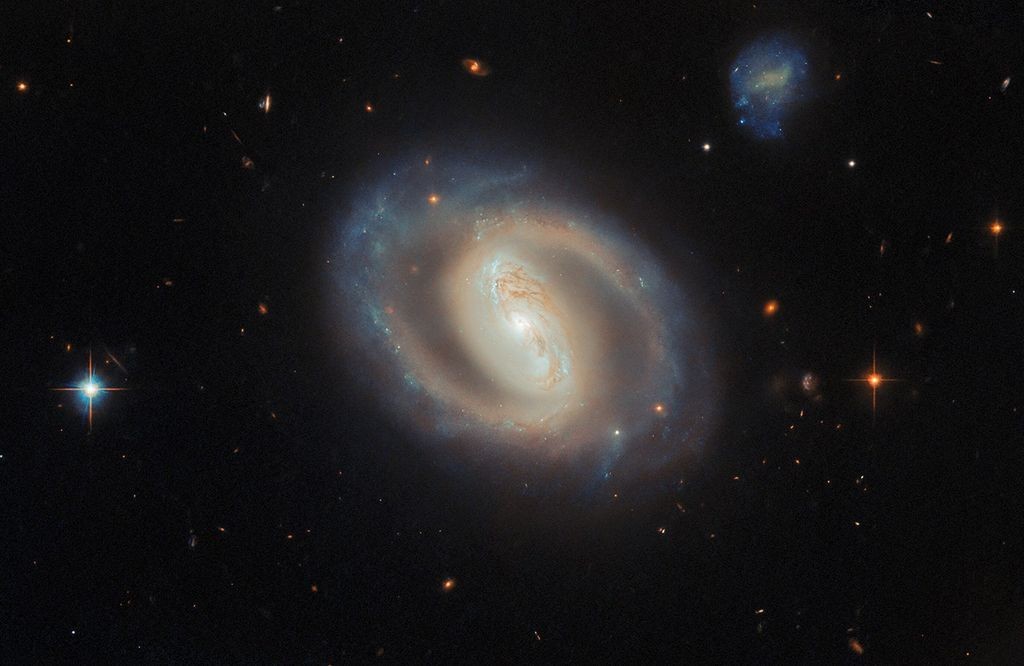
The Hubble Space Telescope has captured a stunning new image of IC 486, a barred spiral galaxy that appears to drift through the void with a delicate, almost otherworldly radiance. Located approximately 380 million light-years from Earth near the constellation Gemini, this celestial object offers both aesthetic beauty and profound scientific insight.
The Anatomy of a Barred Spiral
IC 486 is classified as a barred spiral galaxy. While many galaxies feature arms that curve directly from a central core, a barred spiral possesses a linear, bar-shaped structure of stars running through its center. From the ends of this “bar,” the characteristic spiral arms extend outward into space.
This structural feature is more common than one might expect; astronomers estimate that roughly two-thirds of all observed spiral galaxies possess this central bar. These bars are thought to play a crucial role in galactic evolution, acting as funnels that channel gas toward the center, fueling star formation and the central black hole.
A Core of Intense Activity
Beyond its “gossamer” appearance, the image reveals a much more violent reality at the heart of the galaxy. The bright, white glow at the very center marks the presence of an Active Galactic Nucleus (AGN).
An AGN is a region surrounding a supermassive black hole that is actively consuming vast amounts of matter. As this material falls toward the black hole, it heats up and emits intense radiation, making the center of the galaxy shine much brighter than the surrounding stars.
Why This Observation Matters
Images like this serve as more than just cosmic art; they are vital tools for understanding the lifecycle of galaxies. By studying the structure of IC 486, astronomers can:
– Analyze star formation rates: The density and brightness of the spiral arms indicate where new stars are being born.
– Study black hole dynamics: The luminosity of the AGN provides clues about how much matter the central black hole is consuming.
– Map galactic evolution: Observing how bars influence gas movement helps scientists understand how galaxies change over billions of years.
The beauty of IC 486 lies in the contrast between its soft, swirling arms and the high-energy, turbulent environment of its active nucleus.
In summary, the Hubble Space Telescope’s latest view of IC 486 provides a dual perspective of the cosmos: a serene, spiraling structure driven by the immense, energetic power of a supermassive black hole.