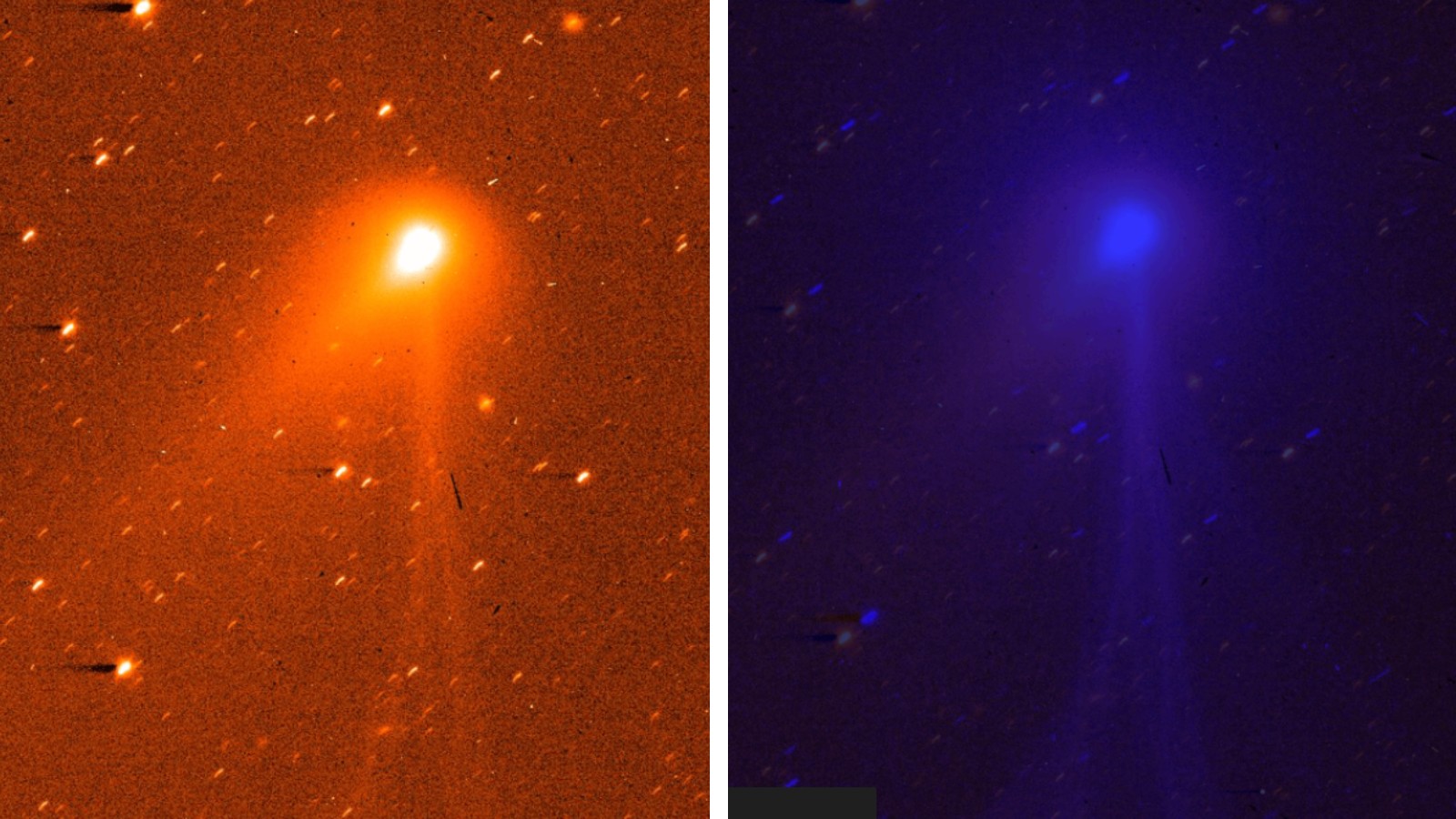
The European Space Agency’s (ESA) JUICE mission has captured a stunning phenomenon: the interstellar comet 3I/ATLAS is ejecting an astonishing amount of water into space—roughly equivalent to filling 70 Olympic-sized swimming pools every single day.
This discovery provides astronomers with a rare “time capsule” from another star system, offering a direct look at the chemical building blocks that existed billions of years before our own Sun was formed.
A Rare Cosmic Encounter
3I/ATLAS is not a resident of our solar system. It is only the third interstellar object ever detected passing through our cosmic neighborhood. While most comets are native to our solar system, interstellar visitors like this one originate from distant star systems, carrying unique chemical signatures from their home worlds.
The discovery was made in November 2025 by the Jupiter Icy Moons Explorer (JUICE), a spacecraft currently en route to Jupiter. Using its advanced suite of instruments—specifically the MAJIS (spectrometer) and JANUS (imaging) tools—the mission was able to analyze the comet’s composition as it moved through our system.
The Mechanics of the Outflow
As 3I/ATLAS approached the Sun, solar radiation began to heat its icy core. This triggered a process known as sublimation, where solid ice transforms directly into gas without becoming liquid first.
While all comets exhibit this behavior, creating the characteristic “coma” (a fuzzy atmosphere) and tail, 3I/ATLAS showed an unexpected level of brightness and activity.
Key Findings from the Data:
- Massive Scale: The comet is releasing approximately two tons of material per second.
- Chemical Composition: The MAJIS instrument identified strong infrared emissions from water vapor and carbon dioxide.
- Deep Reservoirs: Scientists believe these “volatiles”—substances that evaporate easily—were buried deep beneath the comet’s surface and were suddenly released following its closest approach to the Sun (perihelion ).
Why This Matters for Planetary Science
The ability to detect these specific molecules is more than just a feat of engineering; it is a window into the history of the universe.
Because 3I/ATLAS formed around a different star, its chemical makeup acts as a blueprint for how planets form in other parts of the galaxy. By studying the ratio of water to carbon dioxide in an interstellar object, researchers can better understand if the “ingredients” for life—such as water and organic compounds—are common features throughout the cosmos or unique to our solar system.
“The MAJIS data will allow us to better understand the physical and chemical properties of the materials formed around another star billions of years ago,” noted Giuseppe Piccioni of the National Institute for Astrophysics (INAF).
Conclusion
By observing the massive water and gas discharge from 3I/ATLAS, scientists are gaining unprecedented insights into the chemical evolution of distant star systems and the universal building blocks of planets.