The Takeaway: A 1909 Lincoln penny on Mars isn’t a souvenir—it’s a critical scientific tool. NASA’s Curiosity rover uses the coin to provide accurate scale in its microscopic geological photography, turning a mundane Earth object into an essential instrument for understanding the Red Planet.
More Than Just Luck
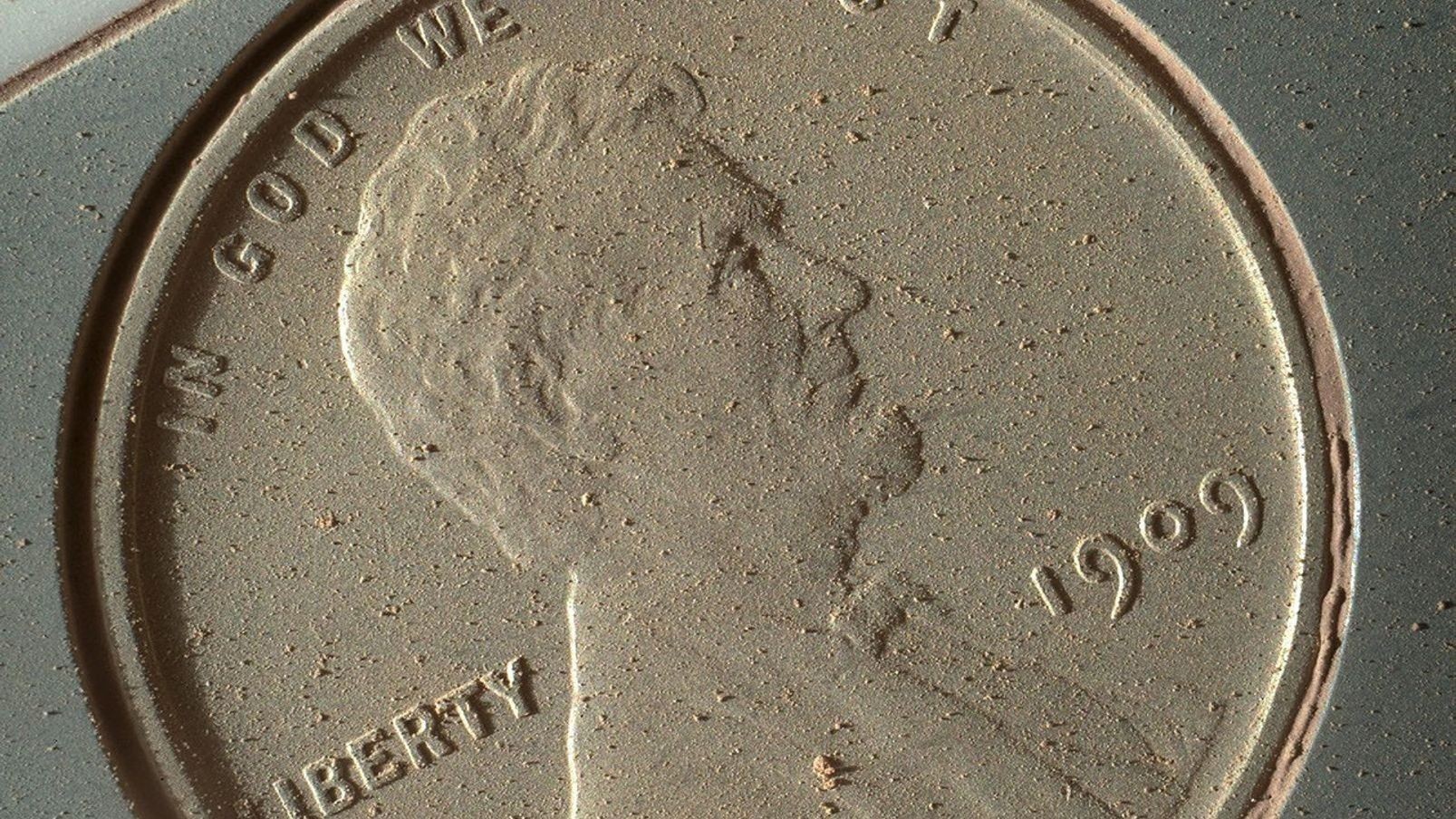
When you look at the latest “Space Photo of the Day,” featuring NASA’s Curiosity rover, you might be startled by the sight of a familiar object resting on the alien soil: a United States penny. Covered in fine, reddish Martian dust, this coin has traveled farther from Earth than any human being.
While the image might seem whimsical—a piece of American history sitting on another world—the presence of the penny is strictly functional. It is not a lucky charm left behind by astronauts, nor is it a decorative artifact. It is a precision tool for scientific measurement.
The Science of Scale
In geological fieldwork, context is everything. When researchers examine rock formations, fossils, or soil samples, determining the actual size of features is crucial for analysis. Without a reference object, it is impossible to know if a crack in a rock is a millimeter wide or a centimeter wide just by looking at a photograph.
On Earth, geologists solve this problem by including objects of known dimensions in their photos:
* For large cliff faces, they might stand next to the formation.
* For medium-sized outcrops, they might use a rock hammer.
* For close-up, detailed shots, they use small, standardized items like a coin.
Curiosity’s Mars Hand Lens Imager (MAHLI) operates on the same principle. MAHLI is designed to take high-resolution, close-up images of rocks and soil. To ensure that scientists back on Earth can accurately measure the features in these photos, the rover includes a penny in the frame.
A Century-Old Reference Point
The specific penny used by Curiosity was minted in 1909, making it a relic from the early 20th century. Its dimensions are standardized and well-known, providing a reliable baseline for measurement.
The photo in question was captured on October 2, 2013 (Sol 411 of the mission). By that time, the rover had been exploring Mars for 14 months. The image clearly shows Martian dust settling on the coin’s surface, illustrating the environmental conditions on the planet.
Ken Edgett, the Principal Investigator for the MAHLI instrument, explained the logic simply:
“When a geologist takes pictures of rock outcrops she is studying, she wants an object of known scale in the photographs… If it is a close-up, as the MAHLI can take, she might pull something small out of her pocket. Like a penny.”
Why This Matters
This practice highlights a fundamental aspect of planetary science: precision requires perspective.
While the image of a penny on Mars is visually striking and serves as a powerful reminder of our connection to Earth, its primary value is data integrity. By including the coin, NASA ensures that every grain of sand and every crack in a Martian rock can be measured accurately. This data helps scientists understand the planet’s geological history, climate changes, and potential for past habitability.
The penny proves that even the most ordinary objects from home can become extraordinary tools when placed in the right context—helping us decode the mysteries of a world millions of miles away.