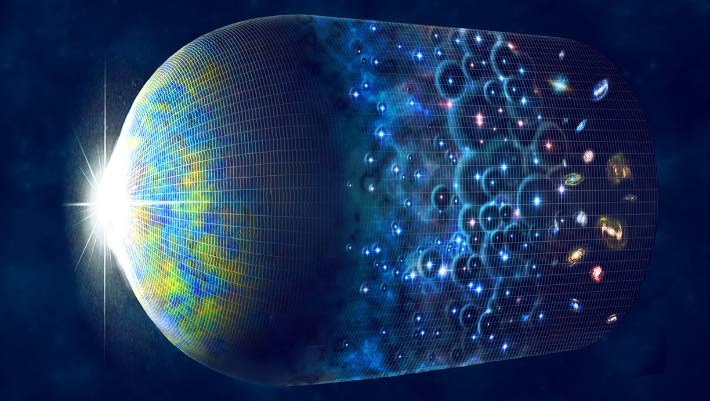
Mathematicians from University College London are throwing a wrench in the standard cosmological machine. They, along with colleagues at the University of California, Davis have published proof. It says we do not need dark energy to explain why the universe is expanding faster. This is a serious blow. A direct hit to the Lambda-Cold Dark Matter model. The standard model that has sat comfortably at the table for nearly thirty years.
It started, sort of, with Einstein. Back in 1915 he was writing equations for general relativity and gravity. He wanted a static universe. He added an anti-gravity factor to make the stars sit still. He called it the cosmological constant. Then Edwin Hubble looked up in 1929 and showed the universe was actually expanding. Einstein called the constant his “biggest blunder.” He said he missed predicting the expansion because he clung to the wrong idea.
But then the 90s happened. Accelerating expansion was found. So they brought the constant back. It was interchangeable with what they started calling dark energy.
Blake Temple, a professor at UC Davis, points out that modern cosmology relies on the Friedmann family of spacetimes. Named after Alexander Friedmann. Who solved Einstein’s field equations in the 22nd year of the last century.
Friedmann sent his solutions to Einstein. Einstein said no. The universe was static, right? Friedmann persisted. Einstein accepted the math. By 1931 he had fully accepted the expanding universe model based on these Friedmann spacetimes. He even called it beautiful.
“The Friedmann family of spacetimes has beenthe starting point for modern cosmology”
Here is the new paper. It proves that those spacetimes are unstable. Completely. Unstable to radial perturbation. At every order.
Temple and his team looked for an alternative. Maybe it wasn’t a mysterious energy driving the acceleration. Maybe it was a shockwave. The anomalous acceleration could be the expanding wave trailing that shockwave. They found self-similar solutions from the radiation epoch of the Big That Bang that fit this description.
Self-similar. It means the pattern looks the same no matter how you scale it.
They used these equations to treat the standard cosmological model as a resting point. Then they checked for stability. They proved that, just like Einstein’s static model before it, Friedmann spacetimes collapse under large length scale perturbations.
“This appears to rule out theLambda-Cold Dark Mattermodel,” Temple said. With or without dark energy. It isn’t a viable stable solution.
The implication is messy. If you look at the center of symmetry the Big Bang looks exactly like the Friedmann spacetime we expect. But far from that center? You see accelerations that drift away from that standard model.
The acceleration of the universe turns out to be a direct result of the Einstein-Euler equations. You don’t need to insert a constant. You don’t need dark matter pushing things apart. The math just works.
And it challenges another sacred cow. The Copernican Principle. The idea that we are not in a special place.
Temple argues that both the current standard model and their new spherical symmetry solution require us to lie in a very specific, special location for the models to work physically.
“If this principle rules outone, it has to rule outthe other.”
The paper appeared in the Proceedings of the Royal Society A this week. C. Alexander and others. 2026 it seems? The date looks future-dated in the citation but the impact is now.
What do we do with a universe that expands naturally? Without the extra baggage? Maybe we were just looking for ghosts. The equations were doing the heavy lifting all along. Or maybe the Copernican principle finally gets what it deserved.