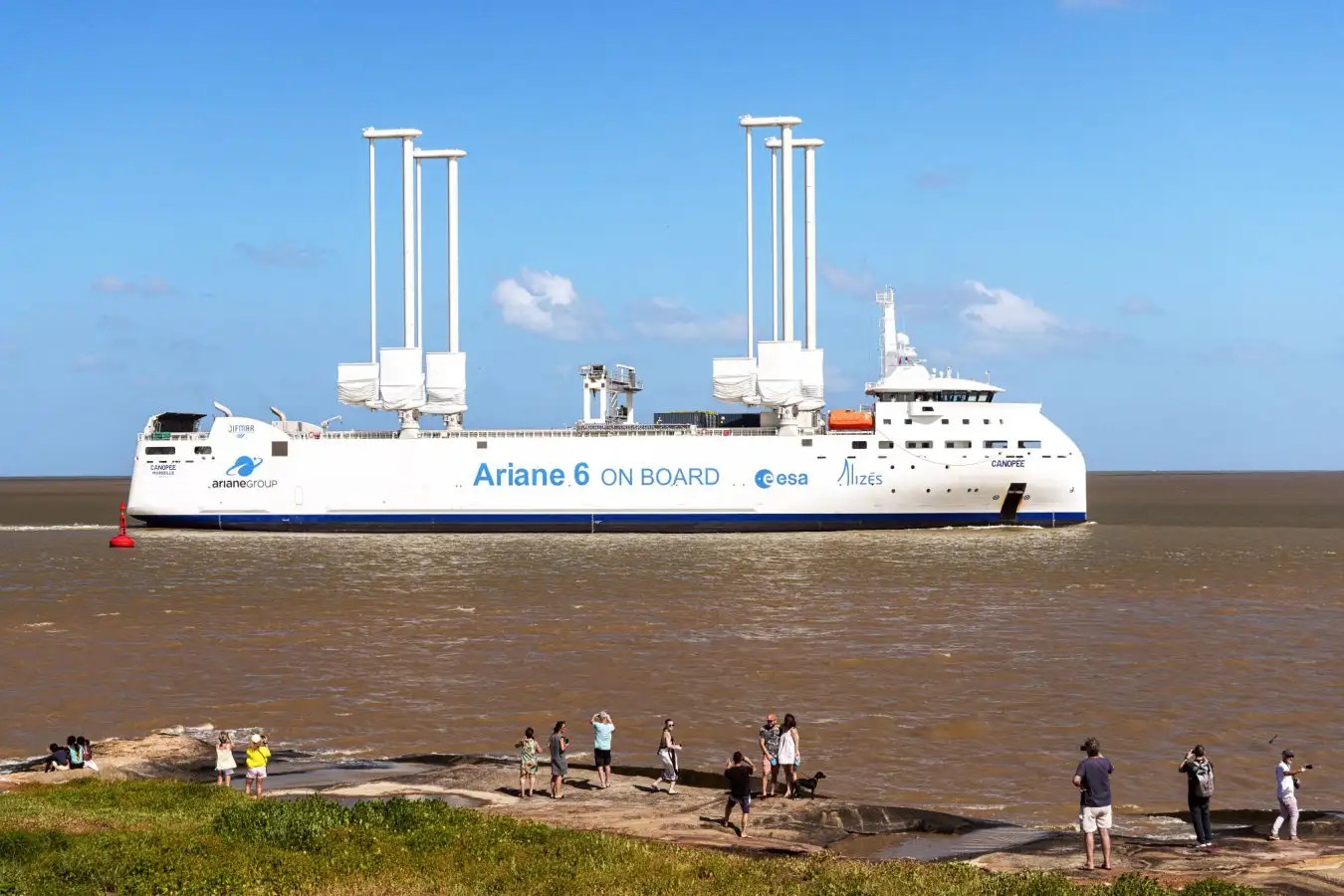
The shipping industry pumps about three percent of the world’s carbon dioxide into the atmosphere. It is growing. Adding high-tech sails to cargo ships could cut those emissions by more than half.
The tech stack
Interest is surging. Wind power is cheap. It cuts fuel costs, plain and simple. Companies are exploring a wild variety of approaches. Some are building ships from scratch with conventional sails. Others are retrofitting existing vessels with automated gear.
The technology is bizarre. Rigid sails look like aircraft wings. Flettner rotors consist of rotating cylinders. Suction sails pull in air to maximize lift. There are even giant kites, similar to those used for kitesurfing, dragging along the side.
“There is a whole spectrum,” says Gavin Allwright. He ranges the vessels from those with minimal wind assistance to those getting half their power from the air.
Going off-route
Here is the problem. Most wind-assisted ships still behave like conventional ones. They take the direct route. They stick to a set speed. This limits the benefit.
Thorben Schwedt from the German Aerospace Center wanted to see what happens if you optimize everything. He and his colleagues varied the route and speed. But with a caveat. The journey can’t take too much longer.
If time didn’t matter, every trip would be fully wind-powered. Simple, right? No. Cargo needs to move. Delays kill revenue. Shipowners lose money when deliveries are slow.
They also factored in hydrogen. An emerging tech. Currently used on a few ships, it stores excess energy. When winds are strong, turbines under the ship generate electricity. That makes hydrogen. Later, when the breeze dies down, the hydrogen powers the engines.
The model runs wild
They used historical weather data for the Atlantic Ocean. A one-year hindcast. Then they let a computer model decide the best routes.
The results were weird.
“The ships go completely wild,” Schwedt said. “You think that can’t be sane.”
It is. The computer chose bizarre detours. Routes that look insane on a map but work beautifully with the wind. On average, these ships used seventy-five percent less energy than those taking direct paths. Schwedt presented this at a European Geosciences Union meeting in Vienna.
The real advantage comes from letting the ship drift wherever the wind allows. Big detours. Savings range from fifty to one hundred percent.
Does it make sense?
“It’s not new,” Tristan Smith at UCL pointed out. “Yacht racers do this all the time.”
Reality check
Not everyone is convinced it scales. Guillaume Le Grand at TOWT agrees the expectations are justified. His company is building sailing cargo fleets in France. They’ve done it.
Smith remains cautious. The seventy-five to one-hundred percent figure? Theoretically possible. Maybe. It depends on the average voyage speed. Speed is set by economics. By what the cargo commands.
In his experience, actual savings are much lower. Most sea-going vessels won’t hit those highs.
The model works on paper. Now they have to prove it with live forecasts, not just historical data. The winds wait for no one, but the clock is ticking for the planet. We will see if the routes hold up.