It is very heavy. It’s really heavy. Osmium holds the title of the densest natural element on Earth. If you can hold a piece in your hands, you can immediately feel its weight. It is one of the platinum group metals in groups 8-10 of the periodic table of elements. However, unlike other soft materials, osmium is hard, brittle and very difficult to work with. It cannot be easily melted and shaped. It does not easily warp even at high temperatures.
Its melting point is the highest of the platinum group metals. This makes casting with standard methods almost impossible. Early electric companies experimented with using osmium wire as the filament of light bulbs. they failed. Tungsten takes over. Tungsten is also strong, but easy to manufacture. Today, osmium is no longer used for lighting. Used as a hardener for metal alloys. Ruthenium has replaced most of its roles, but its history still exists.
The Smell That Named an Element
It is not possible to store pure osmium. It does not exist in nature in its pure form. You have to extract it. The abundance of the Earth’s crust is low. About 0.001 ppm. This is rare. It is found in natural alloys with other platinum metals. Iridosmine. Sisserskite. Aurosmiridium. These are the rocks it hides.
It was discovered by British chemist Smithson Tennant. He studied the remnants of platinum ore that were insoluble in Aqua Regia. He isolated it in 1804 and named it after its smell. The Greek word osme means smell. This element smells of the compounds it forms. Especially osmium tetroxide.
The smell is very distinct. This is very unpleasant. It is also poisonous. Osmium powder releases this volatile gas even at room temperature. The air itself can carry it. Because of this feature, the name stuck. This is a warning flag included in the element name itself.
Osmium in medicine and microscopy
The same poisonous gas OsO4 also has uses. This stains tissues. Why? The biomaterial reduces the solution to black dioxide OsO2. The black color contrasts with the rest of the tissue. Microscopists use it to observe structures clearly. It highlights details that would otherwise be invisible.
Osmium reacts with air faster than other platinum metals. OsO4 is formed when exposed to oxygen at 200 °C. Along with ruthenium, it is the most noble of this group. Cold or hot acids will not touch it. fused alkalies is needed to dissolve it. Adding an oxidant such as sodium chlorate is effective. It breaks down the metal.
Chemistry and isotopes
The chemistry of osmium is complex. Its oxidation state ranges from 0 to +8. It skips +1. This is an gap. The most stable compounds have +2, +3, +4, +6 or +8 states. There are also carbonyl compounds and organometallic compounds. These are in the lower states such as -2, 0 and +1.
The only other element known to reach +8 is ruthenium. Their chemical properties are similar. However, osmium is heavier. It’s much heavier. All its compounds decompose when heated. Back to the powder or sponge. Free element. This is a cycle.
Natural osmium is a mixture of seven stable isotopes. The share of osmium-192 is 40.78%. Osmium-190 follows with 26.26%. The rest are small parts. The concentration of Osmium-184 is only 0.02%. It’s a mix.
The Numbers
| Property | Value |
|---|---|
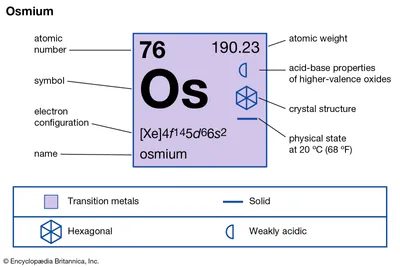
| Atomic The Numbers | 76 |
| Atomic Weight | 190.23 |
| Melting Point | 3000°C (5432°F) |
| Boiling Point | ~5,000 °C (9,032 °F) |
| Specific Gravity | 22.59 (20℃) |
| Oxidation States | +2, +3, +4, +6, +8 |
| Electron Configuration | [Xe]4f 145d 66s 2 |
It’s dense. It is poisonous. This is rare. And it smells awful. It’s osmium. You probably won’t use it every day. But in some microscope slide or old alloy it still works. The rest of the periodic table is light.