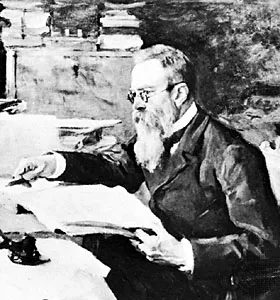
Nicolay Rimsky-Korsakov didn’t just write music. He painted with sound. His 1888 orchestral suite, Scheherazade, is the textbook definition of late-19th-century program music. It’s a work that doesn’t just have a story; it forces the listener into a specific headspace. The inspiration? The Thousand and One Nights. Also known as The Arabian Nights.
The core narrative is brutal but effective. We have Sultan Schahriar, a ruler planning to execute his new wives every morning. Then there is Scheherazade (or Shahrazad), the clever young wife who realizes her only chance of survival is to tell a story so captivating that the Sultan keeps her alive until dawn. She needs to finish the tale tomorrow. And the next day. And the next.
The music captures this dynamic perfectly. You have the sultan’s theme: deep, ponderous, and heavy. It looms over everything. Then you have Scheherazade. She is represented by a recurring, sinuous violin solo. It’s lyrical. It’s light. It dances around the sultan’s grim theme, literally weaving tales to stave off death.
The Composer’s Masterclass in Orchestration
Rimsky-Korsakov was known as a virtuoso of orchestral coloration. He understood instruments better than most. When he looked at The Arabian Nights, he saw a playground. These stories, featuring characters like Sindbad the Sailor and Ali Baba, were wildly popular in Europe during the 1800s. They were exotic. They were colorful. They were perfect for a composer who wanted to show off his ability to manipulate tone and texture.
He didn’t want to create a literal soundtrack. He called the work “an orchestral suite…closely knit by the community of its themes and motifs, yet representing, as it were, a kaleidoscope of fairy-tale images.”
The premiere took place in Saint Petersburg on November 3, 1888. The composer himself conducted. It wasn’t an instant, universal thunderclap, but it quickly became one of the most recognizable pieces of classical music in the world. Why? Because it works on two levels. You can hear the story. Or you can just hear the beauty.
Breaking Down the Four Movements
The suite is structured in four distinct movements. Interestingly, Rimsky-Korsakov originally left them untitled. The names we use today were added later by his former student, Anatoly Lyadov.
The Sea and Sindbad’s Ship
The piece opens with the sultan. His theme comes in through the winds and strings. It’s formidable. It demands attention. The sultan is calling for his newest wife to entertain him. Then, the violin enters. Scheherazade’s melody is light and lyrical. She begins her tale. The interplay here is everything. The heavy, static threat of the sultan versus the fluid, changing narrative of the violin.
The Story of the Kalandar Prince
We return to the familiar violin line. But it changes. It dissolves into animated, marchlike passages. The sultan’s theme intermittently interrupts, reminding us that the clock is ticking. The prince’s story is adventurous. The music reflects that energy. It’s restless.
The Young Prince and the Young Princess
This is the whimsical movement. It’s a love story. It’s told in waltz time. The sultan’s theme appears here too, but it’s less foreboding. Softer. Almost distant. The stakes feel lower, at least for a few minutes.
Festival at Baghdad; the Sea; the Ship Goes to Pieces on a Rock Surmounted by a Bronze Warrior
This finale is a beast. It revisits themes from the previous movements and recasts them. It’s chaotic. It’s loud. It’s a festival that turns into a storm. The ship breaks apart. The music doesn’t resolve neatly. It crashes.
What the Music Actually Represents
Here is where things get interesting for those who dig deeper. Rimsky-Korsakov was adamant about one thing. The music was not intended as an exact portrayal of any particular tale from The Thousand and One Nights.
Despite the titles of the movements, the composer insisted there were no specific character motifs beyond the sultan and Scheherazade. No little musical snippets for Ali Baba. No specific theme for the genie. Just the two central figures.
“In composing Scheherazade, I meant these hints to direct but slightly the hearer’s fancy on the path which my own fancy had traveled, and to leave more minute and particular conceptions to the will and mood of each.”
In other words, the composer gave you the map. But you decide where to walk.
This approach makes Scheherazade a prime example of how program music can function without being literal. It sets a mood. It provides a framework. But it leaves