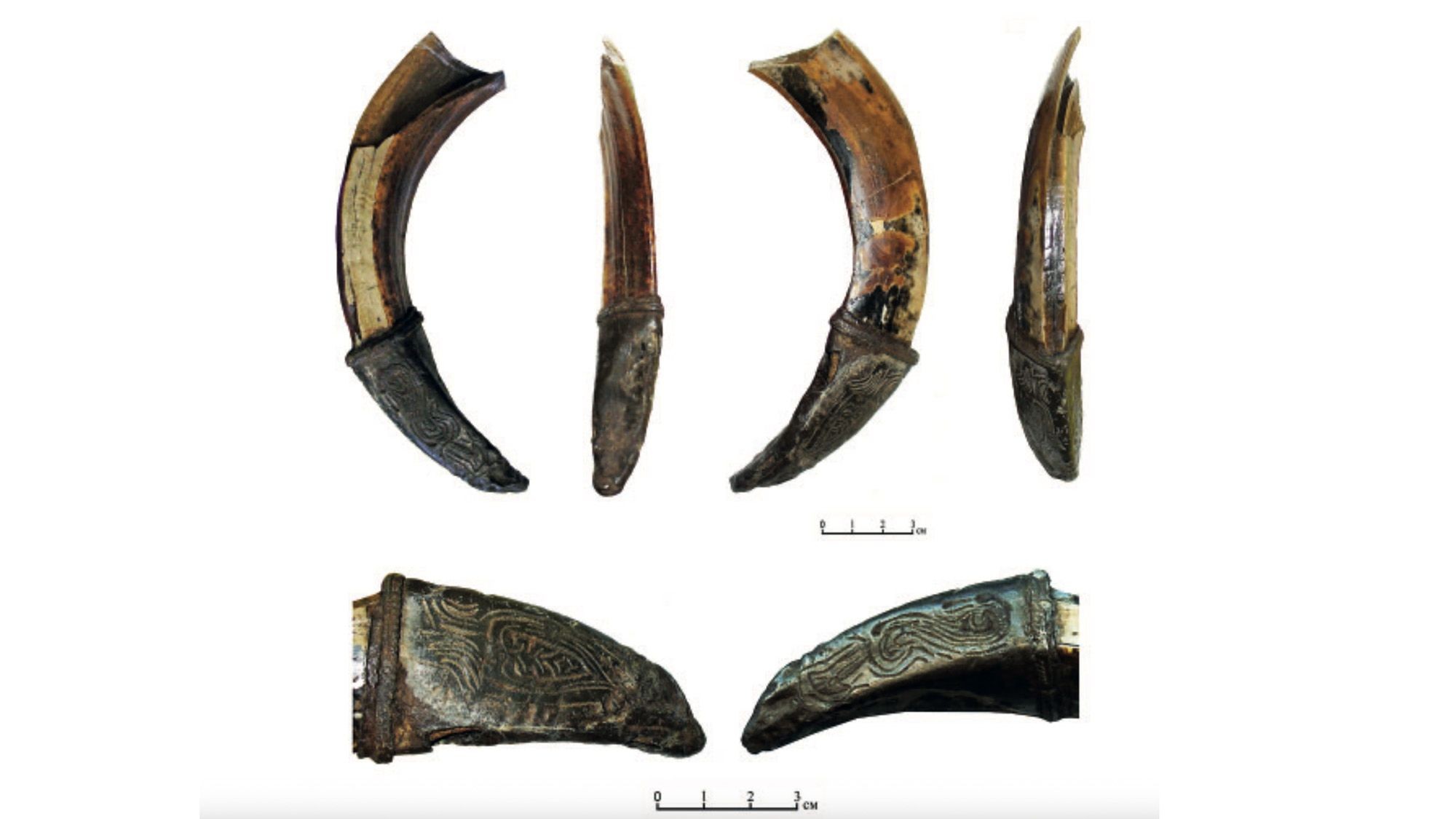
It was 800 years old. Dusty. Heavy with the weight of a creature that once hunted through the deep woods of Kievan Rus.
Archaeologists dug it out of Novgorod-the-Great (or Veliky Novgorod, as history knows it). This isn’t just a tooth. It is a statement.
The artifact: a wild boar tusk, mounted on metal, engraved, and clearly meant for someone with status and superstition. A good-luck charm. Or maybe just bragging rights from the kill.
How-a-Warrior-Carrying-a-Tusk-Worked-as-Amulet
Size matters here.
Natalia Eniosova, a metal scientist at Lomonosov Moscow University and co-author on the new study published in The Volga River Region Archaeology, wasn’t subtle.
“It’s extraordinary because of its size.”
The piece left standing measures 3.9 inches tall. That is massive for a single tusk fragment. It weighs the width of a small thumb. But the boar that grew it? That beast was at least 8 years dead before the carving started. And alive, it weighed over 220 pounds.
“Such an animal would not have-been-hunted-for-food,” Eniosova notes.
Domestic pigs existed. They were practical. You ate them. They were smaller, manageable, less dangerous. You did not waste your hunting arrow on a 200-pound boar unless you were showing off or hunting for something else.
That “something else” appears to be magic.
Where-in-Novelgorod-Did-this-Amulet-Come-From?
The location gives it away.
Excavation site: Troitsky XVI. This zone wasn’t for peasants. It was for the wealthy. The elite. The kind of people who didn’t fear wild predators.
If this belonged to a farmer, he’d have worn a simple bead. An aglet. Something cheap.
This object screamed aristocracy. Hunting trophies belonged to the druzhina —the military retinues—or the nobility. Medieval Russian texts are clear on this: wild boar hunting was a privileged sport. Not for commoners. For the guys who kept swords sharp and lands secured.
But here is where the materials tell a lie.
Which-Material-Is-The-True-Metal
At first glance? Silver.
The mount gleams like the real deal. But when the team analyzed the composition, they hit a snag. It was not silver.
It was almost 100 percent tin. Or a lead-tin alloy designed to look like silver.
Does this mean the noble was poor? No. It means the noble was clever. Tin isn’t cheap everywhere, but in parts of medieval Europe, true silver was vastly more expensive and harder to source. This was budget-conscious luxury. You look like a lord, without the cost of a lord’s bank account draining.
The engraving work?
“It’s a very, very good-done object,” Eniosova says.
Consider that. You are carving a soft, lead-heavy metal that resists fine detail. The result is intricate. It had to be done by hands that knew metal, not by an amateur.
Why-Did-the-Elite-Believe-This-Anti-Curse-Works
Boar tusk amulets vanished between the 11th and 13th centuries. Before that? Everywhere. After? Gone.
Except in Veliky Novgorod, they popped back up. Why the resurgence?
The study suggests two reasons:
1. The physical prowess transfer. Wearing a tusk meant stealing some of that raw power for the battle or the hunt.
2. The “transfer of fortune.” Good luck wasn’t free. You needed an anchor for it. A tusk provided that gravity.
Was there a Scandinavian connection? Possible. Early settlers were Norse. But this piece is from after their departure (by over 150 years). The myth lingered, perhaps. But the object itself is local craftsmanship, adapted for the elite tastes of medieval Rus.
Is-a-Big-Boar-Relic-Still-Rare-To-Day?
Absolutely.
Alexei Gippius, a noted philologist and expert on Novgorod’s history (who wasn’t even involved in this study), calls it “highly significant.”
He adds a critical context: this find illuminates how the early Rus elite actually lived. Not just through charts or treaties, but through the physical talismans they hung around their necks. They didn’t just believe in myths. They wore them.
The tusk is missing the top part—the part where you’d string it through if it was a necklace. But holes at the top of similar animal amulets are a known trait in that period. It fits.
The boar died long ago. Its tusk was pulled from its face, mounted on lead, and carved into a promise: I will survive what he survived.
For one noble warrior, in the muddy, bustling streets of Veliky Novgorod—that might have been enough.
Doesn’t make the legend true.
But it keeps you looking over your shoulder a little more carefully.