Euclid isn’t just looking at the sky. It’s digging through time.
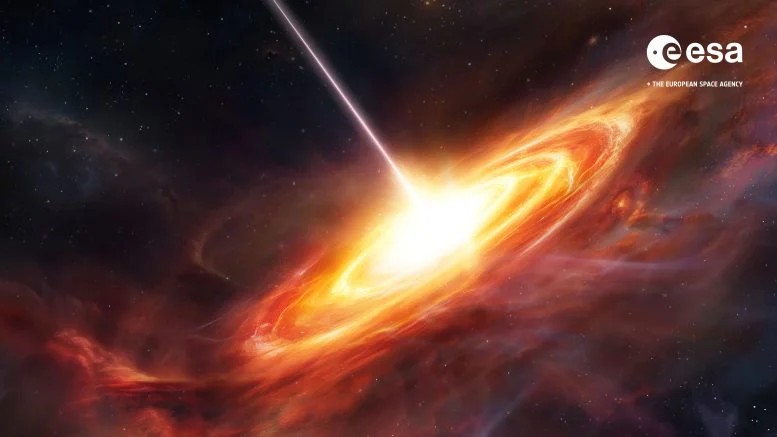
The European Space Agency’s telescope has turned up 31 previously unknown quasars. These aren’t just faint smudges. They are the roaring cores of supermassive black holes eating matter in the Universe’s infancy. Some shine with the brightness of a trillion Suns. All of them date back to when the cosmos was less than 5% of its current age.
This changes how we see the early Universe.
For decades, astronomers hunted these objects. They were looking for answers. Specifically, how did black holes grow so massive so quickly? The search was hard because these objects are rare. Faint. Easily mistaken for closer stars. Until now.
Finding the Faint Giants
Before Euclid, surveys could only find the brightest ancient quasars. The rarest of the rare. That left astronomers with a tiny sample size. A skewed picture. They knew the giants existed but missed the population behind them.
Euclid changed the game. Launched in 2023, it scans broad swathes of sky in infrared. It catches light that previous telescopes missed. This allows for a census. A real one.
“Euclid is a true game-change,” says Daming Yang from Leiden University. He led the discovery paper.
Yang points out that Euclid captures fainter light across huge areas. It lets us ask better questions. Not just did they exist? But how common were they?
The new data includes 31 quasars. The sample stretches back 13.5 billion years. We are seeing light that left these objects when the Universe was a baby.
“By finding and studying them, we better understand how enormous systems formed so quickly. One of the greatest mysteries in astrophysicss.”
Breaking Distance Records
Among these 31 objects, 12 have a redshift of 7 or more.
Redshift measures how much the Universe’s expansion has stretched light. Higher redshift means older light. A redshift of 7 puts the object within the first 770 million years of cosmic time.
The oldest two set new records.
EUCL J1729002.75+064101.8 and EUCL J125808.55+070543.2.
Their redshifts are 7.79 and 7.69. They are 13.1 and 13.3 billion light-years away. They were already shining when the Universe was just 670 million years old. This is earlier than any previously known quasars.
Antonio La Marca, an ESA Research Fellow on the Euclid team, calls it a massive jump.
It took astronomers more than ten years to find the first ten quasars with high redshift. Euclid surpassed that total in a single year.
“The Euclid team has taken a true census for the first time,” La Marca says.
This is a fundamental step. We are moving from spotting exceptions to understanding the rule.
Inside the Early Universe’s Engine
Why do these quasars matter? They illuminate the cosmic dawn.
Silvia Belladitta and colleagues looked closely at the second-oldest quasar. The data is revealing. The black hole sits inside a galaxy packed with gas and dust. Stars are forming there at a furious rate.
This environment suggests a link.
The supermassive black hole needed a huge food supply to power its quasar glow. The host galaxy was busy turning that same gas into stars. They grew together. Co-evolved.
These objects appeared during the epoch of re-ionization.
Before this period, the Universe went through the “dark ages.” Hydrogen gas was cold and neutral. Energetic light from the first stars, galaxies, and quasars stripped electrons from atoms. The gas became ionized. The cosmos turned transparent. Structured.
These ancient quasars were part of that transition. They helped clear the fog.
“Ancient quasars are time machines,” says ESA Project Scientist Valeria Pettorino.
They let us explore how the first galaxies came to be. They are rare. But they are also key.
What Comes Next
Euclid’s capabilities are distinct. Space-based infrared vision. Sharp imaging. Depth. Wide area coverage. It picks out distant objects efficiently.
But the telescope is only half the story.
The data processing required thousands of Euclid Consortium scientists and engineers. They sifted through enormous datasets. They found these rare quasars. Now, ground telescopes can study them further.
The 31 quasars come from the Euclid Wide Survey. That survey will eventually cover more than a third of the sky.
As Euclid maps billions of galaxies, the count of ancient quasars will likely rise. The data will also shed light on dark matter. On cosmic history. On the large-scale structure of the Universe.
We are just starting to see the edges of what’s out there. The light from those trillion-sun objects has traveled 13 billion years to reach us. And now it’s telling us how it all began.