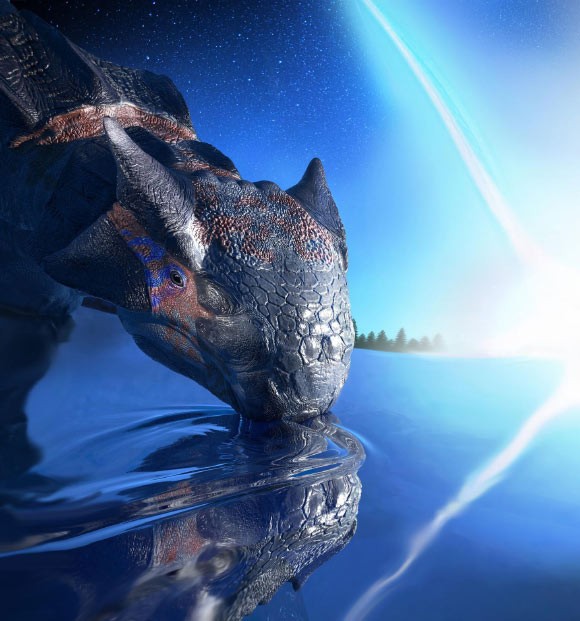
We always imagine the asteroid impact 66 million years ago as a freeze-frame disaster. A global winter. Darkness. Cold. But that’s only half the story.
New research from Purdue University and the University of CU Boulder suggests the sky didn’t just go dark. It got deadly hot.
Why the K-Pg Extinction Wasn’t Just About Winter
About 66 million years ago, a massive chunk of space slammed into what is now the Yucatan Peninsula in Mexico. The town of Chicxulub sits right on the crater site.
The energy released? Roughly $10^{23}$ joules. That is a number that breaks the human brain. Enough to spawn mega-tsunamis and earthquakes that would make today’s tremors feel like a heartbeat. The hole left behind? Between 180 and 200 kilometers wide.
This event wiped out 75% of life. Dinosaurs? Gone. Ammonites? Extinct. But for decades, scientists argued over the mechanism. Did the dust choke the sun first? Or did the heat kill us off instantly?
How Chicxulub Impact Caused Extreme Heat
Brandon Johnson, a planetary scientist at Purdue, says the heat was instantaneous and overwhelming.
“We’re in the realm where we might essentially killing off everything within that first or two hours,” he said.
Here’s what happened, based on their new study:
The impact blasted debris into space. Spherules—tiny molten droplets of rock—separated from the vapor. They circled the globe. Then, they came back down.
When those molten fragments reentered the atmosphere, friction didn’t just burn them. It superheated the air around them.
But here is the twist.
As the vapor cooled, it created vast clouds of fine dust. This dust didn’t just block the sun. It acted like a thermal blanket. It trapped the heat generated by the falling spherules right near the surface.
“It probably looked more like hell than like Venus.”
Wildfires and the Dark Skies of the K-Pg Boundary
The result wasn’t a cold, frozen earth. It was a scorched one.
The combination of reentering debris and trapped dust would have ignited wildfires across the planet. Terrestrial plants and animals didn’t just freeze. They burned.
Johnson describes a world where the daylight was completely blocked. For creatures like humans (had we existed), the sky wouldn’t have been bright. It would have been dark. The only visibility came from a reddish, infernal glow of wildfires below.
Could you see? Barely.
Was anyone alive? Not for long.
Only those who could burrow. Or swim. Or find deep shelter had a chance. The rest? They were cooked.
Did the Asteroid Heat or Cold Kill Dinosaurs?
This new data reignites the debate. It wasn’t just an impact winter. The heat spike was a major driver of extinction.
“The clouds would have blocked daylight,” Johnson noted. “So to any animal… that don’t see far into the infrared… the surface would have probably looked dark. You would only have been able to see reddish glow. But there really wouldn’t be anything alive to do seeing anyway.”
The findings, published in the Journal of Geophysical Research: Biogeosciences, complicate our understanding of the K-Pg mass extinction. It wasn’t a simple choice between freeze or burn. It was both. In a hurry.
The dust settled. The fire burned. The dinosaurs died.
And the sky remained red for a very, very long time.