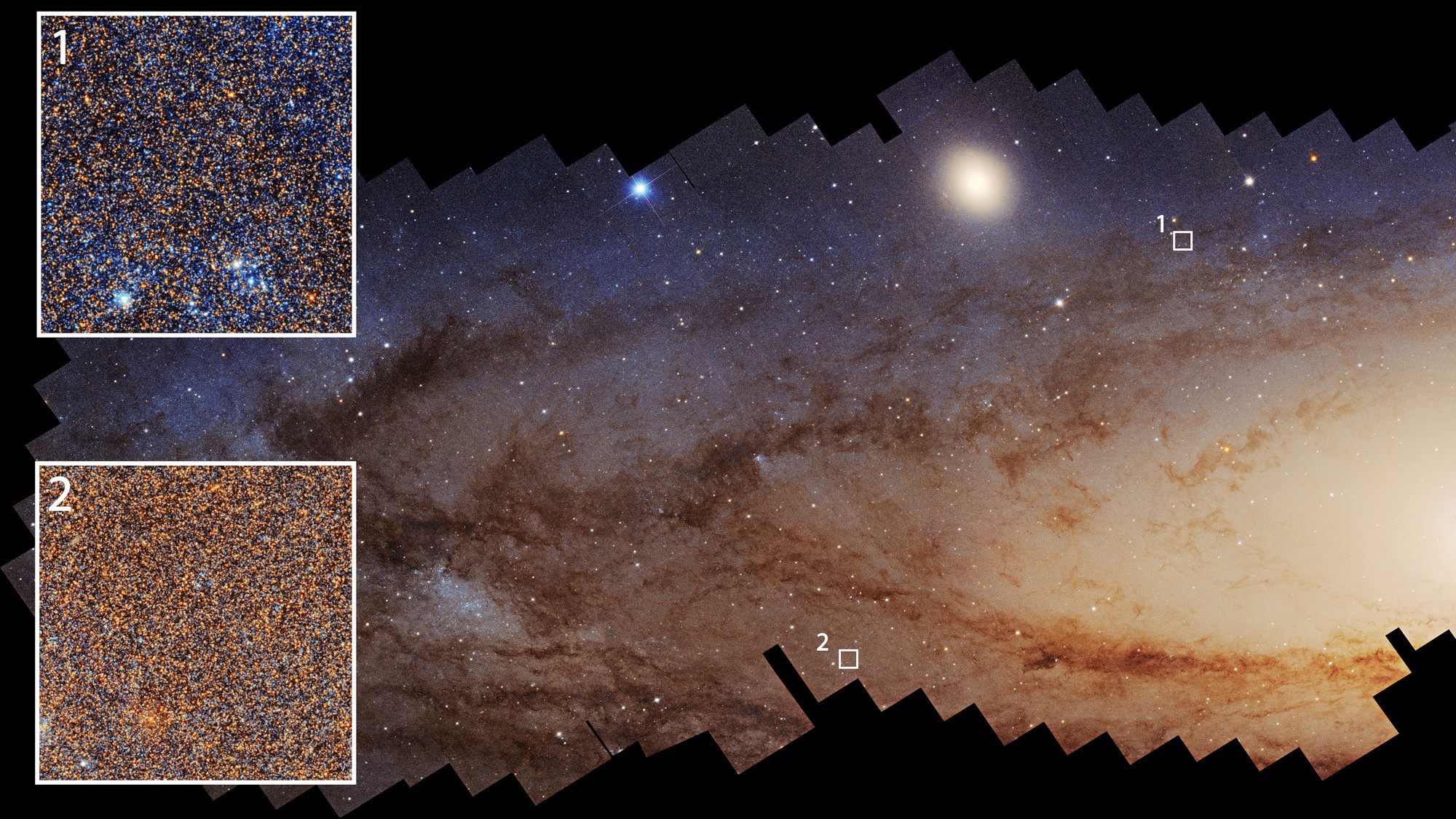
The universe is mostly expanding. Galaxies rush away from each other like cars on a highway. Andromeda is different. It is the only major galaxy speeding toward the Milky Way. It is our galactic next-door neighbor. And new data suggests it might be slowing down.
A recent analysis of Hubble Space Telescope observations hints that Andromeda is winding down from a massive burst of activity. This comes as the galaxy draws closer to a possible collision with us. The findings are in The Astrophysical Journal.
Andromeda’s Star Formation Slowing Down
Andromeda (M31) is a giant spiral. It has roughly twice the mass of the Milky Way. Because it is so close, it serves as an ideal laboratory. Astronomers use it to understand how large spiral galaxies evolve. Specifically, they need to know when and where stars form.
The new study maps about two-thirds of Andromeda’s disk. It covers roughly 200 million stars by combining two major Hubble surveys. The results show a clear trend. Star production has been steadily declining over the past 500 million-years.
This isn’t a sudden stop. It looks more like a natural cooldown.
The Timeline of a Galaxy
We know Andromeda went through a dramatic phase about 2 billion years ago. That starburst was likely caused by a merger. The suspect is M32, a compact elliptical galaxy that still orbits Andromeda today. That event created about a fifth of the galaxy’s stars.
But things changed after that peak.
- 500 million years ago: Stars formed at a rate of one solar mass per year.
- 40 million years ago: That rate halved.
- Today: The rate is just one-fifth of a solar mass annually.
Most of this recent activity is concentrated in a ring about 32, M00 light-years from the center. The drop in activity there is driving the overall decline. It suggests Andromeda is gradually winding down rather than running out of raw material all at once.
Did a Companion Galaxy Trigger This?
Scientists are also looking at M32’s influence. Regions closest to the companion galaxy show a more recent drop in star formation. This makes M32 a plausible culprit. The evidence, however, remains inconclusive. The interaction is complicated.
“We need to measure the individual stars because they become the fossil record of the formation process,” says study co-author Ben Williams. He notes that Hubble is the only telescope capable of high spatial resolution across such a large area. We need those details to read the history properly.
Looking Ahead With Roman
The data gathering doesn’t stop with Hubble. The team will continue analyzing existing archives. They will also look to NASA’s Nancy Grace Roman Space Telescope. It is set to launch on a SpaceX Falcon Heavy as soon as August 30.
Roman offers a field of view at least 1,00 times wider than Hubble’s. It will survey the entire Andromeda disk and its surrounding halo in unprecedented detail. That scale could finally resolve how the merger with M32 shaped the galaxy’s future.
When Will the Collision Happen?
Andromeda is currently best observed in November. You can see it with the naked eye from places with moderate light pollution. It is a bright smudge against the dark sky.
The collision with the Milky Way is still billions of years away. Estimates hover around 5 billion years. The ultimate trajectory is not entirely certain. But the approach is inevitable.
For now, we watch Andromeda slow its birth of stars. It is a quiet end to a violent beginning. The Hubble data provides the first detailed look at this transition. Roman will provide the full picture. Until then, we wait and watch the neighbor draw closer.