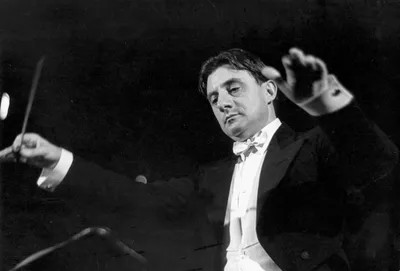
Sir John Barbirolli was more than just a conductor. He was an accomplished cellist. He was born in London on December 2, 1899, the carried the weight of two musical lineages. His father was an Italian violinist in exile. His mother was French. The boy learned to play the violin at the age of four. After that he switched to the cello. At the age of 10, he received a scholarship to Trinity College of Music. In 1912 he transferred to the Royal Academy of Music, where he studied until 1916.
He established himself early as an orchestral and cello soloist. In his mid-twenties, he devoted himself to chamber music. Then he turned around. He moved to opera as a full-time conductor. He spent several seasons at Covent Garden. He worked at Sadler’s Wells. He appeared with the British National Opera. He also conducted with the London Symphony Orchestra. The Scottish Orchestra also employed him.
From the shadow of Toscanini to the New York Philharmonic
The big breakthrough took place in 1936–1937. He was invited to join the New York Philharmonic. He didn’t just visit. He was offered the permanent position of music director. He replaced Arturo Toscanini. It’s a heavy crown. Barbirolli kept his position during the organization’s 100th anniversary celebrations in 1941-1942. This was an unforgettable run.
Next up is Manchester. In 1943, he became the conductor of the Halle Orchestra, where he served until 1970, That’s nearly three decades. There he gained international recognition. The city accepted him. The orchestra flourished under his direction.
By the 1950s, health problems were creeping in. His condition worsened. That didn’t stop him. He kept guest conducting. He recorded. He toured the world with major orchestras. In the years 1961–1967, he was the principal conductor of the Houston Symphony Orchestra. From 1961 to 1970, he was the favorite guest of the Berlin Philharmonic.
In 1949 he was knighted. The title stuck. He died in London on July 29, 1970. The music remained.
“He didn’t just play the notes. He lived them.”
Why did Manchester accept him so readily? Perhaps it’s because he brought that cellist’s understanding a cellist’s understanding of the string section. He knows the tension of the bow. The friction in the wood. It showed in the Hallé’s sound.
Who else did he influence? The generations that followed. The recordings survive. They prove that he was just a relic. He was a force.
His tenure at the New York Philharmonic still gets discussed. How did he manage the Toscanini legacy? He wasn’t trying to be Toscanini. He was Barbirolli.
What made him stand out in the 1960s? The Berlin Philharmonic loved him. They invited him repeatedly. He is not German. He was British. He brought a different kind of warmth. A different pulse.
The Hallé Orchestra became his home. Did he ever