While most moviegoers see science fiction as a playground for the impossible, a physicist watching the film Project Hail Mary sees something much more profound: a rigorous, sometimes terrifying, commitment to the laws of motion.
The film, directed by Phil Lord and Christopher Miller, stands out not because it invents new science, but because it strives to honor existing science. By working with NASA advisors, the production team has managed to capture the visceral reality of how momentum and inertia actually behave in the vacuum of space.
The Danger of Momentum in Zero Gravity
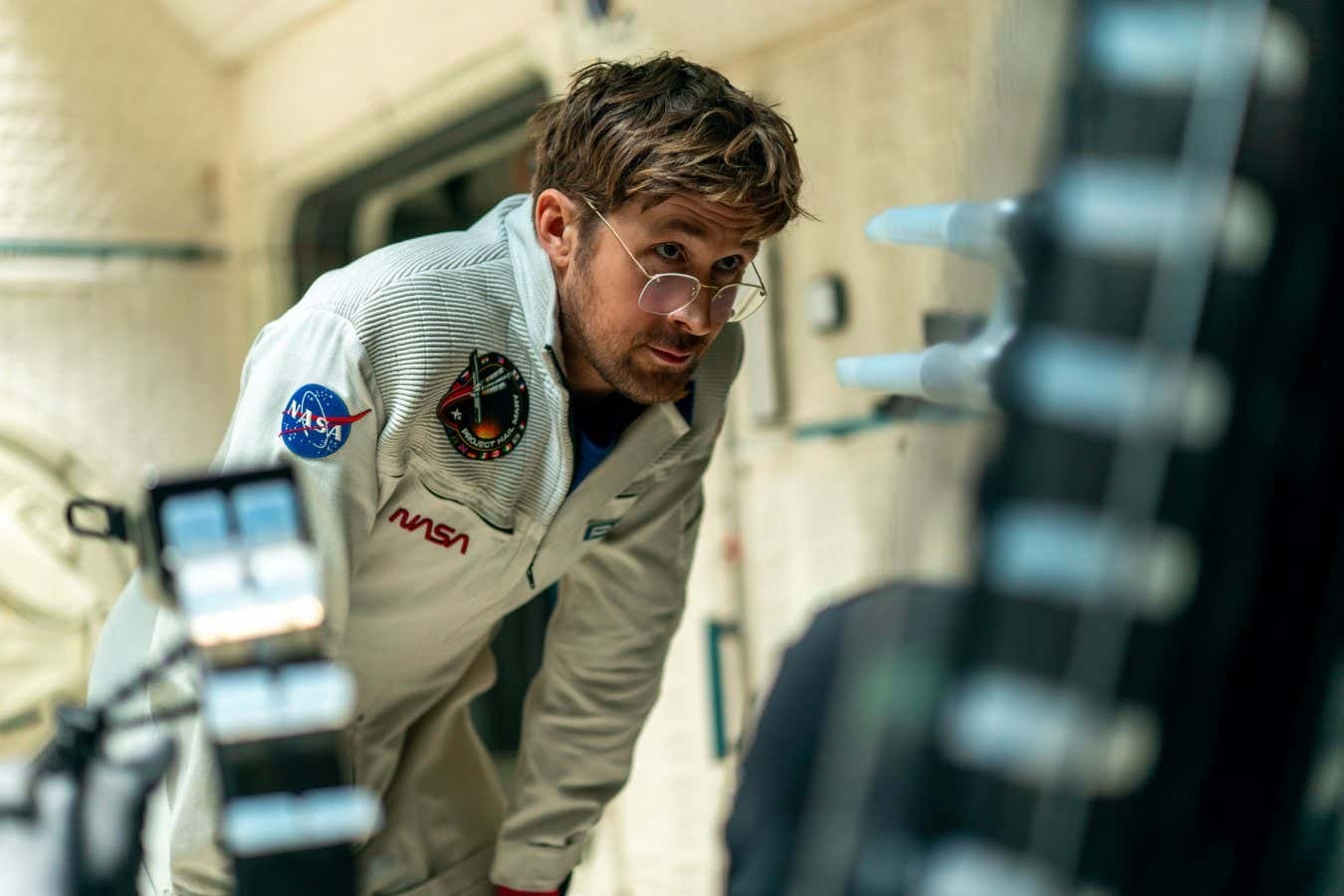
In one striking scene, the protagonist, Ryland Grace (played by Ryan Gosling), is caught unseated when his spaceship suddenly accelerates. Without a seatbelt to anchor him, his body is thrown violently against the ship’s interior.
To a casual observer, this might look like standard cinematic exaggeration. However, from a physics perspective, the scene is hauntingly accurate—and potentially lethal. This moment highlights two fundamental principles:
- Newton’s First Law (Inertia): An object in motion stays in motion, and an object at rest stays at rest, unless acted upon by an external force. In the vacuum of space, without gravity or air resistance to slow things down, these laws are absolute.
- Momentum: Momentum is the product of an object’s mass and its velocity. Because there is no friction or atmospheric drag in space to “bleed off” energy, any sudden change in the ship’s movement results in a high-momentum impact that, in reality, would be catastrophic for a human body.
The tension felt by a physicist in this scene arises from this realism. When the film depicts an object thrown from a ship traveling in a perfectly straight line without slowing down, it isn’t just “movie magic”—it is a precise depiction of a universe without Earth’s friction.
From Ancient China to Isaac Newton
The fascination with these fundamental laws of motion is not a modern phenomenon. While we often credit Isaac Newton with codifying these principles in his Principia, the conceptual roots of inertia stretch much further back.
During research for the book The Edge of Space-Time, it becomes clear that over a millennium before Newton, the Chinese philosopher Mozi and his followers had documented principles remarkably similar to Newton’s first law in the Mo Ching.
This connection reveals a beautiful synergy in how we understand the universe:
1. Ancient Humanists translated and preserved ancient texts like the Mo Ching.
2. Classical Physicists like Newton built upon these fundamental observations of motion.
3. Modern Scientists use these laws to guide space exploration and NASA missions.
4. Artists and Filmmakers use that scientific rigor to create immersive, believable stories.
Why This Matters
The accuracy of Project Hail Mary does more than just satisfy science enthusiasts; it bridges the gap between “stale” textbook physics and the breathtaking reality of the cosmos. When a film treats momentum with respect, it allows the audience to feel the true weight and danger of the void.
The intersection of art, science, and humanities creates a unique synergy: scientists advise artists, who create works grounded in truths preserved by historians and linguists.
Conclusion
By grounding its narrative in the uncompromising laws of Newtonian physics, Project Hail Mary transcends mere entertainment to become a vivid demonstration of how the universe actually moves. It reminds us that the most “spectacular” science is often found in the simplest, most fundamental rules of motion.