It wasn’t a dinosaur.
But it hung out with them. Ruled the water, anyway.
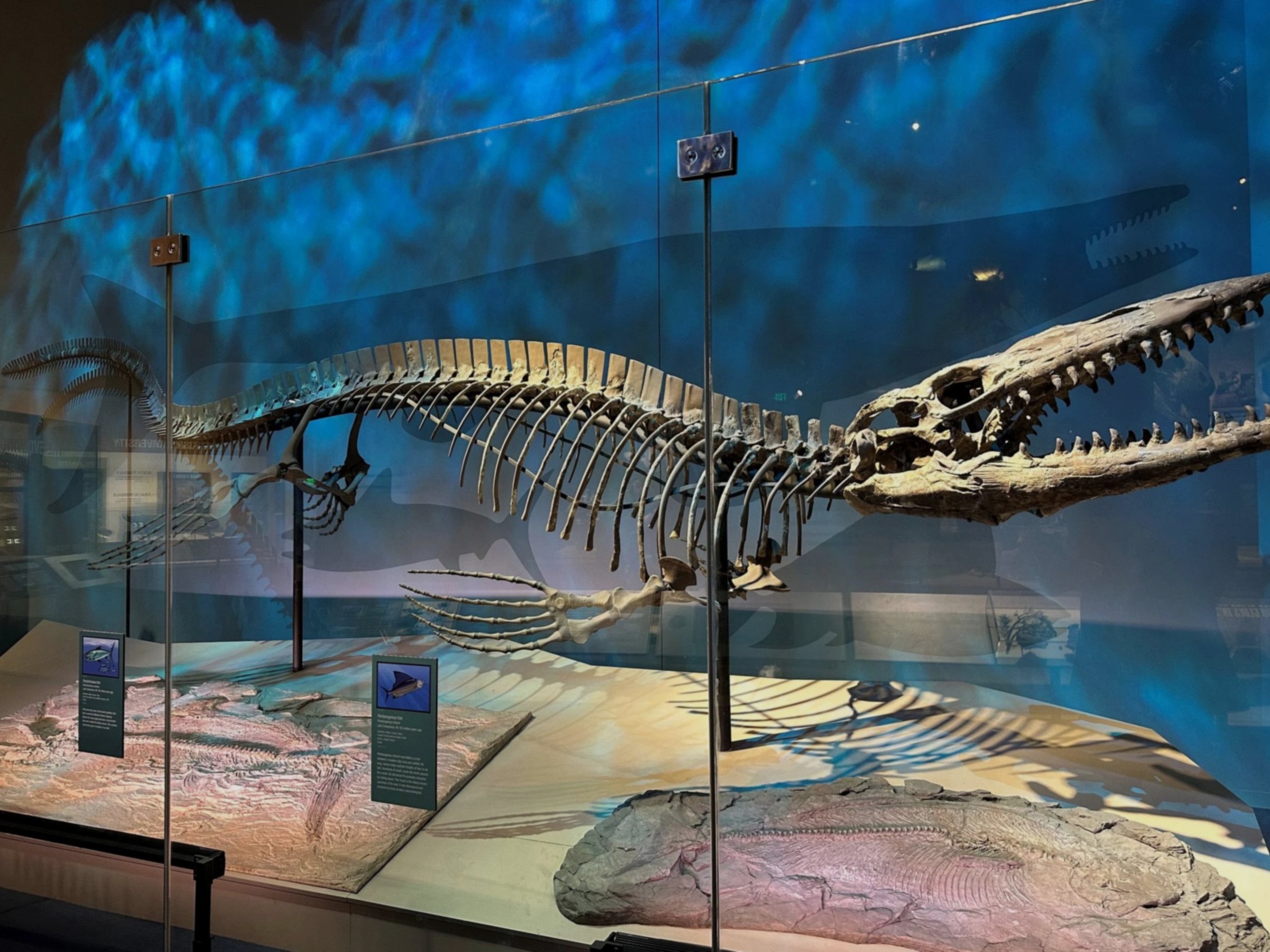
New evidence from Texas shows an ancient marine predator far larger and meaner than anyone guessed. We are talking about a mosasaur. Specifically, Tylosaurus rex. Or T. rex, for short. Don’t mix it up with the land giant. This one ruled the shallow seaway that covered central North America eighty million years ago.
It gets to forty-three feet long. Roughly the length of a schoolbus. Twice the size of the biggest great white sharks alive today.
The team behind the find includes scientists from the American Museum of Natural History (AMNH), the Perot Museum in Dallas, and Southern Methodist. They published the results today in the Bulletin of the AMNH.
“Everything is bigger in Texas,” said lead author Amelia Zietlow. She didn’t qualify the statement. She just let it sit. Apparently. This applies to mosasaurs now too.
Misidentified for a Century
Here’s the kicker.
Zietlow didn’t find a brand new skull in the dirt. She found a mistake.
She was working on her PhD at the AMNH when she stumbled onto a fossil in their storage. It had been labeled Tylosaurus proriger for ages. The standard label for these beasts.
But something felt off.
Zietlow compared this Texas fossil to the “holotype”—the original name-bearing specimen kept at Harvard’s Museum of Comparative Zoology. That original T. proriger fossil was described over 150 years ago. Most of those come from Kansas and date back 84 million years.
The Texas specimens were different. Four million years younger. Larger. And their teeth were finely serrated.
Most mosasaurs didn’t have teeth like that. It suggested a different toolset for tearing.
After comparing it to over a dozen similar specimens in various museums, Zietlow and her colleagues realized the American Museum’s fossil was misidentified. So were several others. They belonged to a distinct species.
One of the most famous victims of this reclassification?
Sophie. The huge skeleton on display at the Yale Peaboid Museum. It’s now a T. rex. So is Bunker, found in 191 and displayed at Kansas University.
Naming the Sea Tyrant
The name pays tribute to an earlier observer. Paleontologist John Thurmond saw in the late 160s that Texas tylosaurs were unusually huge. He called them Tylosaurus thalassotyranus, meaning “sea tyrant.”
He noted it was a cliché. But cliches can be right.
The team kept the short form. Tylosaurus rex. King of the Tylosaurs.
The main specimen— the new holotype—is housed at the Perot Museum in Dallas. Found in 1979 near an artificial reservoir. It sits at 25 to 43 feet depending on which fragment you measure, but the sheer size is undeniable.
And the anatomy suggests raw power. Thick bones. Adaptations for massive neck and jaw muscles. This thing bit with force.
“T. rex appeared to be much meaner than other mosasaurs,” said co-author Ron Tykosk.
Meaner how?
Well, check out “The Black Knight.” Another Perot specimen. It is missing its snout tip. Its lower jaw is broken.
How do you break a mosasaur’s jaw?
You have to be stronger. And bigger.
The injuries match up only with attacks from another T. rex. Same species. Likely same hunting grounds. It wasn’t just eating fish. It was fighting its own.
“Through our study… we have evidence of violence… to a degree not previously seen,” Tykoski noted.
That is not a small detail.
Redoing the Tree
There’s a problem with mosasaur science.
For nearly thirty years, researchers used the same dataset. Same list of features to map how these reptiles evolved. Little changes, same core structure.
It’s like using a map from 1990 to drive to a place built in 2020. You miss things.
Zietlow’s team rebuilt the dataset. From scratch. They looked at all the traits, the teeth, the jaw muscles, the bite force evidence.
The result? We need to rethink mosasaur evolution entirely.
“This discovery is not just about naming… it highlights the need to revisit longstanding assumptions,” Zietlow said.
The tools used to study them needed a software update, essentially. A physical one, anyway.
Michael Polcyn from Southern Methodists added that this reshapes the entire picture. Texas is suddenly a critical spot for understanding these ecosystems. A key region.
The old assumptions are crumbling. The proriger we knew might have been a catchall for a much more violent, serrated, and larger predator all along.
We thought we knew these reptiles. We read their bones, labeled them, and put them behind glass.
But the bones told a different story all along. We just weren’t listening. Or looking close enough.
So, what else is mislabeled?