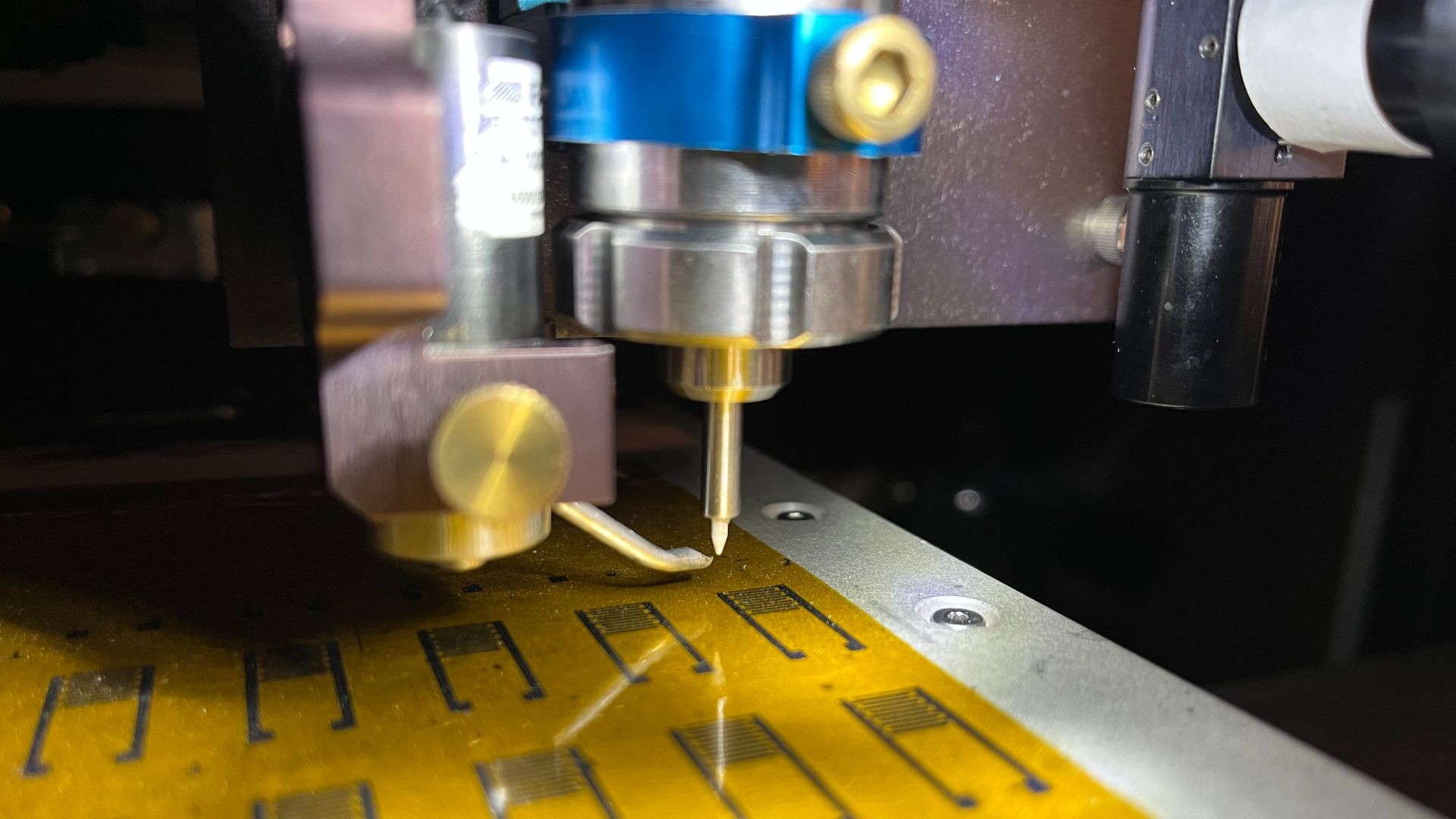
Engineers have achieved a significant milestone in bioelectronics by developing printed artificial neurons that can “talk” to biological cells in a living brain. This breakthrough, recently published in Nature Nanotechnology, offers a potential roadmap for two transformative fields: highly efficient neuromorphic computing and advanced brain-computer interfaces (BCIs).
The Challenge: Why Silicon Fails the Brain
To understand why this discovery matters, one must look at the fundamental incompatibility between current technology and human biology.
Traditional computing relies on silicon chips—rigid, two-dimensional structures made of fixed transistors. In contrast, the human brain is a dynamic, 3D matrix of flexible cells. Biological neurons are constantly evolving; their connections strengthen with use and fade when neglected.
Current brain-computer interfaces often struggle because they attempt to communicate with delicate neural tissue using “crude” electrical pulses that do not match the brain’s natural language. This mismatch can lead to poor integration and limited functionality.
The Innovation: Mimicking the “Spike”
Previous attempts to create artificial neurons generally fell into two camps:
1. Soft organic materials (like gels): These mimic the texture of the brain but are often too slow to match neural signaling.
2. Hard metal oxides: These are fast enough but lack the biological nuance.
The research team, led by Mark Hersam of Northwestern University, bypassed this dilemma by using printable inks containing molybdenum disulfide (a semiconductor) and graphene (a conductor) on a flexible polymer substrate.
While polymers are typically seen as obstacles to electrical flow, the team discovered they could be used to their advantage. By precisely controlling how the polymer heats up and partially decomposes, they created tiny “filaments of energy.” This allows the device to produce a “snap back negative differential resistance” —a sudden burst and subsequent drop in energy that closely mimics the way a real neuron “spikes.”
Proving the Connection
To test the efficacy of these lab-made cells, the researchers placed the artificial neurons alongside slices of mouse brain tissue. The results were highly encouraging: the biological neurons responded to the artificial signals at the same pace as they would to natural ones. This suggests that the brain can effectively “decode” these synthetic signals as if they were biological in origin.
Future Horizons and Remaining Hurdles
The implications of this technology are vast, ranging from medical and computational breakthroughs to:
– Neuromorphic Computing: Creating AI hardware that mimics the brain’s architecture, drastically reducing the massive energy consumption required by current digital AI.
– Medical Prosthetics: Developing more seamless interfaces to control robotic limbs or assistive devices.
– Neuro-regeneration: Potentially using artificial neurons to replace damaged cells in patients suffering from degenerative diseases like Alzheimer’s.
The Road Ahead
Despite this progress, experts caution that we are not yet ready for permanent brain implants. Timothée Levi, a professor of bioelectronics, notes that while we can control these neurons for short durations, long-term stability remains a major hurdle.
Furthermore, a single neuron is only one piece of the puzzle. The “frontier problem” facing scientists is integration. To truly replicate the brain, researchers must figure out how to link these artificial neurons together through artificial synapses to create complex, functioning circuits.
“We have a series of devices that mimic different elements of the brain, but we need to integrate them together into circuits that achieve the full functionality.” — Mark Hersam, Northwestern University
Conclusion: While the ability to synchronize artificial and biological neurons is a landmark achievement, the next great challenge lies in connecting these individual components into complex, long-lasting neural networks.