Most 3D printers are boring. Slow. They lay down plastic slice by slice. Wait. Wait some more. It’s like watching paint dry in fast forward.
But what if you could print a human ear in minutes? Not just any ear. A living one. Soft. Viable. Ready for a transplant?
Researchers at EPFL aren’t just asking the question. They are answering it. With a method 70 times more efficient than before.
Stop Stacking, Start Rotating
This isn’t normal 3D printing. This is TVAM. Tomographic Volumetric Additive Manufacturing. Think of a CT scan running backwards.
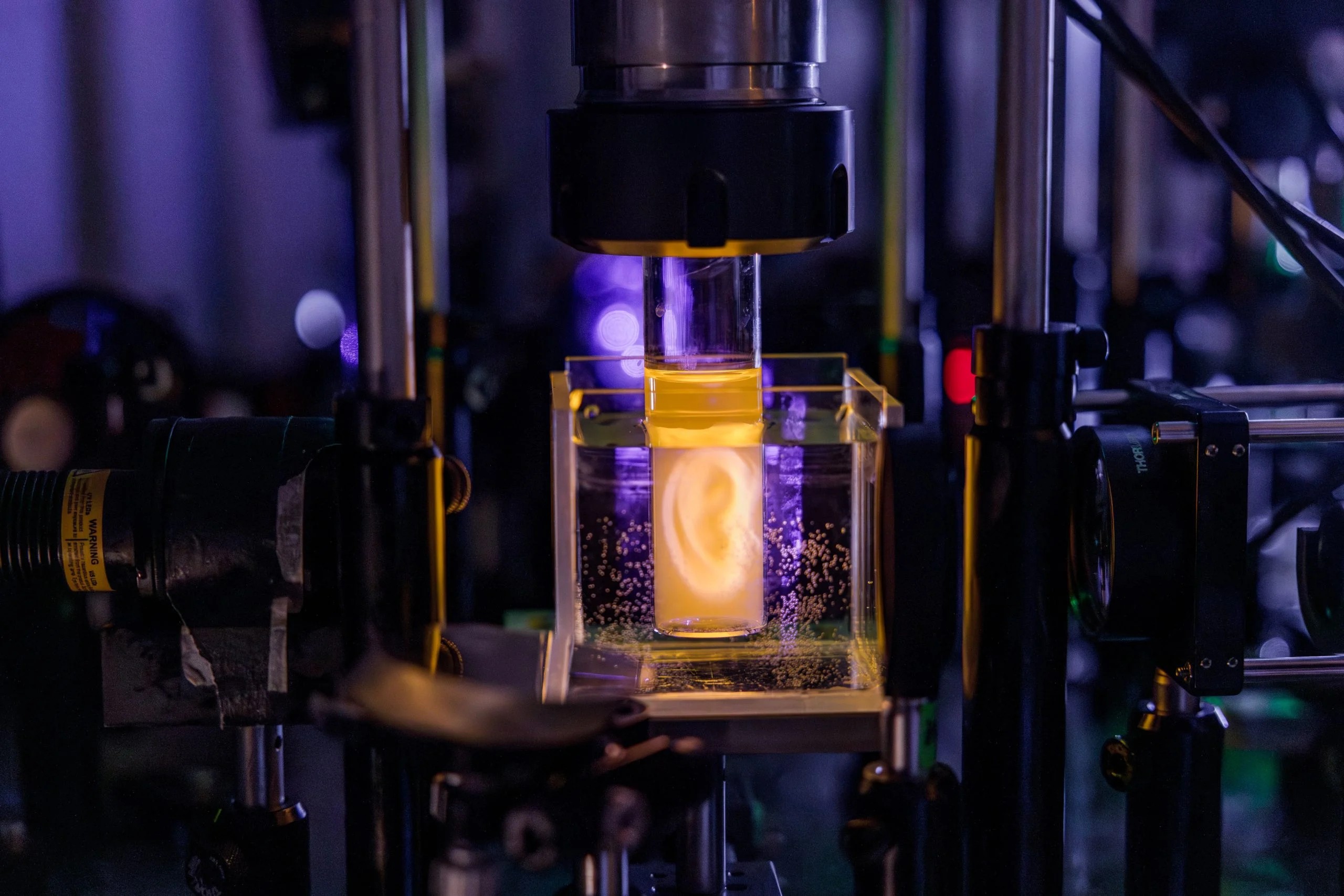
A laser shines into a spinning vial of goo. The liquid hardens only where the light hits hardest. The structure forms all at once. No layers. No waiting. Just a complete object rising from the resin like a conjuring trick.
Previous versions struggled. Energy loss. Low efficiency. The EPFL team fixed this by changing how they handle light.
“We control the phase, not the brightness.”
That small tweak saved massive amounts of laser power.
Faster. Larger. Living.
The new device controls laser phases directly inside the printer. It is the first of its kind. The result?
Millimeter-scale objects print in seconds. Centimeter-scale ones take only minutes. And here is the kicker: the cells survive.
In one test they printed a life-sized human ear. Using a 150mW laser diode. Cheap hardware. High reward. In another experiment cells printed into a small construct stayed alive for six days. They formed networks. Real biological function.
Why does this matter? Light scattering usually ruins 3D prints in thick tissues. This system fights back with self-healing beams. The signal finds the path. The structure stays true.
The Surface Problem
Speed is one thing. Quality is another. Laser interference often leaves a grainy mess on the surface. Rough. Useless for implants.
The team solved it by killing the speckle. A new technique smooths the finish. Maria Alvarez-Castaño notes this brings bioprinting closer to medical reality. Real implants require smooth edges. Not sandpaper textures.
“Finally possible to bioprint at near-clinical scale.”
Says Christophe Moser. He knows what he’s talking about. He heads the Laboratory of Applied Photonic Devices at EPFL.
What Comes Next?
They won’t stop at ears. Future work targets high-cell-density resins. Tougher to print. Harder to control. They plan to predict chemical reactions inside the resin in real-time.
Maybe print onto existing objects. Maybe around them.
There’s talk of stopping the rotation altogether. Projecting holograms directly without spinning the vial. That would simplify the hardware. Cut down vibration. Improve speed again.
We are moving toward a future where your body repairs itself using printers. Is it scary? Maybe.
It is also inevitable. The hardware is cheap. The efficiency is high. The biology works.
We just need to wait for the resin to set.