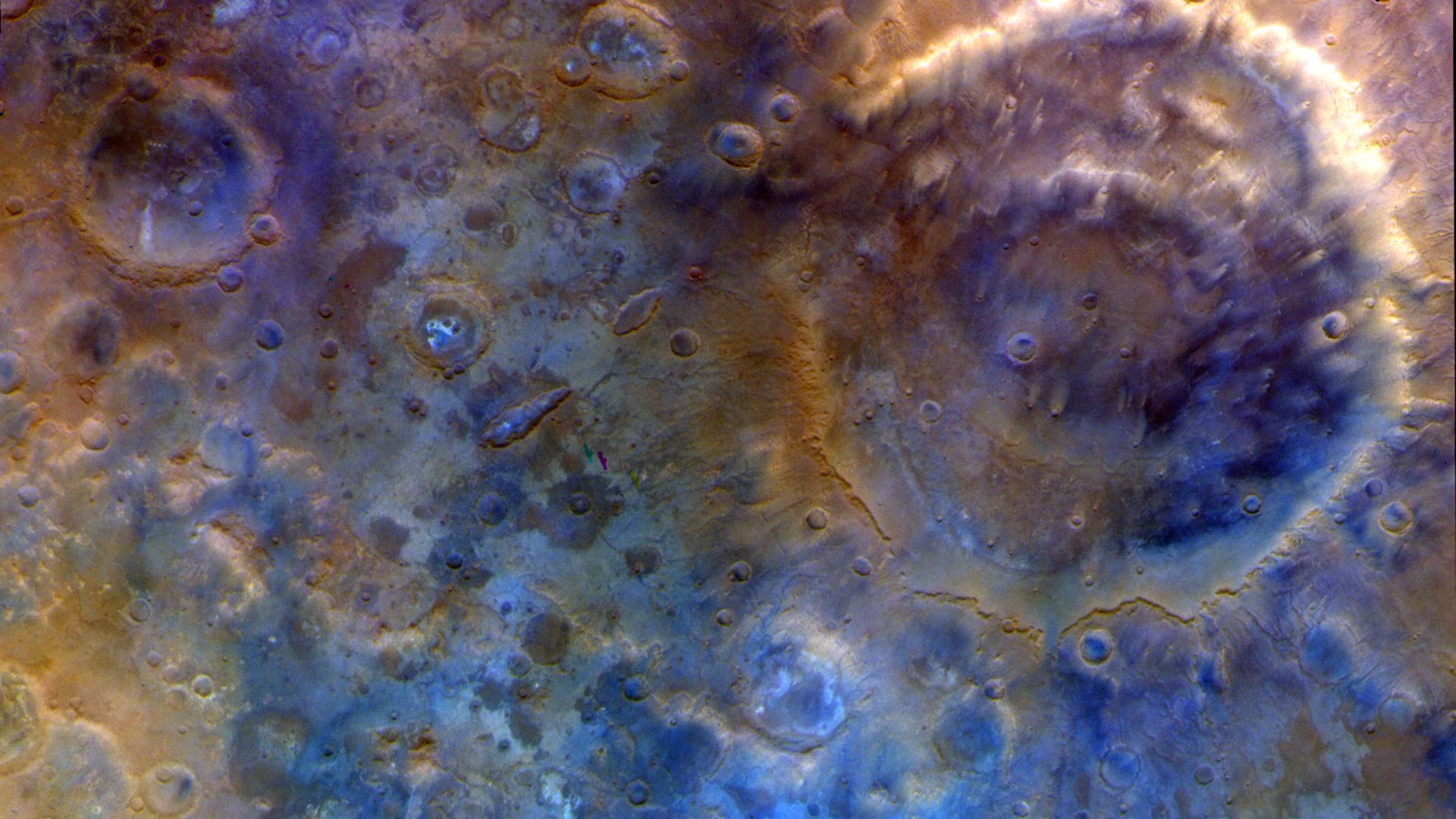
The Red Planet just looked blue.
Is that us? Or did the universe switch the filters on?
NASA’s Psyche spacecraft sent down some seriously tinted shots last week. It happened during a close flyby. The probe is headed for asteroid 16 Psyche. Mars is just a pit stop. A gravitational slingshot. A speed boost.
The pass was tight. About 2,864 miles out. May 15.
“We’ve captured thousands of images.”
Those words came from Jim Bell. He’s the instrument lead. A scientist at Arizona State. They weren’t just looking for pretty pictures though. They needed to calibrate the multispectral cameras. Get the colors right before hitting the main target. The asteroid. The metal ball in the belt.
What did they see?
Huygens crater. It has two rings. Double-ringed. The southern highlands looked rough. Craters stacked on top of craters.
Then there was the Syrtis Major. Wind blowing over the ground. Visible. Clear. The south pole too. Loaded with water-ice. Bright white. High-resolution stuff.
As the ship turned away the angle shifted. Mars became a thin crescent. Rare view. Most probes don’t see the planet from that high up.
Sunlight scattered through the dust.
It made a glow. A bright edge around the sphere. Not what the models expected.
“It created a brighter-than-expected glow.”
The ship left Mars looking fuller again. Almost whole. You could spot the Valles Marineris. The canyon system. Massive scar across the face of the rock.
Here’s how we get anywhere.
We don’t just point and shoot. Not usually. We use gravity. We swing by planets. We steal speed. That’s how solar-powered craft work. Cheap fuel. Free physics.
Psyche launched back in October. 2023. A complex dance through the solar system.
The flyby worked. Speed went up 1,000 miles per hour. Orbital plane shifted. Just a degree. Small tweak. Huge change in where you end up.
16 Psyche sits way out there. Between Mars and Jupiter. Three times farther from the Sun than we are. It takes longer to circle it. Slower year.
The Deep Space Network confirmed the trajectory. Everything looks green. On schedule for August 2029. That’s when the orbit happens. The mapping begins. The real science.
The asteroid is special.
Think of a building block of a planet. A planetesimal. It got knocked around early on. Lost its shell. Now we’re looking at the naked core. Exposed. Metallic. Iron and nickel.
Lots of it.
So much metal it might be worth quadrillions. Just sitting out there in the dark.
Useless to us. For now.
We don’t know how to get it out there. Let alone mine it. The tech doesn’t exist. The logistics are a nightmare.
Maybe we just admire it from orbit. Map its surface. Guess its composition.
Or maybe the blue images mean something. Did the calibration work? Is the data clean?
We’ll see next month. More calibration. Mars fading into the black.
Do you actually know much about Mars though?