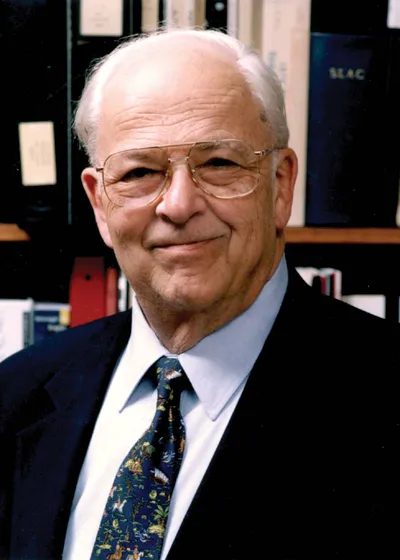
Burton Richter didn’t just find a particle. He found a gap in our understanding of the universe that had been hiding in plain sight. Born in Brooklyn on March 22, 1931, Richter became one of the most significant figures in modern physics. His work at Stanford University didn’t just add to the textbooks. It rewrote them.
He earned his doctorate from MIT in 1956. The same year, he joined Stanford as a research associate. By 1967, he was a full professor. The trajectory was standard for a brilliant mind. The impact was anything but.
Proving Quantum Electrodynamics at Extreme Scales
Richter’s early work was rigorous. He tested quantum electrodynamics at distances so small that previous theories struggled to hold up. The results confirmed the math. But confirmation isn’t discovery. Discovery requires looking where others aren’t.
Richter looked harder. With support from the Atomic Energy Commission and collaboration from David Ritson, he built something new. They constructed the Stanford Positron-Electron Asymmetric Ring. This wasn’t just a machine. It was a colliding-beam accelerator designed to smash particles together at high speeds. The goal was to see what broke apart.
The J-Psi Particle and the Nobel Prize
In 1973, the accelerator worked. Richter saw something unexpected. It wasn’t a known particle. It was massive. It lived longer than expected. He called it the J-particle. Today, we know it as the J/psi particle.
This was the first of a new class of mesons. These particles were heavy. They were stable in ways that defied the standard models of the time. The discovery shook the physics community. It proved that the subatomic world was more complex than anyone realized.
Richter wasn’t alone in the discovery. Samuel C.C. Ting made the same find independently. Both men shared the 1976 Nobel Prize for Physics. This is the famous J/psi discovery. The simultaneous find highlighted how ready the scientific community was for this new reality.
Why This Matters Today
The J/psi particle changed how we look at matter. It wasn’t just a new item on a list. It opened a door. The heavy, long-lived nature of the meson suggested deeper layers of interaction. It forced physicists to rethink how quarks bind together.
Richter died on July 18, 2018, in Stanford, California. His legacy isn’t just the Nobel medal. It’s the framework he helped build. That framework still underpins particle physics. When scientists look for dark matter or study the early universe, they use the tools and theories born from that era.
The Stanford Positron-Electron Asymmetric Ring is gone. The machine that made it all possible doesn’t exist anymore. The particle it revealed does. The J/psi particle remains a cornerstone of the Standard Model. It reminds us that sometimes, the biggest shifts come from looking at the smallest things with the clearest eyes.