250 Years in Space
It is America’s 250th. Big deal? Sure.
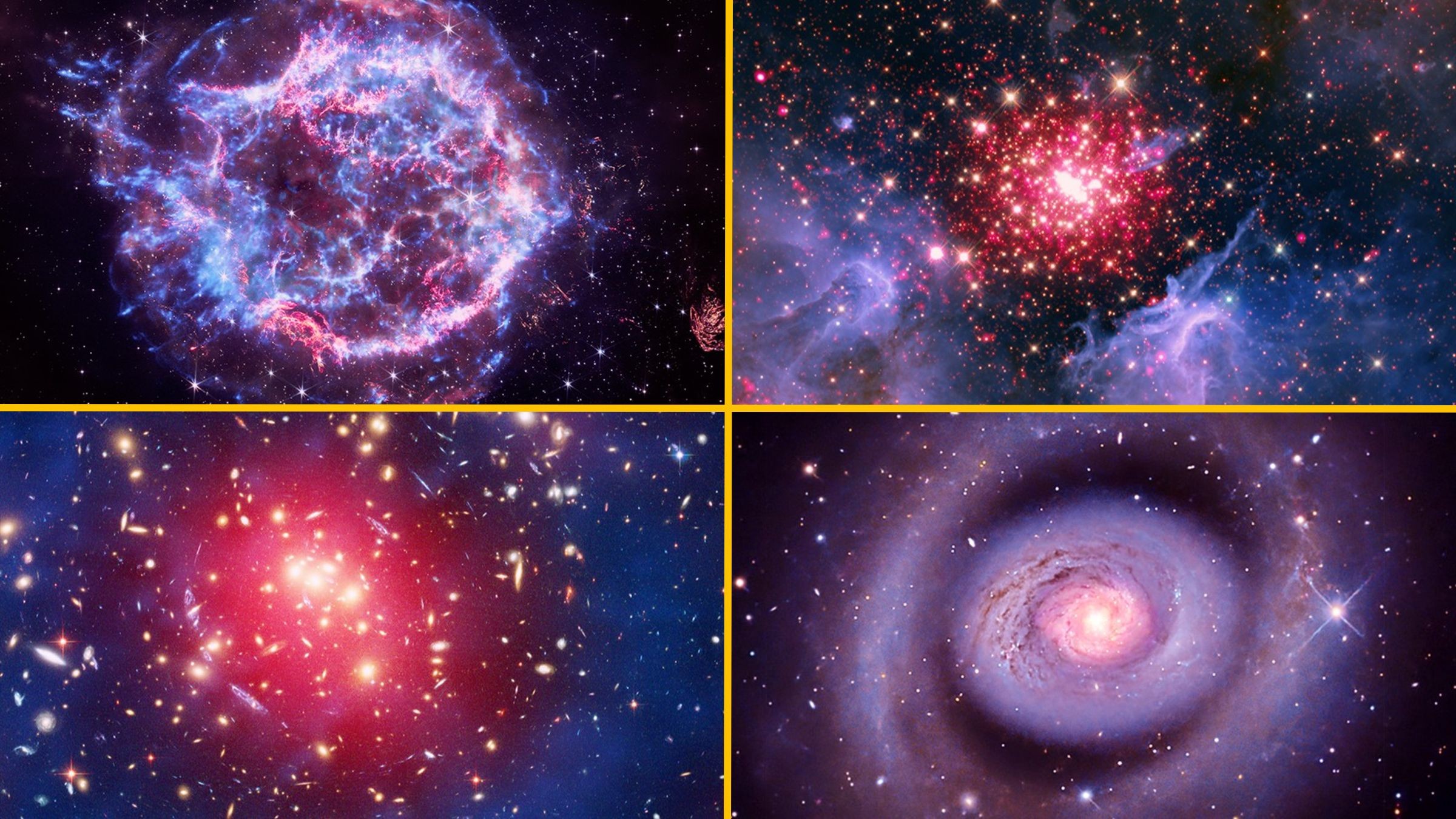
NASA decided to mark the bicentennial-plus with something appropriate. Not flags. Not cake. Cosmic imagery. They pulled from the Chandra X-ray Observatory. Orbital resident since 1999. Chandra sees things our eyes cannot. Specifically high-energy X-rays.
The agency mixed this data with feeds from Hubble and the James Webb Space Telescope. Ground-based telescopes joined in too. The result is a four-part collection. Rendered in red white and blue.
It’s deep space dressed up for the Fourth of July.
Cassiopeia A: The Fireworks
Look at the top left. It’s Cassiopeia A.
11,000 light years away. A supernova remnant. To put it bluntly it looks like an actual Fourth of July explosion. A massive star blew up there. Roughly 340 years ago.
Chandra provides the blue and purple data. That’s the blast wave. It traces iron calcium and oxygen. Then comes JWST. Infrared data overlays in red and white. This highlights the expanding debris shell. Dust floating outward.
“It’s all the result of a massive stellar explosion”
NGC 3603: Baby Stars
Top right brings us to NGC 3603.
Twenty thousand light years out in the Carina spiral arm. This is a giant nebula. The largest in the Milky Way visible to our eyes. But what does Chandra see? X-ray light. Bright harsh activity.
Hubble adds optical infrared and ultraviolet layers. You get a glittering field. Highly active young stars are born there. Lots of dust and gas involved.
It is chaotic. Beautiful chaos.
M94: The Starburst
Bottom right shifts focus.
NGC 4736 also known as M94. It sits in Canes Venatici about 19 million light years distant. It’s a spiral galaxy. But look at the core. Outside that oval center there’s a ring. A “starburst” ring.
New stars form there constantly. Chandra X-rays layer over visible light. That visible light came from astrophotographers on the ground. Collaboration.
Dark Matter
Finally the bottom left image. ZwCl 0024 1652.
This isn’t a single object. It’s a galaxy cluster. Five billion light years away in Pisces. Chandra reveals superheated gas. Shown in red. This gas reservoir holds more mass than all the galaxies in the cluster combined.
That’s heavy.
Hubble data helps astronomers infer something else entirely. Dark matter. Invisible but present. Pulling things together.
Seeing With Ears
The images aren’t the only output.
NASA included sonifications for three of these objects. NGC 36 3. M94. And ZwCl 00 52 5.
Data becomes sound. You can hear the nebula. Hear the galaxy. Experience space through another sense.
Is space supposed to be silent? Not in these files.