


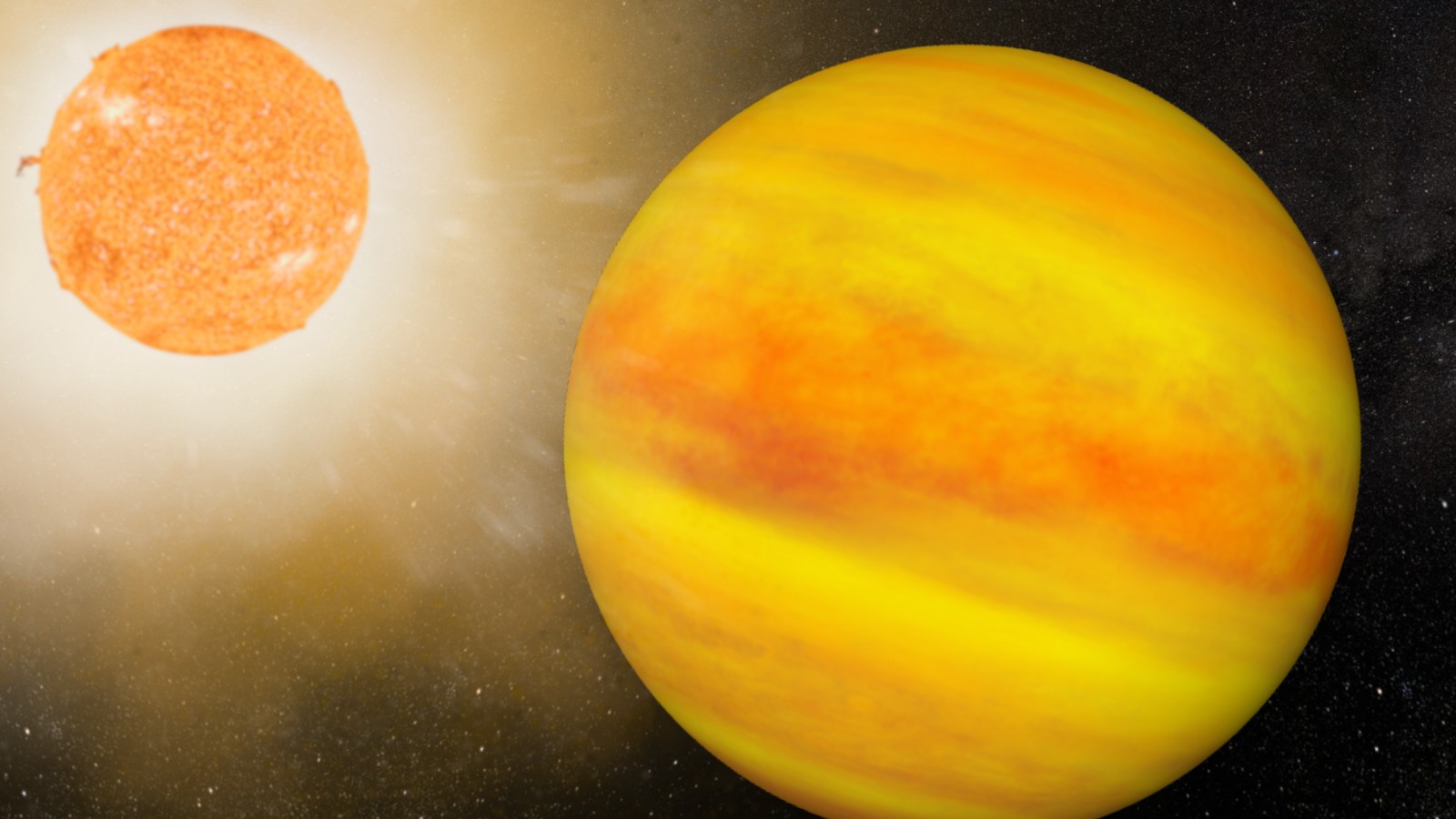
Hot Jupiters don’t care about your rules. These gas giants burn so close to their stars they finish orbits in days, making our own solar system look painfully slow and mundane.
Enter CoRoT-2 b. It is massive, three-and-a-half times heavier than Jupiter, located 696 light years away, and orbits its sun every 41 hours. Or so we thought.
Here is the twist. Most of these planets are tidally locked. One face stares eternally at the fire. The other freezes in the dark. Simple physics. Predictable. Boring?
CoRoT-2 b refuses to lock up. It is spinning at its own pace.
That breaks the model. Completely.
Aurora Kesseli, leading the study from the NASA Exoplanet Science institute, admits she prefers the anomalies. The outliers.
“I really like looking at the weird one finding planets that don’t fit the standard picture and doing some mystery solving”
Standard models fail when faced with reality. A one-size-fits-all approach never worked, especially not for planets we’ve been studying for years. Every oddity sharpens the tools we use to map the rest of the cosmos.
The Misplaced Heat
For a rock like Earth, tidal locking creates a brutal divide. Eternal noon on one side, eternal midnight on the other.
Gas giants are messy. They have atmospheres. Thick, swirling atmospheres that carry heat.
Usually, hot Jupiters show a hotspot on their dayside, dragged slightly westward by the drag of their orbit. It follows a pattern. A predictable breeze.
CoRoT-2 b does the opposite. Its hottest point sits against the flow. Upwind. That defies intuition. Why?
Kesseli looked for reasons. Not because she wanted to, but because the data screamed inconsistency. Understanding rotation matters, even for dead rocks around red dwarfs, because heat distribution dictates climate. Climate dictates if life could ever crawl out of a puddle. A spinning world feels different than a stationary one. The winds would scream differently.
The numbers revealed the culprit. Or rather, the anomaly.
On CoRoT-2 b a single day lasts about three Earth days.
Its year lasts one and a half days.
So the planet rotates once for every two trips around the star. Slow rotation. Very slow. Almost counter to the tidal forces that should be whipping it into alignment.
It works, mathematically, but it shouldn’t. Not easily.
Kesseli found three potential hypotheses to explain the lag. The data pointed clearly to one.
“I was very pleasantly surprised when I tried bunch of methods and was like Aha this is actually like one of three hypotheses”
She was right. One theory fits the mess. But now comes the harder question.
Why is it spinning so slowly in the first place?
We don’t know. Yet.
The planet keeps spinning. We keep watching. Maybe the next one will break something even more important.


