100 million years ago. Before that? Dry. Bone dry. Hot, too, with days reaching 430°C. It was a planet baked to a crisp. But then one Mercurian day changed everything. Just one day.
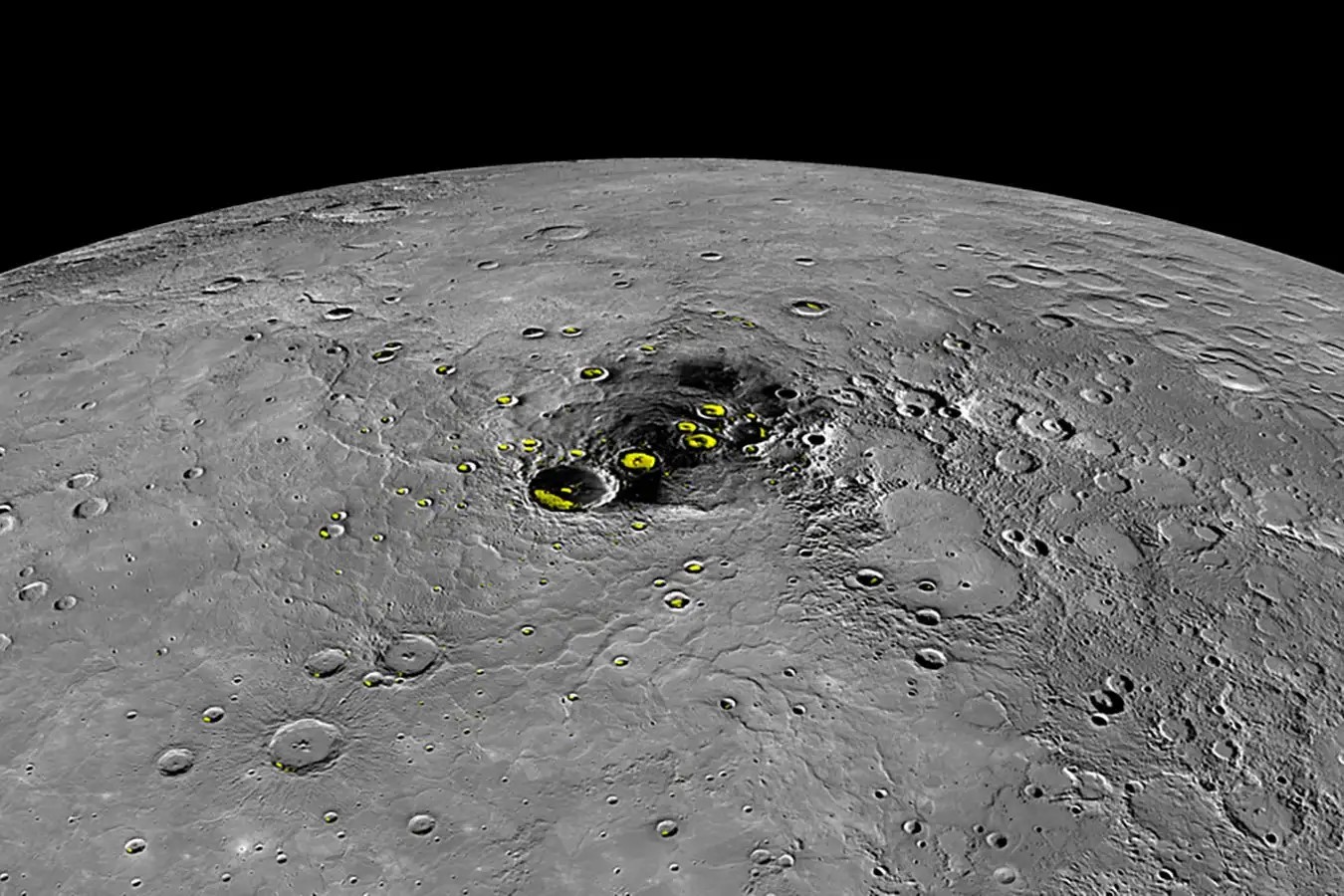
The puzzle starts at the poles. NASA’s Messenger orbited Mercury from 2011 to 2015 and found ice there. Real ice. Deposits meters deep sitting in the shadows of craters that never see sunlight. We called these permanently shadowed regions.
Ice doesn’t melt in those spots. But how did it get there?
Old theories blamed a small comet-like rock. About 17 kilometers across. Moving fast, 30 km/s. It smashed in. We assumed it delivered the water. Now Parvathy Prem from the Johns Hopkins Applied Physics Laboratory disagrees with the size. Or the speed.
“We’ve known for a while that Mercury’s poles have ice. The idea that those ice deposits might have been laid down by an impactor is also not new but this is the first time we’ve really modelled that process,” says Prem. “It is the first time we’ve looked in detail how exactly the movie plays out.”
Her team ran the simulation. A massive chunk of rock and ice slammed into the surface. It made the Hokusai crater. You can see it there now. The impactor vanished almost entirely. It turned into gas. Mercury briefly wore an atmosphere. Thick with water. Thin as a whisper otherwise.
Prem says it would have been too thin for our eyes to catch. Look in the wrong light? Nothing. But look in the right wavelengths. The planet would have been glowing. Just for a bit.
The sun didn’t let that last. Radiation tore the atmosphere apart quickly. But some survived. One-fifth of the water vapour from the hit drifted north and south. It fell into those cold craters. It stayed there.
Most models missed this much ice. This new scenario matches Messenger ’s measurements better. A bigger rock hitting slower traps more water on the surface than the old math predicted.
One Mercurian day lasted 176 Earth days in the model. “This would certainly have been the most eventful day in the last billion years of Mercury history,” Emily Costello at University of Hawaii points out.
It explains why Earth’s moon stays dry while Mercury isn’t. “Mercury recently experienced a large-scale water delivery. The moon did not ” says Costello. Similar planets, different endings.
Maybe the rest of inner space got water this way. Earth included. “Mercury ’s polar ice deposits are this interesting geological record of how and when water came to be in the inner solar system,” says Prem. Now we are reading that record trying to understand what it’s telling us.
BepiColombo helps. It launched 2018. Arriving soon.