We found it. An atmosphere. On a rocky world outside our solar system, sitting right in the zone where liquid water might survive. It feels like the last major hurdle finally cleared. Twenty years ago we asked if Earth-like planets even existed. Turns out they are everywhere. Then we looked for them in the Goldilocks zone. We found some. But the real test was the air. Did any of them manage to hold onto it?
LHS 1140b says yes.
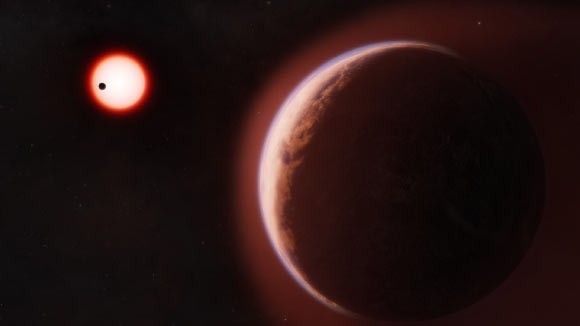
The planet orbits a small, dim star named LHS 1140, or Gliese 3055 if you prefer older catalog names. It sits about 39 light-years from Earth, hanging in the constellation Cetus. The star itself is a boring M-dwarf. Three billion years old. Quiet. Inactive. It has three known planets. We are looking at the middle child.
B is the big one here. Discovered in 2017. It is 5.6 times heavier than Earth. Roughly 1.7 Earth radii across. It takes 24.7 Earth days to make one trip around its sun.
The sunlight it gets is dimmer than ours. About 42 percent. The surface sits at an equilibrium temperature of -47°C (-53°F). Cold. Very cold. But not frozen solid forever. Maybe.
Astronomers used the Magellan Clay telescope in Chile. Specifically an instrument called WINERED. In 2024, they watched the light passing by the planet and saw a leak. Helium was escaping into space. Driven out by X-rays and extreme ultraviolet light from the star.
But wait. In 2025, they looked again.
No helium. The leak had stopped. The atmospheric escape is variable. It changes on human timescales. You don’t see that often.
“It is a rare privilege to witness the attitude of an extrasolar planet change so fast.”
So what is actually up there? Models suggest a layered cake of gases. The top is helium-heavy and starved of hydrogen. Water? It gets stuck lower down, near the surface. Trapped in the cold.
It makes for an interesting comparison. Its neighbor, planet C, shows no sign of an atmosphere at all. All that gas boiled away eons ago. B and C seem to sit on opposite sides of a cosmic line. The “cosmic shoreline.” One side holds its breath for billions of years. The other lets it all out in a huff.
Why does B still have air while C does not? Nobody is entirely sure. But having an atmosphere changes the conversation completely. No atmosphere means no life as we know it. Just a rock floating in the dark.
Harvard’s Dr. Robin Wordsworth notes we are moving past the “does it exist?” phase. We are asking “does it stay?” The answer for LHS 1140 b is… probably. For now.
Dr. Jason Dittmann from Florida raises a thorny point. Is this a stable, Earth-like atmosphere leaking a little here and there? Or is it a bare rock that occasionally burps out fresh gas from deep down, which then immediately evaporates away?
That is the million-dollar question. Literally, considering the James Webb Space Telescope will spend the next few years looking for water vapor in that upper atmosphere. If they find water, it stays. If not, B is just a fleeting ghost.
The findings hit the journal Science. July 16, 2126. (Or so the press release says, assuming we aren’t already living in the future.)
The paper lists Collin Cherubim and the team. They claim the first confirmed atmosphere on a rocky, habitable-zone exoplanet. It’s a headline. But the details are messier. Variable leaks. Cold surfaces. A neighbor stripped bare.
It’s not perfect. It’s not stable in the way we’d like. It’s just something. And maybe something is enough.
What does a changing sky look like from the surface? We can guess. But for now, we are watching from 39 light-years away, waiting for the telescope to blink.