For over a century, paleontologists have argued.
Did the first snakes burrow like worms? Did they slither through the surf? Or did they crawl over the land among the leaf litter?
The evidence was thin. Fewer than ten early snake skeletons existed. It was a guessing game.
Until now.
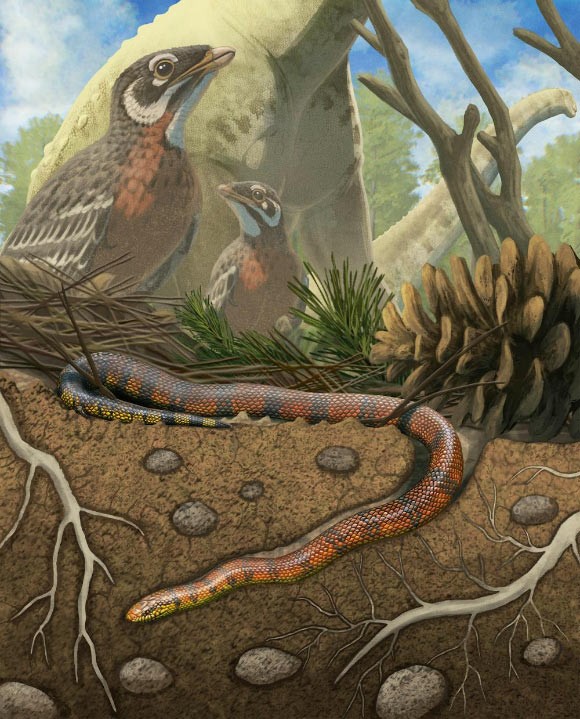
A fossil found in Brazil is changing the conversation. The specimen, named Tametara mirim, lived roughly 80 million years ago in the Late Cretaceous. It was unearthed in 2022 near Presidente Prudente in São Paulo. This is the first articulated snake skeleton ever found in Brazil. It is one of the few three-dimensional snake fossils from the Mesozoic anywhere on Earth.
The preservation is extraordinary.
“Snakes are essentially highly modified lizards. Sometime in the age of dinosaurs one lizard lineage lost its limbs and stretched out their body.” — Dr. Roy Ebel
But the question remains: why?
Why Tametara Mirim Points to Burrowing
Dr. Roy Ebel of Museums Victoria Research Institute led the study. His team used high-resolution CT scans on the skull. They reconstructed the brain, cranial nerves, and inner ear. This is the most detailed picture of a stem snake brain we have seen.
The results were surprising.
The brain shape was unlike any other early snake. Or any modern one.
But the real proof came from the bone density.
Head-first burrowers need strong skulls. The strain of digging into dirt is intense. So they evolve denser, thicker bones on the skull roof. This trait appears in many burrowing lizards.
Tametara mirim had this trait.
Dr. Ebel noted that the fossil fits among the most specialized head-first burrowers alive today. Not generalists. Specialists.
The brain scan confirmed it. The visual centers were reduced. The forebrain was simplified. This points to an underground life. Dark. Tight. Hidden.
How Snakes Evolved: A Multitrack History
Here is the twist.
Earlier studies looked at Dinilysia patagonica, a snake from Argentina. That fossil showed the opposite. Its bone structure and brain suggested it was a surface dweller. Non-burrowing.
This creates a problem for the old theories.
One theory said all snakes started as swimmers.
Another said all started as surface crawlers.
A third said all started as burrowers.
None of them fit.
The two oldest snakes we can study had brains more different from each other than many snakes alive today.
Tametara mirim was tuned for the dark. Dinilysia patagonica was shaped for the open.
At the very dawn of snake history, they were already sensing the world differently.
This suggests snakes did not descend from a single ancestor with one fixed lifestyle. Instead, early lineages branched out quickly. Some went underground. Some stayed on the surface. Some may have gone to the water.
This happened over tens of millions of years. Different groups tried different experiments in evolution. Some succeeded. Others died out.
The result is the 4,200+ species of snakes we see today.
Where to Find Early Snake Fossils
Most of this comes from very specific places. Brazil. Argentina. The sedimentary rocks of the Late Cretaceous hold the key.
The Tametara mirim specimen was found in a quarry. It required careful extraction. The preservation allowed researchers to see microstructures in the bone.
These details matter. They provide quantitative data. Not just opinions.
The study was published in Nature on July 22, 206. The authors concluded that snake origins were not a single path. They were parallel experiments.
Ecological breadth. That is what drove the change.
So, did early snakes burrow? Yes.
Did they swim? Likely some did.
Did they crawl? Yes.
The answer is all three.
And the debate is far from over. We only have a handful of these fossils. There is still so much we do not know.
The ground is shifting.